
What if the wine you enjoy most isn’t the bottle with the grandest-sounding region or the grape name you recognise? Choosing can feel daunting when labels are full of unfamiliar terms and descriptions such as “bright”, “structured” or “elegant” don’t make the taste any easier to picture. If you’ve ever wondered whether a bottle will suit your palate, meal or occasion, start with what you already enjoy.
You don’t need expert knowledge to choose well. Decide whether you tend to prefer fresh and crisp, rich and rounded, light and fruity, or deep and savoury. Then use clues about grape, region and style to narrow down your options. If you can, think of a wine you’ve enjoyed before and what you liked about it: the freshness, fruit, body or finish.
This guide explains how to read useful details on a wine label, match a bottle to food and company, and explore styles that might become new favourites. We’ll look at approachable examples from regions such as Burgundy and Bordeaux, and show how an independent merchant can turn your preferences into thoughtful suggestions, whether you’re choosing one bottle or a mixed case.
Key Takeaways
- Look past impressive-sounding labels and start with the flavours and textures you know you enjoy.
- Use grape, region and vintage as clues to a wine’s style, not as promises of an identical taste.
- Choose a broad style first, then consider how it will work with your meal and occasion.
- Pair food and wine by balancing or contrasting flavours rather than following rigid rules.
- Describe your preferences to a knowledgeable merchant or compare different styles in a curated mixed case.
Choosing wine: what matters beyond the label?
If you’re new to choosing a bottle, begin with what you enjoy drinking and eating. You don’t need to decode every term or know the names of famous regions. Ask yourself whether you’d rather have something light and refreshing or richer and more warming. These simple impressions are useful clues, not a test of expertise.
Wine is made by fermenting grapes. Red, white, rosé and sparkling are broad styles, each with plenty of variation. A style gives you a starting point; the specific bottle reflects further choices, from the grapes and growing conditions to the producer’s methods. For a wider overview of its history, production and cultural role, see Wikipedia’s reference on the subject.
Grape, growing place and winemaking all shape a wine’s style, so no single label clue tells the whole story. Use the information on the bottle to form a first impression, then compare it with flavours and textures you already know you like.
Which basic taste clues help you describe a wine?
Body is the sense of weight or richness in your mouth. A light-bodied wine can feel more like water or tea, whilst a full-bodied one may feel closer to milk or cream. Acidity gives a fresh, mouth-watering lift, rather like biting into a crisp apple. Tannin, most noticeable in some reds, can leave a drying sensation similar to strong tea. Sweetness ranges from dry to noticeably sweet.
You don’t need to memorise these terms. Describe what you notice in ordinary language: “light and zesty”, “smooth and fruity” or “drying and robust”. You can also note whether the wine feels light or rich, and whether you’d want another glass with food. Those details help you identify what to seek out next.
How can a wine label give you a useful first clue?
A label may emphasise the grape variety, region, producer or vintage. Each offers a different starting point, but none guarantees the exact flavour in the bottle. A grape name can suggest a typical character; the place it was grown and the producer’s decisions also shape the result. Vintage identifies the harvest year, useful context when comparing bottles from the same region or producer.
Regional names can stand in for grapes or traditions. Burgundy and Bordeaux, for example, are distinct French regions with their own approaches and styles. Their names are useful clues, but they don’t tell you whether a particular bottle will feel light, rich or savoury. If you’d like to explore one region further, the Burgundy wine styles found in the Côte de Beaune offer a more focused place to start.
Read the label as a guide, not a promise. Pair its clues with your own preferences, and you’ll have a more personal way to choose than relying on a prestigious name alone.
How grape, region and vintage shape a wine’s style
A grape variety offers a useful starting point, not a flavour guarantee. Pinot Noir is often associated with lighter-bodied reds, while Cabernet Sauvignon can give a firmer, more structured impression. But the grape is only part of the picture. The same variety can express itself differently depending on where it grows and how the producer makes the wine.
What can grape variety suggest about a wine?
Think of a grape name as a broad signpost. It can hint at the fruit, texture or structure you might encounter, but it can’t tell you exactly what’s in the glass. Pinot Noir grown in a cooler setting may develop differently from Pinot Noir grown somewhere warmer; choices in the vineyard and cellar also influence the final style. Exploring a familiar variety from different places can help you work out which characteristics you prefer. The Wine Institute, which represents California wineries, offers further information about wine regions and grape varieties.
Grape, place and winemaking work together to shape a wine’s style, rather than any one factor deciding its character. Climate influences how grapes ripen, whilst the vineyard site and local traditions can affect what growers plant and how producers handle the harvest. These influences help explain why a regional name can be informative, but never a complete tasting description.
What can Burgundy, Bordeaux and Champagne tell you?
Burgundy, Bordeaux and Champagne each have distinctive growing conditions and winemaking traditions. Their names point to a place and its heritage, not one uniform flavour. Mosse and Mosse has a particular focus on Burgundy and Bordeaux, giving you a way to explore how regional differences show up in the glass without first learning every local classification. Champagne, meanwhile, is a regional reference that can help orient you towards sparkling styles. Explore Champagne and sparkling wine styles to see how place and tradition inform a category.
The vintage is the year the grapes were harvested. Conditions vary from year to year, and their effects differ between regions: a warm, dry season can influence ripening differently from a cooler, wetter one. Vintage is useful context, especially when comparing bottles from the same place, but it isn’t a standalone quality rating.
If you’re curious how grape, region and vintage translate into a bottle that suits your palate, you can share your preferences with Mosse and Mosse for personal guidance.
How to choose wine for your taste, food and occasion
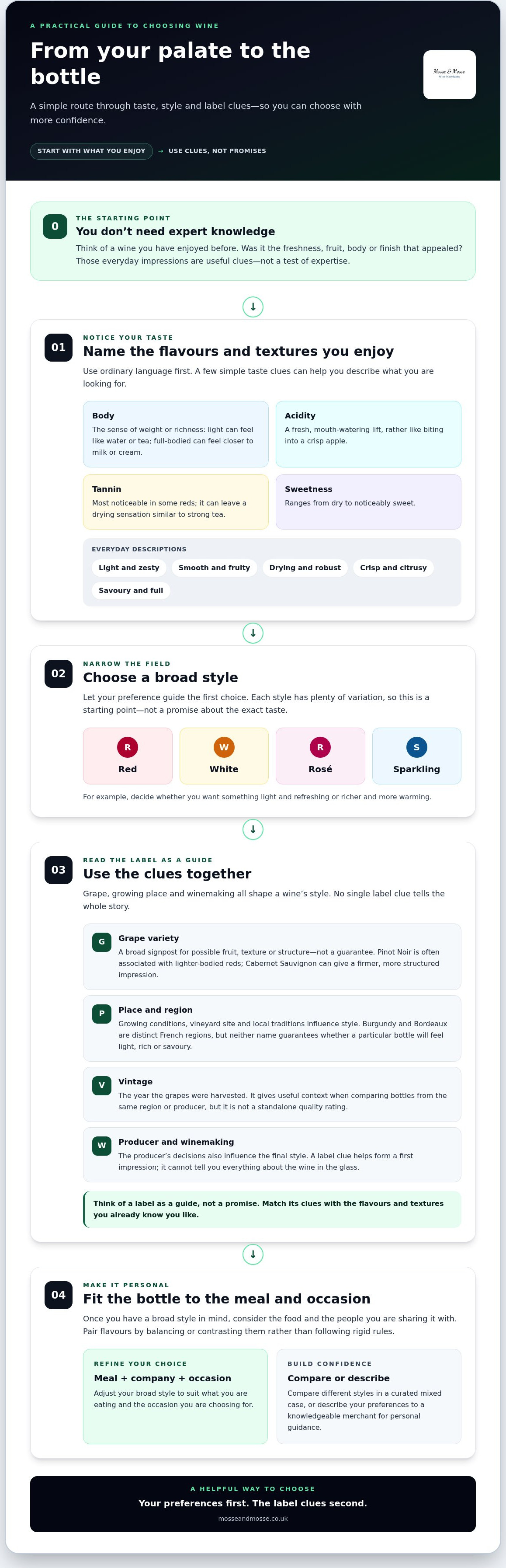
A simple process can turn a crowded choice into a personal one. Work through these steps, then adjust for the meal and the people you’re sharing it with.
- Name the taste you enjoy. Think of flavours and textures you tend to choose, such as crisp and citrusy, soft and fruity, or savoury and full.
- Choose a broad style. Decide whether red, white, rosé or sparkling best fits that preference. This narrows the field without locking you into a particular grape or region.
- Consider the food and occasion. Match the wine’s weight and character to the meal, then consider whether you’re choosing for an everyday supper, a gathering or a celebration.
How do you match wine to the food?
Start with the whole dish, not just its main ingredient. Consider whether it’s light or substantial, how rich it is, and the effect of seasoning, herbs and sauce. A fresh white can work well with a lighter dish, whilst a structured red may stand up to richer flavours. For example, think about whether the wine’s freshness will balance a creamy sauce or whether its weight will match a hearty dish. These are starting points, not rules.
Pair by complement or contrast. A rounded style can echo the richness of a creamy sauce; fresh acidity can bring a lively counterpoint to a rich dish. If the meal has bold spices or a tangy dressing, take those into account too, as they can influence how the wine tastes alongside the food. The best pairing is one you enjoy, so don’t feel obliged to follow convention. If you’re curious about how grape-growing choices influence style, Cornell University’s grape and wine research offers a deeper look at viticulture and winemaking.
How should the occasion influence your choice?
For an everyday glass, choose a style you’ll enjoy with a familiar meal. For a celebration or a table of guests, think about what will suit the food and offer broad appeal, rather than choosing solely for the label. If you’re unsure which styles everyone prefers, a mixed case lets you explore different grapes and regions instead of committing to several bottles of one type.
Choosing online? Use flavour descriptions and region as clues, then compare them with what you already know you like. Mosse and Mosse is an independent Suffolk merchant with a curated selection from Burgundy, Bordeaux, Spain, Italy and the New World. Discuss your wine preferences for personal guidance on a bottle or mixed case for your meal and occasion.
Finding wine with personal guidance from a Suffolk merchant
A bottle’s description can only tell you so much. A conversation about the flavours you enjoy, what you’re serving and who’ll be at the table can make the choice more personal. Mosse and Mosse is an independent wine merchant based in Suffolk, with a curated range of European and New World bottles and a particular focus on Burgundy and Bordeaux.
You don’t need specialist vocabulary to explain what you’re looking for. Try simple descriptions: fresh rather than rich, soft rather than firm, or fruit-led rather than savoury. Then add the meal or occasion. Those details help narrow the options to styles that better fit your tastes.
When can a curated selection make choosing easier?
A mixed case is a practical way to explore different styles over several meals or occasions, rather than choosing the same grape repeatedly. Individual bottles suit a specific meal or a smaller gathering, whilst larger formats can be an appealing choice for sharing. Think about how and when you plan to enjoy the bottles, then choose a format that suits.
Variety can also help you notice what you like. You might find that you prefer a lighter style with supper, but reach for something richer when the food is more substantial. A curated selection gives you a way to compare wines without needing to know every regional term in advance.
How can Suffolk customers and UK mainland buyers get started?
Mosse and Mosse is based in Suffolk and serves customers across the UK mainland. For wine drinkers in Ipswich, Norwich, Bury St Edmunds, Sudbury, Stowmarket, Newmarket, Thetford, Diss, Attleborough, Southwold, Aldeburgh, Framlingham, Woodbridge, Long Stratton and Saxmundham, the merchant’s personal service can help make choosing more straightforward. If you’re drawn to Bordeaux, the Bordeaux wine selection is one place to begin exploring the regional range. Burgundy expertise offers another route for readers interested in that region.
When choosing, share a few useful details: flavours you tend to enjoy, what you’re planning to eat, and whether you’re buying for yourself, guests or a celebration. Even a short description such as “something fresh for a summer lunch” gives a helpful starting point. Personal guidance can help you find a bottle or mixed case to suit your preferences and occasion.
Let your next bottle reflect what you enjoy
Your next choice can be an opportunity to discover something new, not a test of how much you know. Notice what stays with you after a glass: lively freshness, a silky texture or flavours that unfold slowly. Those impressions are useful clues for future choices, and there’s no need to dress them up in technical language.
Keep it simple. Think about what you’ve enjoyed before, what you’re planning to serve and the mood you’d like the bottle to suit. Mosse and Mosse’s personalised guidance draws on a carefully curated range and particular knowledge of Burgundy and Bordeaux, helping make the search more individual than choosing by label alone.
A bottle you love doesn’t have to be the most famous or familiar. It’s the one that brings pleasure to your table. Talk to Mosse and Mosse about finding a wine you’ll enjoy.
Frequently Asked Questions
Is wine always better as it gets older?
No. Many bottles are made to be enjoyed within a few years, and extra ageing won’t automatically improve them. Only some wines have the balance and structure to develop favourably in the bottle. Storage matters too: heat, light and fluctuating temperatures can speed deterioration. Unless you know a bottle is suitable for ageing and has been stored well, it’s usually sensible to enjoy it rather than save it indefinitely.
Can wine be made without animal-derived fining agents?
Yes. Some producers use alternatives such as bentonite clay or plant-based proteins, whilst others don’t fine their wine. Traditional fining agents can include egg white, milk protein and isinglass, which is made from fish. If avoiding animal-derived ingredients matters to you, look for vegan information on the label or in the producer’s details. These label clues can help wine drinkers in Ipswich, Norwich, Bury St Edmunds, Sudbury, Stowmarket, Newmarket, Thetford, Diss, Attleborough, Southwold, Aldeburgh, Framlingham, Woodbridge, Long Stratton and Saxmundham make a more informed choice.
What happens if a bottle of wine is left open overnight?
It’s usually still drinkable, but exposure to air can dull the fruit and make the flavour seem flatter or more sour. Sparkling wine may lose much of its fizz. If a bottle has been left open, smell and taste a small amount before serving; discard it if it seems unpleasant. Next time, reseal the bottle promptly and keep it in the fridge, including red wine, to slow changes.
Does wine need to be decanted before serving?
No, decanting isn’t essential for every bottle. It can separate an older red from sediment that has collected at the bottom, or give a young, firm red some air before serving. Pour slowly and stop when you see sediment approaching the neck. For a delicate or older bottle, too much time exposed to air may cause its aromas to fade, so decant shortly before serving.
Is natural wine the same as organic wine?
No. Organic wine relates chiefly to how grapes are grown, including the use of permitted vineyard inputs under the relevant certification scheme. “Natural wine” has no single universally agreed definition; the term generally describes a low-intervention approach in the vineyard and cellar. A wine can be organic without being described as natural, and natural wines aren’t necessarily certified organic. Check the producer’s information for details rather than assuming the terms mean the same thing.
How should sparkling wine be opened safely?
Chill the bottle first, then point it away from people, glassware and anything fragile. Keep a thumb over the cork as you loosen the wire cage, and hold the cork firmly. Tilt the bottle slightly and twist the bottle, not the cork, allowing the pressure to ease it out slowly. Aim for a gentle sigh rather than a loud pop; this gives you better control and helps prevent spills.


