

Left Bank Bordeaux is usually more Cabernet Sauvignon-led, with firmer tannins and structure, while Right Bank wines are more often Merlot-led, with smoother textures and softer fruit. This right bank vs left bank Bordeaux guide explains the distinction as a useful starting point, not a rule: grape blend, soil and producer all shape the finished wine.
If you associate the Left Bank with Cabernet Sauvignon and the Right Bank with Merlot, you have the essential distinction. The pleasure is in tasting how it plays out: a structured, age-worthy red on one side, a rounder, fruit-led expression on the other, with plenty of variation within each bank.
Compare the flavours and textures, then consider the soils, appellations and blending traditions behind them. This helps you decide which Bordeaux style suits your palate, whether you’re choosing a bottle for dinner or exploring the region more broadly.
Key Takeaways
- Use grape variety as a first clue: Left Bank reds tend to be Cabernet Sauvignon-led, while Right Bank blends more often centre on Merlot.
- Explore how gravel on the Médoc influences the Left Bank’s structured style, and how Right Bank soils shape its different expressions.
- Look beyond the broad bank divide: appellation, blend and producer all affect a wine’s flavour and texture.
- Compare the two styles side by side to notice differences in tannin, fruit and structure for yourself.
- Use your preferred texture and flavour profile to guide your choice, then explore Bordeaux wines that fit your palate.
Left Bank vs Right Bank Bordeaux: What's the Difference?
The Gironde Estuary and its rivers divide Bordeaux into banks with distinct soils, appellations and classic blends. Médoc gravel and Cabernet Sauvignon help define the Left Bank, while limestone and clay characterise much of the Right Bank.
Gravel, clay and limestone soils
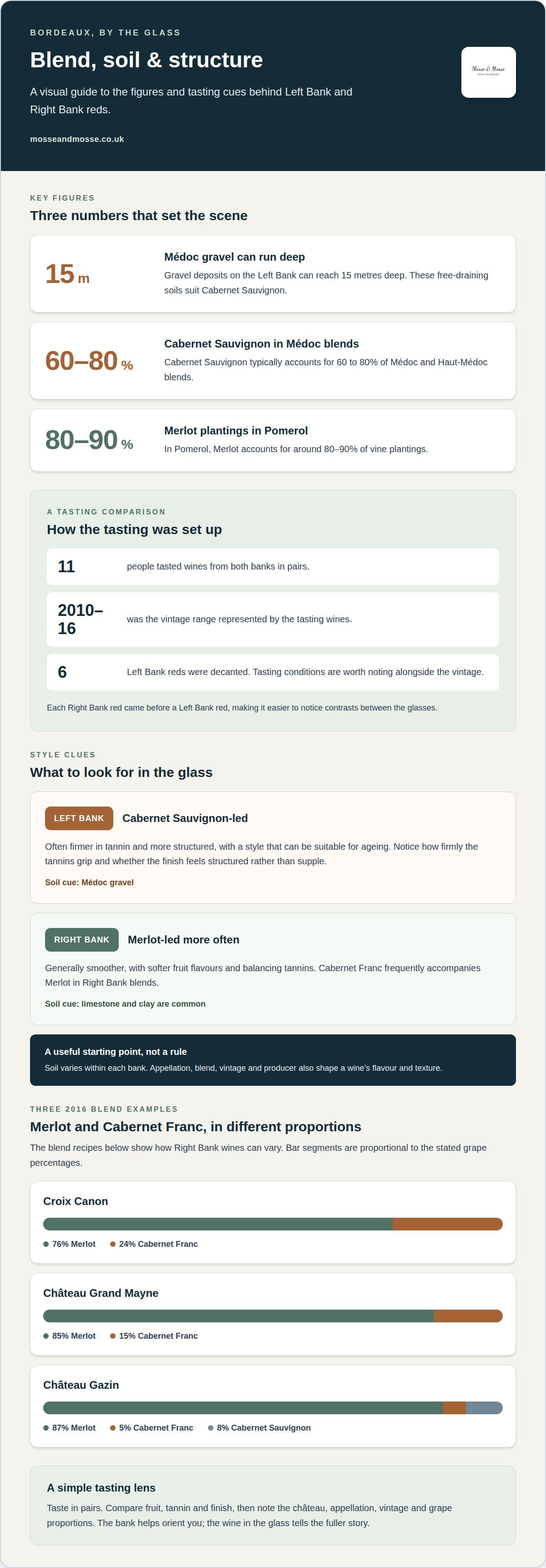
On the Left Bank, Médoc gravel deposits can reach 15 metres deep. These free-draining gravel soils suit Cabernet Sauvignon, which typically accounts for 60 to 80% of Médoc and Haut-Médoc blends. Explore Médoc and Haut-Médoc wines to see how the appellations express this classic combination.
Across the Gironde, Right Bank vineyards more often have limestone nearer the surface and less gravel. Clay and limestone create a different growing environment from the Médoc’s gravel terraces. Soil varies within each bank, so an appellation gives a more precise clue than “Left” or “Right” alone.
Wine classifications
Bordeaux’s classifications are not one unified ranking. The Médoc classification dates to 1855, while the Saint-Émilion classification was first introduced in 1955 and is reviewed every 10 years. Graves has a separate classification for dry red and white wines, devised in 1953 and finalised in 1959.
Sauternes has a classification distinct from those for Médoc, Graves and Saint-Émilion. The Graves classification covers dry wines, while Sauternes is a separate appellation and classification context. These systems reflect different places and wine categories, not a single scale for comparing every Bordeaux wine.
Appellations and blends are associated with each bank in different ways. Médoc and Haut-Médoc are Left Bank names, where Cabernet Sauvignon often leads the blend. Graves and Pessac-Léognan lie south of Bordeaux city on the Left Bank and produce both red and white wines. On the Right Bank, Saint-Émilion and Pomerol are known for Merlot-led reds.
Four of Bordeaux’s five First Growths are in the Médoc and Haut-Médoc region. This concentration helps explain the Left Bank’s historic prominence, but classification is only one guide. Producer, vintage, blend and appellation all influence a wine’s style and price.
| Criterion | Left Bank | Right Bank |
|---|---|---|
| Example appellations | Médoc, Graves, Pessac-Léognan | Saint-Émilion, Pomerol |
| Common soil cue | Gravel | Limestone and clay |
| Typical red blend lead | Cabernet Sauvignon | Merlot |
| Classification example | Médoc, Graves | Saint-Émilion |
Choose by appellation and the style you enjoy, using the bank as a helpful first clue.
Prices don’t follow a simple bank-by-bank rule: at different budgets, compare appellation, producer, vintage and bottle condition. For a Bordeaux visit, the drive between the Left Bank and Right Bank takes 45 minutes to an hour each way; many Médoc estates receive visitors by appointment, so arrange a tasting with the estate before travelling.
How do Left Bank and Right Bank wines taste?
A right bank vs left bank Bordeaux guide is most useful when it helps you compare actual wines, not just labels. In one Bordeaux tasting, 11 people tried wines from both banks in pairs. Each Right Bank red came before a Left Bank red, giving tasters an immediate contrast between the glasses.
Left Bank Cabernet Sauvignon wines
Left Bank reds are often Cabernet Sauvignon-led, with tannin and structure that can make them suitable for ageing. Pauillac and Saint-Julien offer clear examples of this classic style. When tasting, notice how firmly the tannins grip, how the fruit develops, and whether the finish feels structured rather than supple.
The tasting wines ranged from the 2010 through 2016 vintages, bringing vintage differences into the comparison. Six Left Bank reds were decanted. Those tasting conditions matter: note the vintage and whether the wine was decanted, then compare its texture and finish with the Right Bank wine alongside it.
Cabernet Sauvignon and Merlot bring different balances to a blend. Cabernet Sauvignon is associated with firmer tannins, while Merlot-led wines are generally smoother, with softer fruit flavours and balancing tannins. Grape variety alone doesn’t determine the experience: blend proportions, vintage and producer all shape what you taste.
Right Bank Merlot and Cabernet Franc
Right Bank blends more often centre on Merlot, frequently accompanied by Cabernet Franc. In Pomerol, Merlot accounts for around 80-90% of vine plantings. Cabernet Franc can add another dimension, so compare the blend details instead of assuming every Right Bank wine shares one profile.
Three 2016 wines show how the proportions vary: Croix Canon was 76% Merlot and 24% Cabernet Franc; Château Grand Mayne was 85% Merlot and 15% Cabernet Franc; Château Gazin combined 87% Merlot, 5% Cabernet Franc and 8% Cabernet Sauvignon. Those blends offer a practical tasting exercise: notice whether the fruit, structure and texture change with each recipe.
For a fair comparison, choose bottles at a similar stage of maturity and taste them in pairs. Start with your first impression, then compare fruit, tannin and finish. A second taste can reveal details you missed at first. Note the château, appellation, vintage and grape proportions to connect your impressions to each wine’s blend and origin.
Use this right bank vs left bank Bordeaux guide as a tasting prompt, not a verdict. The Gironde’s geography helps orient you, but individual grapes and estate choices explain the differences in your glasses. Include a white Bordeaux for another perspective: three white wines in the tasting were blends of Sauvignon Blanc and Sémillon. To explore Bordeaux styles through a guided tasting, discuss a Bordeaux tasting comparison.
Right Bank soils, appellations and wine styles
Left Bank names include Margaux and Pauillac, with notable châteaux such as Château Margaux and Château Mouton Rothschild. Right Bank benchmarks include Saint-Émilion and Pomerol, home to famous estates such as Château Cheval Blanc and Pétrus.
Pomerol and Saint-Émilion soils
Pomerol’s soils include clay, which helped vines through the heat of 2022. Limestone also lies close to the surface across parts of the Right Bank, creating a contrast with the gravel terraces associated with the Left Bank. Saint-Émilion’s vineyards span different sites, including the plateau and its foothills, so soil and position can give wines distinct character within one appellation.
That variation matters in the glass. A Pomerol wine shaped by clay may differ from one grown on other soils, even within the same appellation. Saint-Émilion also includes varied vineyard sites rather than one uniform terroir. These local differences help explain why an appellation name alone cannot describe every wine’s texture or structure.
Right Bank appellations and châteaux
Pomerol and Saint-Émilion are the best-known Right Bank appellations. Pétrus is a celebrated Pomerol château; Château Cheval Blanc, Château Ausone and Château Figeac are prominent Saint-Émilion names. Fronsac and Canon-Fronsac offer further appellations to explore, each with its own place in the wider Right Bank landscape.
Saint-Émilion’s classification was first introduced in 1955 and is reviewed every 10 years. It offers a formal distinction for estates, while Pomerol has no equivalent classification system described here. That difference makes it useful to understand the appellation and producer together, rather than expecting a single ranking to explain quality or style across both areas.
On the Left Bank, gravel-rich Médoc sites are closely associated with Cabernet Sauvignon, tannin and structure. Margaux stands out for its classified estates, with 21 classified growths. Its wines still vary: the blend depends on the grape varieties and plots selected by each château. Margaux is not simply one uniform flavour, even within a famous appellation.
Plot selection gives producers a way to balance a blend. Cabernet Sauvignon can contribute firmness, while Merlot may bring a softer element; the proportions shape the finished wine’s character. The same principle applies across the Garonne and Gironde, where a bank or appellation points towards a style but does not dictate every detail.
For a named example, Château Deyrem Valentin is a 2014 Margaux wine, while Château Rouget is a 2019 Pomerol. Comparing these bottles by appellation, blend and vintage is more revealing than relying on “Left Bank” or “Right Bank” alone. Soil helps explain the contrast, but the producer’s choices bring each vineyard’s character into the glass.
Left Bank and Right Bank tasting comparisons
A side-by-side tasting reveals more than a bank label can. In a Bordeaux tasting, 11 people compared wines from both banks, with reds tasted in pairs: each Right Bank wine came before a Left Bank wine. That sequence gives the palate a direct contrast, instead of relying on memory between separate tastings.
The wines spanned vintages from 2010 through 2016, allowing tasters to encounter different years as well as different estates. Six Left Bank reds were decanted. Decanting and serving order are worth recording, because they form part of the tasting conditions; the grapes, blend and vintage also shape what appears in the glass.
For a useful comparison, taste each pair slowly. Start with your first impression, then note how tannin feels across the mouth, how the fruit develops, and whether the finish feels firm or supple. A Cabernet Sauvignon-led wine may seem more structured; a Merlot-led wine may feel smoother. These are tendencies, not a substitute for assessing the wine in front of you.
Keep the Gironde’s geography in mind, but don’t let it decide your impression before tasting. Compare Left Bank and Right Bank wines at a similar stage of maturity, noting each château, appellation and vintage. Cabernet Franc also deserves attention in Right Bank blends: alongside Merlot, it can shift a wine’s balance, so not every Right Bank red tastes alike.
- Appearance: note the colour and its intensity before tasting.
- Palate: compare fruit, tannin and texture between the two glasses.
- Finish: record which wine leaves the longer or more structured impression.
Include white Bordeaux for another regional contrast. Three white wines in a tasting were blends of Sauvignon Blanc and Sémillon, showing that Bordeaux’s identity extends beyond red grapes. Climate and vintage influence both colour and red styles, so record the year alongside each wine rather than treating bank as the only explanation.
The clearest takeaway is to compare specific bottles, not broad labels alone. A tasting of two wines at a time makes differences in fruit, structure and tannin easier to notice. To explore those contrasts with guidance, discuss a Bordeaux tasting comparison.
Mosse and Mosse
Based in Suffolk, Mosse and Mosse can help you turn the Left Bank and Right Bank distinctions into a personal choice. From Framlingham and nearby Ipswich, explore Bordeaux wines by appellation and producer, whether you’re drawn to a structured Cabernet-led red or a softer Merlot-led style.
Turn to Mosse and Mosse for guidance choosing a wine to suit your palate or meal. The range also includes white wine, Champagne and sparkling wines, offering other styles to explore alongside Bordeaux reds.
Contact Mosse and Mosse to discuss the Bordeaux styles you enjoy.
Choose your next Bordeaux bottle with confidence
A right bank vs left bank Bordeaux guide is a starting point, not a tasting verdict. For your next bottle, decide what you want at the table: a wine to explore slowly, a match for a particular meal, or something to share on a special occasion. Let the producer, appellation and vintage refine your choice.
Mosse and Mosse offers Red Wine, White Wine, and Champagne & Sparkling Wines, giving you several ways to explore your preferences beyond one regional comparison. If you’d like a personal steer towards a bottle that suits your palate or plans, contact Mosse and Mosse.
Every glass is another opportunity to discover a Bordeaux style you love. Enjoy the exploration.
Frequently Asked Questions
So which bank should you drink?
Choose the bank whose usual texture and structure appeal to you, then decide by appellation and producer. If you enjoy firmer, more structured reds, start with a Left Bank Cabernet-led wine; for a smoother, fruit-led style, try a Right Bank Merlot-led bottle. For a direct comparison, open wines from both banks with the same meal and notice which balance you prefer.
What is the difference in grapes and soil?
Left Bank reds are commonly Cabernet Sauvignon-led and associated with gravel, while Right Bank reds more often centre on Merlot and grow on varied clay and limestone soils. These are regional tendencies, not rules for every vineyard. Cabernet Franc can form a substantial part of a Right Bank blend, so check the grape proportions when comparing bottles.
Which Region Should You Visit?
Choose the Médoc to explore Left Bank names such as Margaux and Pauillac. Graves and Pessac-Léognan offer a different southern stop, with both red and white wines to discover. For Right Bank appellations, consider Saint-Émilion or Pomerol. Shape your itinerary around the area that interests you most, rather than trying to cover every Bordeaux region in one visit.
What areas and appellations are considered Bordeaux’s Left Bank and Right Bank?
The Left Bank lies west of the Gironde and Garonne rivers and includes the Médoc, Haut-Médoc, Margaux, Pauillac, Graves and Pessac-Léognan. Across the Dordogne and Gironde, Right Bank appellations include Saint-Émilion, Pomerol, Fronsac and Canon-Fronsac. Entre-Deux-Mers sits between the Garonne and Dordogne, so it belongs to neither bank’s classic red-wine grouping.
How do Left Bank and Right Bank Bordeaux wines differ in grape varieties and blends?
Left Bank red blends usually lead with Cabernet Sauvignon, supported by Merlot, Cabernet Franc and sometimes Petit Verdot. Right Bank blends are more often Merlot-led, with Cabernet Franc alongside. A traditional red Bordeaux blend can include up to six grape varieties, so the bank name won’t tell you the full recipe. Check the blend details to understand how each château has balanced its grapes.
How do the soils and climate differ between Bordeaux’s Left Bank and Right Bank?
Gravel is a key Left Bank soil feature, particularly in the Médoc, while Right Bank vineyards include clay and limestone, with limestone closer to the surface in many places. Bordeaux has about 800 millimetres of rainfall per year. Within either bank, soil type and vineyard position influence drainage and vine growth, while each vintage’s conditions also shape the resulting wine.


