
Burgundy’s best discoveries aren’t always the names you already know. Exploring lesser-known Burgundy appellations brings the region’s character into focus: Burgundy is known chiefly for Pinot Noir and Chardonnay, and its wines sit within four ascending grades: regional, village, Premier Cru and Grand Cru.
It’s easy to assume that a less familiar appellation means a less distinctive wine. In Burgundy, the place name on the label tells you a great deal about a wine’s identity, and smaller appellations have stories of their own. This guide explains what Burgundy is known for and how its classification works, then looks at the Côte Chalonnaise, including Bouzeron, the only Burgundy appellation devoted to Aligoté, and Rully. You’ll see what sets these appellations apart and how to understand their wines, whether you’re already a Burgundy enthusiast or deciding where to begin.
Key Takeaways
- Pinot Noir and Chardonnay define much of Burgundy, but the appellation and vineyard site add important clues to a wine’s character.
- Learn how regional, village, Premier Cru and Grand Cru labels indicate a wine’s place in Burgundy’s vineyard hierarchy.
- Climats are defined vineyard plots, helping explain why wines from nearby sites can have distinct identities.
- Compare Bouzeron’s focus on Aligoté with Rully’s range of wines to find a different side of the Côte Chalonnaise.
- See how the Côte Chalonnaise’s appellations and producers offer more ways to explore Burgundy beyond its most familiar names.
What kind of wine is the Burgundy region known for?
Burgundy is best known for wines made from Pinot Noir and Chardonnay. Pinot Noir produces the region’s reds, while Chardonnay is behind its celebrated whites. Style depends not only on the grape, but also on the vineyard and its conditions. Exploring lesser-known appellations means paying attention to those differences rather than judging a wine by grape variety alone.
The region stretches from Chablis in the north to the Mâconnais in the south, with a vineyard corridor running about 50 kilometres from Dijon to Maranges. Its 84 appellations identify approved wine-growing areas, but those areas contain smaller, distinct vineyard sites. Burgundy’s 1,247 climats are defined vineyard plots, each with its own name and place in the local landscape.
A climat can differ from a neighbouring plot through its aspect, slope, soil and exposure. Burgundy’s limestone seabed soils formed about 200 million years ago, providing one part of this varied setting. Altitude also matters: Hautes-Côtes vineyards are typically around 100 metres higher than the main Côte d’Or slope. Saint-Romain’s vineyards sit between 350 and 410 metres above sea level, illustrating how conditions change within Burgundy.
These differences help explain why Burgundy’s highest-level wines are classified by vineyard site rather than by property. A named climat can therefore carry significance across producers: the site gives the wine its geographical identity, while the grower and winemaking shape its expression. In the Côte d’Or vineyards, this close relationship between place and label is especially visible in the Premier Cru and Grand Cru hierarchy.
Burgundy’s Premier Cru and Grand Cru designations indicate a vineyard’s place in the region’s classification system. These designations identify vineyard standing, not a producer’s estate size. The Chablis Grand Cru appellation itself contains seven named climats. Reading the place name can therefore reveal more than simply whether a bottle is red wine or white.
Ownership adds another layer. The Clos de Vougeot Grand Cru vineyard covers 50 hectares and has about 80 owners, while Le Chambertin is owned by 21 producers. Such divisions mean that wines carrying the same vineyard name can come from different growers. Their shared origin connects them, but each producer’s choices make the finished wine distinct.
To get a useful first read of a Burgundy label, identify the appellation, then look for a named climat and its classification. Next, note whether the wine is red or white and which grape it uses. This approach connects the regional Bourgogne level with particular villages and vineyard sites, making Burgundy’s complex map easier to understand without assuming familiar names tell the whole story.
How are Burgundy wines classified?
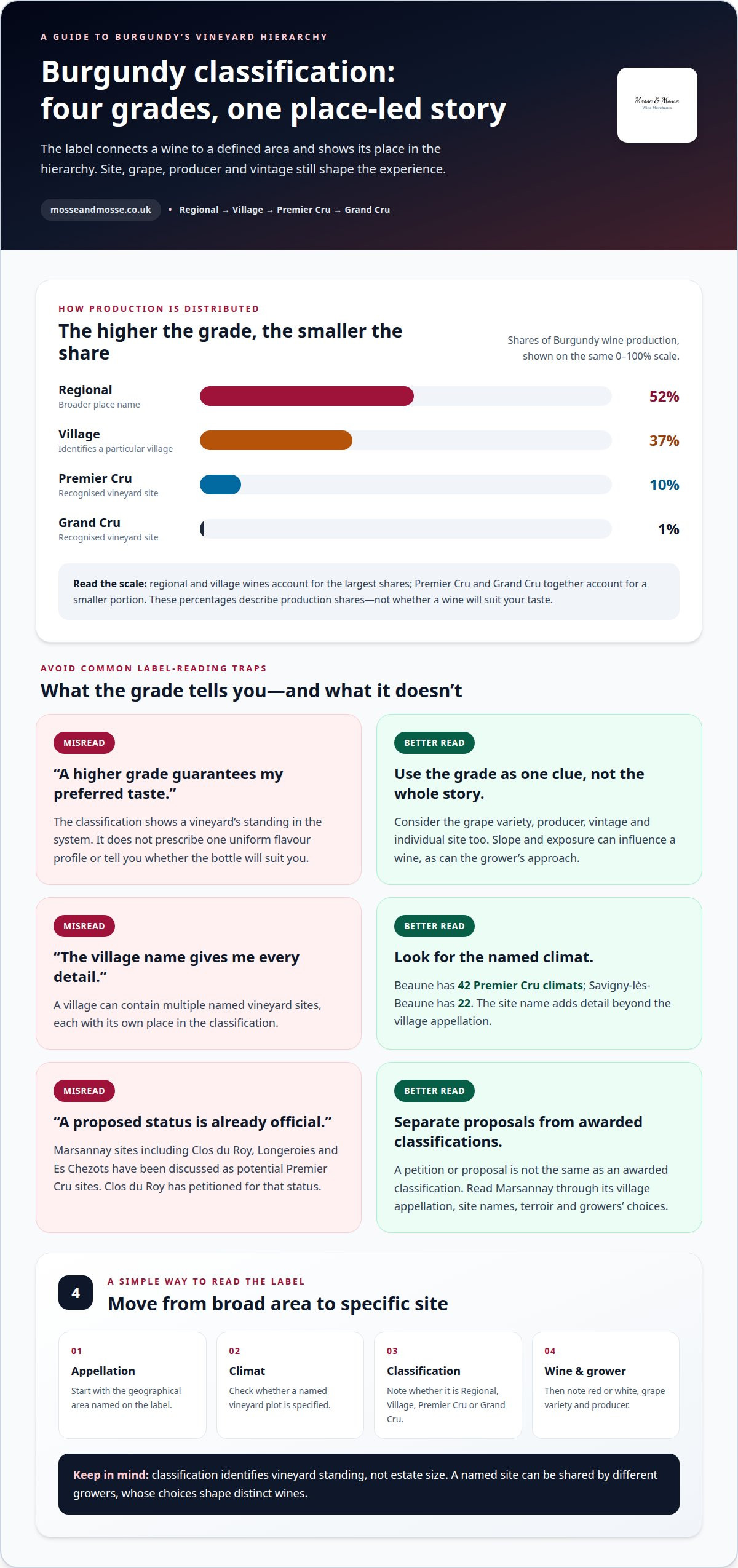
Burgundy uses four ascending grades: regional, village, Premier Cru and Grand Cru. These appellations link a wine to a defined geographical area and indicate its place in the vineyard hierarchy. Regional wines carry a broader place name, while village wines identify a particular village. Premier Cru and Grand Cru labels point to recognised vineyard sites within that system.
The grades also describe different portions of Burgundy’s production. Regional wines account for 52%, village wines 37%, Premier Cru wines 10%, and Grand Cru wines 1%. These shares help explain why the top classifications are less common. They don’t, by themselves, tell you whether a bottle will suit your taste: grape variety, producer, vintage and the individual site all shape the experience.
Beaune shows how a village appellation can contain numerous Premier Cru sites. It has 42 climats classified as Premier Cru, giving growers a range of named vineyard origins under the same village name. A Beaune Premier Cru label therefore combines the village identity with a specific site designation. To understand its finer distinctions, look for the climat named on the label, not just the wider appellation.
Savigny-lès-Beaune offers another example, with 22 climats classified as Premier Cru. The classification identifies vineyard standing, but doesn’t prescribe one uniform flavour profile. Differences between slopes, exposure and each grower’s approach can influence how a wine tastes. For a fresh style, use the named vineyard and producer as clues, then consider how the site’s conditions and vintage shape the finished wine.
Marsannay shows how vineyard reputation and formal classification can develop differently. Clos du Roy, Longeroies and Es Chezots have been discussed as potential Premier Cru sites, while Clos du Roy has petitioned for Premier Cru status. A petition or proposal is not the same as an awarded classification. For now, understand Marsannay’s wines through their village appellation, site names, terroir and growers’ individual choices.
For UK buyers wondering about typical prices, there’s no single figure for lesser-known Burgundy appellations. Price depends on the appellation, classification, producer and vintage. A regional wine and a named Premier Cru have different vineyard designations, but the label alone cannot establish the value of every bottle.
UK buyers can find these wines through specialist wine merchants and retailers, where appellation and site names help organise Burgundy selections. If you’d like guidance on choosing between village and Premier Cru styles, get in touch with the team to discuss what you enjoy and what you’re looking to discover.
Côte Chalonnaise appellations, including Bouzeron and Rully
The Côte Chalonnaise covers 4,475 hectares of vineyards, a substantial area in which named villages and individual growers offer useful ways to explore local differences. For anyone exploring lesser-known Burgundy appellations, looking beyond the headline classification can reveal details about soils, vineyard holdings and neighbouring sites.
Côte Chalonnaise village appellations
Village appellations identify local origins within the wider Côte Chalonnaise, while vineyard and producer details can help distinguish wines further. The area around Givry has over 13 soil types, a reminder that one village name can encompass varied growing conditions. That local complexity matters when comparing wines: the appellation gives a starting point, while the grower’s holdings show which sites shape a particular bottling.
Domaine Joblot provides a concrete Givry example. Its land covers 14 hectares, including nine hectares classified as Premier Cru. Those holdings show how a producer’s selection of sites can influence the range of wines made under one village name. Montagny offers another angle: its appellation has 211 vineyards classified as Premier Cru. Rather than relying on a broad regional label alone, these details help identify the specific vineyard context behind a wine.
Exploring lesser-known Burgundy appellations also means seeing how sites relate to neighbouring villages. In Monthélie, some of the strongest Premier Cru sites continue from Volnay’s Clos des Chênes, while Les Duresses borders Auxey. These links across village boundaries add useful geographical context: nearby sites may share a wider landscape while retaining distinct appellation identities. The names do more than mark a map; they help explain the local pattern of vineyards.
Chardonnay villages and underrated producers
For a Chardonnay-focused exploration, Montagny’s vineyard classification offers another way to compare producers and sites. In the Côte Chalonnaise, a named vineyard can be a more precise reference than the village name alone. Consider that detail alongside the producer’s holdings, as the Givry example shows, to understand how a domaine’s selection shapes its range.
The Côte de Beaune has further less-familiar sites worth investigating. Pernand-Vergelesses has eight climats classified as Premier Cru, while Santenay has 12. These examples give readers specific places to explore beyond the region’s best-known village names. A useful comparison starts with the appellation and named climat, then considers the producer’s interpretation of that site.
Côte Chalonnaise wines reward attention to these finer details. Soil variation around Givry, classified vineyard holdings in Montagny and the connections between Monthélie’s neighbouring sites each offer a different route into the region. Together, they make appellation names a starting point for discovery, not the whole story.
Domaine de Villaine and Côte Chalonnaise wines
Domaine de Villaine offers a useful way to understand how a grower’s work shapes a Côte Chalonnaise wine. Its estate extends across 29.33 hectares, and it has managed its land organically since 1986. It has been certified organic since 1997. Those details give context to the domaine, while appellation and grape variety explain each wine’s regional identity.
The estate’s Rully property covers six hectares, as of 2017. Rully sits within a region where Chardonnay and Pinot Noir both matter, so the village name alone doesn’t tell you whether a bottle is red or white. Look for the grape and wine colour on the label, then consider the producer and vintage for a fuller picture of its character.
Further south, the Mâconnais has shown potential for producing more serious wines. Pouilly-Fuissé is its best-known village wine, and the appellation added Premier Cru vineyards in 2021. Viré-Clessé became an appellation in 1999. These examples show how named villages and vineyard classifications can give readers more precise ways to explore white Burgundy beyond familiar appellations.
Coulanges-la-Vineuse offers a different regional perspective. Its wines are made mainly from Pinot Noir, with Chardonnay used for white wine. Marsannay, at the northern tip of the Côte de Nuits and extending into Dijon’s suburbs, produces red and white wines as well as rosé made from Pinot Noir. Rosé production has almost entirely died out, despite the appellation’s former reputation for that style.
Marsannay’s rules also distinguish its rosé vineyards from its red wines. Red wine from vineyards dedicated exclusively to rosé production must be declassified to Bourgogne Rouge. This detail shows how a wine’s colour, vineyard use and label can intersect. It also explains why Marsannay’s history with rosé doesn’t make it the appellation’s defining style today.
Across the Côte de Beaune, villages produce both red Pinot Noir and white Chardonnay. Meursault, Puligny-Montrachet and Chassagne-Montrachet are associated with rich white Burgundy, while Pommard, Volnay and Corton are well-known red examples. Seven of the Côte de Beaune’s eight Grand Cru appellations produce white wine, a striking reminder of Chardonnay’s importance in the region. Explore Côte de Beaune wines by village and colour to see how their identities differ.
From Domaine de Villaine’s Rully holdings to the varied wines of Marsannay and the Mâconnais, Burgundy rewards attention to place and producer. If you’d like help discovering white wines from these regions, get in touch with the team.
Mosse and Mosse
Mosse and Mosse can help you turn what you’ve learned about Burgundy’s appellations into a more informed wine choice. When weighing a lesser-known village against a familiar name, consider the grape, classification and producer together. These details give you a clearer sense of what to expect, whether you’re drawn to Pinot Noir reds or Chardonnay whites.
Its Burgundy selection includes red and white wines, with guidance shaped around what you enjoy and what you’d like to discover. Champagne and sparkling wines are also available if you’re choosing wines for a broader occasion. For a friendly conversation about finding a Burgundy wine to suit your preferences, contact Mosse and Mosse.
Choose your next Burgundy discovery
Exploring lesser-known Burgundy appellations can help you find a wine that feels personal, not simply familiar. Let the label lead you to a village or vineyard, then consider the grape and style you enjoy most. Your next choice might be a fresh white for a quiet supper, a red to share over dinner, or something sparkling for a celebration.
Mosse and Mosse offers red and white wines, Champagne and sparkling wines, giving you different styles to consider for your next discovery. If you’re unsure where to start, a conversation can help you narrow down your preferences and choose what to explore next. You don’t need to know every appellation before you begin; curiosity is a fine place to start.
Contact Mosse and Mosse to talk through your Burgundy interests and find a new bottle to enjoy. Let the next label lead somewhere unexpected.
Frequently Asked Questions
Not sure where to start?
Start by choosing red or white Burgundy, then explore an unfamiliar appellation in that style. For whites, compare Chardonnay-led Montagny with Aligoté-focused Bouzeron; for reds, try a village such as Maranges or Marsannay. Read the appellation and producer together, then note which combination you enjoy. This gives your next tasting a clear focus without requiring you to learn Burgundy’s entire map first.
What grapes are grown in Burgundy?
Pinot Noir and Chardonnay are Burgundy’s principal grapes, producing its best-known red and white wines. Other varieties offer useful contrasts: Bouzeron is devoted to Aligoté, while Bourgogne Passe-Tout-Grains blends Pinot Noir and Gamay. St Bris is a distinctive white-wine appellation made from Sauvignon Blanc rather than Chardonnay. These names help explain why Burgundy wines can differ in style even before you consider their individual vineyard sites.
Which lesser-known Burgundy appellations are worth exploring?
Consider Bouzeron for Aligoté, Saint-Romain for its higher-altitude vineyards, and Auxey-Duresses for wines from the valley west of Meursault. Maranges offers another route into southern Burgundy, while Coulanges-la-Vineuse brings Pinot Noir-led wines from the Yonne. Choose based on the style you want to taste, then compare producers within the appellation. That makes an unfamiliar place name a practical starting point, not just a label to memorise.
What are the main grape varieties and wine styles in lesser-known Burgundy appellations?
Pinot Noir and Chardonnay remain Burgundy’s key varieties, but appellations can point to more specific styles. Bouzeron centres on Aligoté; Montagny produces Chardonnay, while Coulanges-la-Vineuse makes mainly Pinot Noir alongside white wine from Chardonnay. Marsannay produces red and white wines and can also make Pinot Noir rosé. These distinctions make grape and colour useful first clues when choosing an appellation to explore.
What are the differences between Mâconnais appellations such as Viré-Clessé, Saint-Véran and Pouilly-Fuissé?
Each name identifies a different Mâconnais appellation, so compare the village designation and producer rather than treating all regional Chardonnay as identical. Viré-Clessé became an appellation in 1999. Pouilly-Fuissé is the Mâconnais’ best-known village wine and added Premier Cru vineyards in 2021. For Saint-Véran, use the appellation and producer as your starting points, then compare the bottle’s vintage and description.
Which overlooked Burgundy appellations produce good-value Pinot Noir?
For Pinot Noir to investigate, start with Maranges, Coulanges-la-Vineuse, Marsannay or Fixin, which specialises in red wines. Maranges is particularly focused on the grape, with Pinot Noir accounting for 95% of its production. To judge value, compare wines at the same classification level and consider producer and vintage alongside the appellation. This creates a more meaningful comparison than relying on a famous village name alone.


