
A Premier Cru can be an intriguing bottle for a collector, even though Grand Cru sits higher in Burgundy’s hierarchy. This introduction to Premier Cru Burgundy explains why a vineyard’s classification is a starting point for understanding a wine, not the whole story.
It’s easy to assume Burgundy and Bordeaux classify wine in the same way. They don’t: Burgundy’s four quality levels classify places, from regional and village wines through Premier Cru to Grand Cru, while Bordeaux’s 1855 Classification ranks estates.
You’ll learn what Premier Cru means on a label, how these vineyards differ from Grand Cru sites, and why Burgundy’s system is not interchangeable with Bordeaux’s. We’ll also look at what classification can tell you as a collector, including the roles of vineyard identity, producer and vintage, so you can read labels with more confidence and understand what makes these wines compelling.
Key Takeaways
- Read Burgundy’s four-level hierarchy as a classification of vineyard sites, not a ranking of producers.
- Distinguish Premier Cru climats within a village from Grand Cru vineyards, which have their own appellations.
- Look beyond the designation: producer and ownership can shape the character of wines from the same vineyard.
- Consider vineyard, producer and vintage together when judging a Premier Cru’s appeal for collecting and ageing.
- Use the label’s place names to understand where a wine sits in Burgundy’s system, rather than applying Bordeaux’s estate-based approach.
How does Burgundy's classification compare to Bordeaux?
Burgundy classifies vineyard sites, while Bordeaux’s historic system ranks estates. That difference shapes how a label connects a wine to its origin, producer and vintage.
The history of Burgundy classification
Burgundy’s modern classification developed through controlled appellations, formalised during the 20th century. The distinction matters because a Premier Cru names a recognised vineyard place, rather than a domaine’s position in an estate ranking.
In 1861, Burgundy’s classification identified first-class vineyards; most later became Grand Cru appellations when France implemented national AOC legislation in 1936. Burgundy’s AOC system was established in 1936, giving defined wine-growing places formal status. Chambertin, for example, is a Grand Cru vineyard in Gevrey-Chambertin. Its standing belongs to the site, not one producer.
Burgundy’s classification tiers and rules
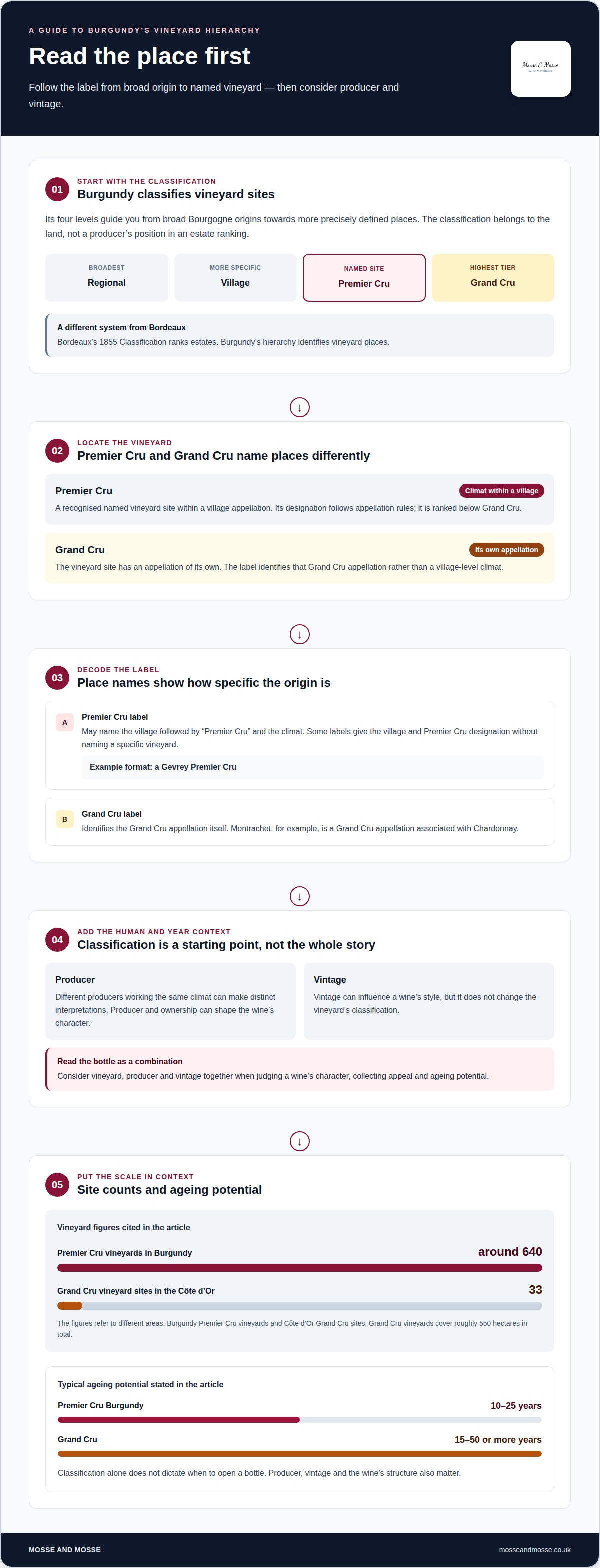
Burgundy’s four levels are regional, village, Premier Cru and Grand Cru. They guide you from broad Bourgogne origins towards more precisely defined vineyard sites. Two bottles from the same domaine can carry different classifications if their grapes come from different places.
Burgundy has over 80 AOCs, including designations for individual vineyards. Premier Cru vineyards are climats within a village appellation; their designation follows appellation rules, rather than Bordeaux’s estate ranking. Grand Cru sites have their own appellations. A Premier Cru label may name both the village and climat, such as a Gevrey Premier Cru, while a Grand Cru label identifies its own appellation.
How are Burgundy Premier Cru vineyards classified, and who sets the rules? French AOC appellation rules define recognised vineyard areas and the terms permitted on labels. A Premier Cru climat is a named site within a village, ranked below Grand Cru.
How should you choose, serve and store Burgundy Premier Cru wine? Compare the village, climat, producer and vintage, then serve Pinot Noir at 14-16°C. Store the bottle somewhere cool, dark and stable, away from temperature swings.
Bordeaux provides a useful contrast. Its 1855 Classification ranks estates, so the estate name is central to that hierarchy. Burgundy instead gives prominence to the land: a Premier Cru designation identifies a vineyard tier, while the producer remains important to the wine’s character. Explore Bordeaux wines alongside Burgundy to see how the two regions express origin differently.
That distinction helps make sense of labels from the Côte de Beaune and Gevrey. Vintage can influence a wine’s style, but it does not change the vineyard’s classification. Nor does classification describe every aspect of the finished wine: producers working the same climat can make distinct interpretations. Treat the place name as your starting point, then consider the domaine and vintage for a fuller picture.
Premier Crus and Grands Crus: what are the differences?
The distinction is more than a rung on a ladder: each designation points to a different scale of vineyard identity. The label shows whether the wine comes from a broad region, a village or a named climat.
The Burgundy wine hierarchy
Burgundy’s four levels run from regional Bourgogne to village, Premier Cru and Grand Cru. Each level narrows the place named, helping you understand how specifically a wine expresses its origin. A village wine carries its village appellation; a Premier Cru comes from a recognised climat within that village. Grand Cru sits above it, with an appellation of its own.
Premier Cru and Grand Cru are both tied to distinguished vineyard sites, but they differ in rank and appellation structure. Burgundy has around 640 Premier Cru vineyards, while its Côte d’Or has 33 Grand Cru vineyard sites. Grand Cru vineyards cover roughly 550 hectares in total, a small share of Burgundy’s planted vineyard area.
The limited area helps explain why Grand Cru bottles can be scarce. The finest Grand Cru wines are produced in quantities ranging from a few hundred to a few thousand cases per year. Site, vintage and producer all influence the finished wine, so the higher classification signals a vineyard’s standing, not a guarantee that every bottle will taste alike.
Classification on wine labels
A Premier Cru label may name the village and climat, such as a village followed by “Premier Cru” and the vineyard name. Some labels give the village and Premier Cru designation without naming a specific vineyard. Grand Cru labels identify the Grand Cru appellation itself. These place names show how precisely the wine’s origin is defined.
Consider Montrachet: it is a Grand Cru appellation associated with Chardonnay, while a Premier Cru label identifies a particular climat within its village. Grand Cru vines must be at least three years old for their grapes to qualify for Grand Cru wine. This is one part of the appellation framework, alongside the defined vineyard site.
Ageing potential can also differ, though classification alone doesn’t dictate when to open a bottle. Premier Cru Burgundy typically has an ageing potential of 10-25 years; Grand Cru vineyards typically have an ageing potential of 15-50 or more years. Producer, vintage and the wine’s structure remain useful considerations when choosing a bottle to drink or cellar.
If you’re comparing Burgundy’s still wines with a celebratory alternative, discuss your choice of Champagne and sparkling wines.
What is a Premier Cru in Burgundy?
A Premier Cru is a named vineyard site recognised for the consistent quality of its wines. Its reputation matters, but the grower who tends the grapes and makes the wine also shapes the result.
Premier Cru vineyard designation
Burgundy has around 640 Premier Cru vineyards, known as climats, whose names can appear on labels. The designation places a wine within a village appellation and identifies its vineyard origin. For readers, the climat name offers a more precise clue than the village alone, whilst the producer and vintage help explain the style in the bottle.
A label may show the village followed by “Premier Cru” and the climat name, or give the village and designation without naming a specific vineyard. Les Cazetiers and Clos Saint-Jacques are examples of named Premier Cru sites. The name indicates the vineyard’s place in Burgundy’s hierarchy; it does not make every wine from that site identical.
Producer influence and vineyard ownership
Ownership can be fragmented, so bottles from one vineyard may come from different producers. Le Chambertin has 21 producers, while Clos de Vougeot has around 80 owners. Each producer works with their own grapes and choices in the cellar, creating distinct expressions of a shared place. That makes the domaine an important part of the label’s story.
Scale also varies. A good-sized Burgundy domaine may cover 10 hectares and make about 15 wines, while many Côte d’Or growers release only a few hundred cases a year. Small production can make particular bottles harder to find, but vineyard rank alone doesn’t explain quality or whether a wine feels expensive. Producer, vintage and site all contribute.
Premier Cru vineyards and appellations
Premier Cru sites are found in Burgundy’s wine-growing areas, including the Côte d’Or and Chablis. The Côte d’Or’s Côte de Nuits and Côte de Beaune include renowned red and white vineyard names. Examples include the red Premier Cru Cros Parantoux and the white Les Pucelles. Chablis also has Premier Cru vineyards, which account for about 15% of its annual production.
Names such as Les Amoureuses and Les Santenots du Milieu show how a climat can become central to a wine’s identity. Burgundy’s terroir is expressed through place, grapes and the producer’s approach, not designation alone.
Which Burgundy Premier Cru wines offer good value for beginners? Compare a less-famous climat with the producer and vintage rather than choosing by rank alone. Which Burgundy regions and appellations have Premier Cru vineyards? They include the Côte d’Or, across the Côte de Nuits and Côte de Beaune, and Chablis.
Premier Crus as collector and investment wines
Collectors value Premier Cru Burgundy for its combination of place, producer and vintage, not classification alone. A bottle from a recognised climat can offer distinctive character, while the grower’s choices influence the result. For collecting, producer and provenance matter as much as the vineyard name. For investment, a prestigious label alone cannot establish future value.
Ageing potential adds another dimension. Structured red Premier Crus from the Côte de Nuits can age harmoniously for twenty to thirty years in great vintages. White Burgundy can improve in bottle for a decade or more. These are possibilities, not a schedule for every wine: vintage conditions, producer and storage all affect how a bottle evolves. Meursault’s Les Santenots du Milieu, for example, gives collectors a named Premier Cru site to follow across vintages.
Scarcity can make certain bottles sought after, but it is not the same as investment performance. Burgundy’s fragmented ownership means one climat may be bottled by different producers, each offering a distinct interpretation. Romanée-Conti, a Grand Cru rather than Premier Cru, illustrates how a celebrated place can attract intense attention. Its status does not make every Burgundy bottle a sound investment.
How much does Burgundy Premier Cru cost in the UK? There is no single price: producer, climat, vintage, bottle condition and availability all affect the cost of a particular wine. Compare these details rather than assuming that a higher classification automatically means better value. Meursault Premier Cru and a Côte de Nuits Pinot Noir also offer different expressions of Burgundy, so what suits your cellar matters as much as prestige.
Pay particular attention to provenance, storage history and condition. A damaged label, low fill level or signs of heat exposure can affect confidence in an older bottle. Vintage matters too: a celebrated year may attract greater demand, but producer style and the wine’s development remain central. For drinking, choose an age and style you’ll enjoy; for a cellar, consider whether its expected evolution fits your plans.
Investment brings additional risks. Demand can change, and selling a bottle later may not be straightforward. Treat Premier Cru first as wine to understand and enjoy, rather than assuming the classification promises a financial return. Compare the site, producer and vintage, then make storage part of your decision. Discuss your Burgundy selection if you’d value guidance on choosing a bottle for your collection.
Mosse and Mosse
Mosse and Mosse helps you turn Burgundy’s classification into a more considered choice, with personal guidance on wines, producers and vintages. If you’re weighing a Premier Cru against a Grand Cru, the vineyard name is one part of the picture; style and the occasion matter too. Explore Burgundy alongside the wider selection of white wines and Champagne and sparkling wines to find a bottle that suits your preferences.
Whether you’re choosing a wine to enjoy now or hoping to discover a new producer, a little context can make the decision more rewarding. Contact Mosse and Mosse to discuss your Burgundy choices.
Let your next bottle reflect your taste
A thoughtful introduction to Premier Cru Burgundy can open the door to a more personal way of choosing wine. Start with what you enjoy in the glass, then follow your curiosity towards unfamiliar producers, villages and vintages. A bottle needn’t be chosen for prestige alone; discovering a style that suits you is reason enough.
Mosse and Mosse offers red and white wines, Champagne and sparkling wines for different tastes and occasions. If you’re considering Burgundy for your table or cellar, get in touch to explore the choices with your preferences in mind.
Contact Mosse and Mosse to discuss your next wine choice, and enjoy discovering what speaks to you.
Frequently Asked Questions
Why is place, vineyard and terroir so important in Burgundy?
Place helps explain why two Burgundy wines made from the same grape can taste different. Soil, slope, aspect and local growing conditions influence how grapes ripen, while each producer’s decisions shape the finished wine. A named climat gives a more precise sense of origin than a broad regional label. Comparing neighbouring sites can reveal differences in character, even when the grape variety and vintage are shared.
What is Burgundy wine?
Burgundy wine comes from the Burgundy region of eastern France, where producers make red, white and sparkling wines. Pinot Noir is the best-known red grape, while Chardonnay is widely used for white Burgundy. The label may name a broad regional appellation, a village or an individual vineyard site. That range means “Burgundy” covers many styles, from fresh, straightforward bottles to wines with greater depth and ageing potential.
What should red Burgundy taste like?
Red Burgundy is generally made from Pinot Noir, so expect a lighter-bodied wine than many deeply coloured reds. Flavours can include cherry, raspberry and other red fruits, with freshness and fine tannins; some bottles develop earthy or savoury notes. Style varies with site, producer and vintage. For a first tasting, try the wine slightly cool and notice how its fruit, acidity and texture change as it opens.
Where exactly is Burgundy?
Burgundy lies in eastern France, stretching from Chablis in the Yonne to the southern limit of Beaujolais, a distance of more than 137 miles. Its principal wine areas include Chablis, the Côte d’Or, the Côte Chalonnaise and the Mâconnais. The Côte d’Or itself includes the Côte de Nuits and Côte de Beaune. These names help place a bottle within the region before you explore its village or vineyard.
What does Premier Cru mean in Burgundy wine?
Premier Cru identifies a recognised vineyard climat within a village appellation. A label may identify a village and indicate Premier Cru, sometimes with a climat name. Some labels use the village and Premier Cru designation without naming a particular climat. This introduction to Premier Cru Burgundy helps you read the label: the designation tells you about the site’s classification, not the producer’s identity.
How does Burgundy Premier Cru compare with Grand Cru, village and regional wines?
Think of the four designations as increasingly specific signals of origin. A regional Bourgogne label points to a wider area; a village wine identifies its village; Premier Cru narrows the origin to a classified climat within that village; Grand Cru names its own appellation. This can help you decide what to explore next. If you enjoy a village wine, look for a Premier Cru from the same village to compare its site and character.


