
The highest cru on the label isn’t automatically the bottle you’ll enjoy most. If Chablis Premier Cru vs Grand Cru sounds like a simple good, better, best decision, you’re not alone. Cru status tells you about the vineyard classification, but it can’t tell you everything about the wine in your glass. The producer and vintage matter, too.
Both classifications sit above Chablis in the region’s four-tier hierarchy, and both are made from Chardonnay. The distinction starts with the vineyards: Chablis has 40 recognised Premier Cru climats and seven Grand Cru climats, grouped on one hillside near the town. Site can contribute to a wine’s weight, complexity and ageing potential, but classification alone doesn’t guarantee a particular style. This guide explains the hierarchy, compares the sites and offers practical ways to choose, whether you’re looking for a bottle for supper or a more layered wine for a special occasion.
Key Takeaways
- In chablis premier cru vs grand cru, Grand Cru is the higher classification, but rank alone doesn’t determine which wine will suit your palate.
- Compare the vineyard site as well as the cru: Premier Cru covers a broader range of locations, whilst Grand Cru comes from a more concentrated group of sites.
- Weight and complexity can vary between wines. Neither classification has one fixed tasting style.
- Consider the site, producer and vintage together, then match the wine’s described style to your meal or occasion.
Chablis Premier Cru vs Grand Cru: where each sits in the hierarchy
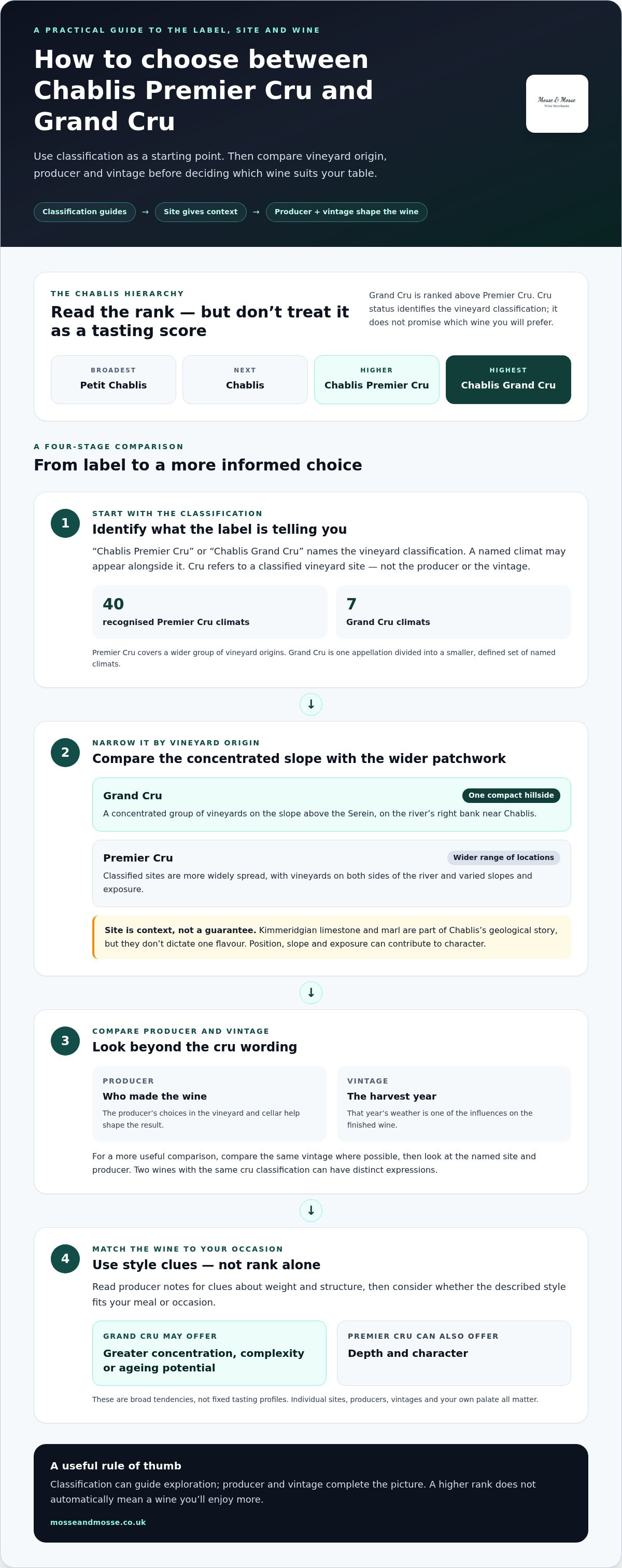
Both Premier Cru and Grand Cru are quality classifications within Chablis, with Grand Cru ranked above Premier Cru. From the broadest to the highest classification, the hierarchy is:
- Petit Chablis
- Chablis
- Chablis Premier Cru
- Chablis Grand Cru
This order is a useful starting point when reading labels, not a promise that you’ll prefer every wine higher up the ladder. Cru status identifies the classification of the vineyard site. The producer’s approach and the vintage also help shape the wine.
What do Premier Cru and Grand Cru mean in Chablis?
Here, cru refers to a classified vineyard site, or climat, rather than a producer or vintage. Premier Cru covers a number of classified sites, whilst Grand Cru is one appellation divided into named climats. The Chablis (AOC) classification system offers further background on how these classifications fit within the appellation.
Chablis recognises 40 Premier Cru climats and seven Grand Cru climats. “Premier Cru” therefore describes a wider group of vineyard origins, whilst a Grand Cru label points to one of a smaller, defined set. The classification signals a site’s standing in Chablis, not a guaranteed tasting score or a universal measure of enjoyment.
How does the Chablis hierarchy help read a label?
Start with the appellation wording. “Chablis Premier Cru” or “Chablis Grand Cru” identifies the classification; a named climat may appear alongside it. The producer’s name and vintage are separate clues: one tells you who made the wine, the other identifies the harvest year. Keep these details distinct when comparing bottles.
For example, two labels may both say Premier Cru but name different climats and producers. To make the comparison more useful, compare the same vintage where possible, then look at the named site and producer. A broader white Burgundy guide can place Chablis in context with other white wines from Burgundy, while the label helps you focus on the Chablis site and maker.
So, in chablis premier cru vs grand cru, use the hierarchy to understand the vineyard classification, then look beyond the ranking. A higher classification can guide your exploration, but your preference depends on the individual wine, not prestige alone.
Chablis Premier Cru vs Grand Cru: how vineyard sites shape the wine
The Grand Cru vineyards form a concentrated group on the slope above the Serein, on the river’s right bank near the town of Chablis. Premier Cru climats are more widely spread, with classified sites on both sides of the river. In broad terms, Grand Cru comes from one compact hillside, while Premier Cru covers a wider patchwork of locations.
Where are the Grand Cru and Premier Cru vineyards?
On a map, look for the Grand Cru slope beside Chablis and the Serein. Its named climats sit together rather than being scattered across the appellation. Premier Cru sites, by contrast, occupy a wider range of positions on both banks. Their slopes and exposure vary, so the classification includes vineyards with different local settings rather than one uniform landscape.
Vineyard position and cru classification are related, but they aren’t interchangeable. Position describes where a plot lies; classification identifies its recognised standing within Chablis. Both help explain a wine’s origin and potential character, but neither tells the whole story. A map can help you visualise the river and the concentrated Grand Cru hillside, while the named climat on the label narrows the origin further.
What can site and soil contribute to Chablis?
Kimmeridgian limestone and marl are part of Chablis’s geological story. These layers of limestone and clay-rich material form the ground beneath many of the region’s vineyards. They provide useful context, but they don’t dictate one flavour or make every wine taste alike.
Slope and exposure affect how much sun vines receive and how fruit ripens. These details differ from site to site, and vineyard position is only one influence on the finished wine. The producer’s choices in the vineyard and cellar, along with that year’s weather, also shape the result. That’s why two wines with the same cru classification can have distinct expressions.
For chablis premier cru vs grand cru, think of the map as a guide to origin, not a tasting guarantee. Site can contribute to a wine’s character, while producer and vintage help determine how that character comes through in the glass. If you’re exploring Burgundy, find personalised wine guidance.
Which Chablis should you choose? Compare style, producer and occasion
Choosing between the two isn’t simply a matter of selecting the higher classification. Grand Cru wines may offer greater concentration, complexity or ageing potential, whilst Premier Cru can also deliver depth and character. These are broad tendencies, not fixed tasting profiles: individual sites, producers and vintages all make a difference.
Does Grand Cru always taste better than Premier Cru?
No. Grand Cru ranks higher, but that doesn’t mean every drinker will prefer every Grand Cru to every Premier Cru. Your experience depends on the wine’s style, vintage and producer, as well as your own palate. When comparing bottles, look at the named sites and producer notes for clues about weight and structure rather than relying on the cru wording alone.
A useful rule of thumb is: classification can guide exploration, whilst producer and vintage complete the picture. If you enjoy a particular producer’s approach, that may be a more helpful starting point than choosing solely by rank. The climat name can also help you compare wines from different sites within the same classification, though it won’t promise an identical style from bottle to bottle.
Which classification suits your meal or occasion?
Let the food and occasion help narrow the choice. A lighter, more direct style may suit seafood or a relaxed lunch; a wine with more weight or complexity could work with poultry or a richer dish. These are flexible suggestions, not strict pairing rules, and neither classification guarantees a particular flavour or weight.
For an everyday meal, you might prioritise freshness and an approachable style. For a special dinner, you may want to explore a wine with greater depth or ageing potential. Read the producer’s notes and vintage information, then consider whether the described structure suits the occasion. These details offer a more useful basis for choosing than the label’s rank alone, whether you’re browsing in person or looking to buy wine online with confidence.
In chablis premier cru vs grand cru, choose the wine that fits your preferences, food and occasion. Cru status is a helpful guide, not a substitute for personal taste. For personalised guidance as you explore Burgundy, speak with our wine team.
Explore Chablis with a more confident, taste-led choice
Once you understand what the classification tells you, let your own preferences lead. For chablis premier cru vs grand cru, start with the style you enjoy, then consider the site, producer and vintage before deciding whether a wine suits your plans.
- Decide on the style you want. Consider whether you’re drawn to a lighter, more direct wine or one with greater weight and complexity. Treat these as possible tendencies, not guaranteed profiles.
- Compare the named sites. The climat gives you a more precise sense of origin than the cru wording alone. It can help you explore differences between wines within the same classification.
- Consider producer and vintage. Read the accompanying information to understand the winemaker’s approach and the conditions of the harvest. These details help complete the picture of the wine you’re choosing.
Premier Cru and Grand Cru are useful guides to vineyard classification, but they can’t tell you what you’ll personally enjoy. Let the label start your search, then use the details and your own taste to make the final call.
A simple checklist for comparing Chablis labels
Read a label in stages rather than letting the cru name make the decision for you. Check the appellation and classification first, then consider the site, producer and vintage as separate clues. Tasting notes can help you picture a wine’s style, but they describe an expected impression, not a guarantee of how you’ll experience it.
- Check the appellation and cru wording.
- Compare the named site, producer and vintage.
- Use tasting notes as guidance, alongside your own preferences.
Get personal guidance on choosing Burgundy
If you’re choosing a wine for a particular meal, occasion or preferred style, a conversation can help make the options clearer. Mosse and Mosse is an independent Suffolk wine merchant with a specialism in Burgundy, offering personalised guidance and a curated selection of wines.
Share what you enjoy and what you’re choosing a bottle for. Explore Burgundy with our team.
Make your next Chablis choice your own
The most rewarding bottle isn’t necessarily the one with the grandest wording on its label. Let what you enjoy guide your next choice: perhaps you’re curious about a more layered style, or simply want a white wine that suits a particular meal. Keep a note of the producers, sites and vintages that appeal, and use those preferences to shape what you explore next.
That’s the practical value of understanding chablis premier cru vs grand cru: classification gives you a starting point, while your palate makes the final decision. You don’t need to follow a rigid ladder or choose by prestige. A thoughtful recommendation can help connect the style you like with the occasion you have in mind.
As an independent Suffolk merchant with a specialist focus on Burgundy, Mosse and Mosse offers curated wine choices and personalised service. Discuss your Burgundy preferences with us and take your next step towards a bottle you’ll be excited to share.
Frequently Asked Questions
Is Chablis Grand Cru always better than Premier Cru?
No. Grand Cru is the higher classification, but it won’t automatically be the more enjoyable choice for every drinker. In the chablis premier cru vs grand cru comparison, consider the producer, vintage and named site as well as the classification. If you prefer a fresher, more straightforward style, a particular Premier Cru may appeal more than a richer Grand Cru. Match the wine to your palate and occasion, not rank alone.
How many Grand Cru climats are there in Chablis?
Chablis Grand Cru is one appellation divided into seven climats. A climat is a named vineyard site, and its name may appear on the wine label to identify a more specific origin. Use it to compare provenance with other bottles, rather than as a promise of a particular flavour. The expression of a climat can vary with the producer’s decisions and the conditions of each vintage.
Can Chablis Premier Cru be aged?
Yes, some Premier Cru Chablis can develop with bottle age, but there isn’t one reliable ageing window for every bottle. The wine’s structure and ageing potential depend on the individual producer, vintage and site. If you’re deciding whether to open or cellar a bottle, look for guidance from its producer and consider the vintage information. Avoid assuming that every Premier Cru will improve for the same length of time.
What food goes well with Chablis Premier Cru or Grand Cru?
Both can pair well with seafood, shellfish and poultry, but choose according to the wine and the way the dish is prepared. Delicate seafood may suit a more restrained style, whilst a richer sauce or more substantial poultry dish could call for greater weight in the wine. Consider seasoning and texture, too. A cru label alone can’t determine the best match, so let the finished dish guide you.
What does climat mean on a Chablis wine label?
A climat is a named vineyard site with its own recognised identity and boundaries. It isn’t a grape variety or the name of the producer. On a Chablis label, the climat name can help you pinpoint where the grapes were grown and compare origins more closely. Treat it as useful context, not a tasting forecast: the same site can produce wines with different expressions according to vintage and winemaking.
Is Chablis always made from Chardonnay?
Yes. Chablis is made from Chardonnay, so the grape variety remains the same across the appellation’s classifications. Differences between bottles come from factors such as vineyard site, vintage and the producer’s winemaking choices, rather than a change of grape. This is useful context for wine drinkers in Ipswich, Norwich, Bury St Edmunds, Sudbury, Stowmarket, Newmarket, Thetford, Diss, Attleborough, Southwold, Aldeburgh, Framlingham, Woodbridge, Long Stratton and Saxmundham comparing Chablis labels. For personalised Burgundy wine guidance, contact Mosse and Mosse.


