

A bigger Champagne name isn’t automatically the better match for your table. In the grower Champagne vs big houses comparison, producer size tells only part of the story. The useful questions are who grows the grapes, who makes the wine and what style they’re aiming for.
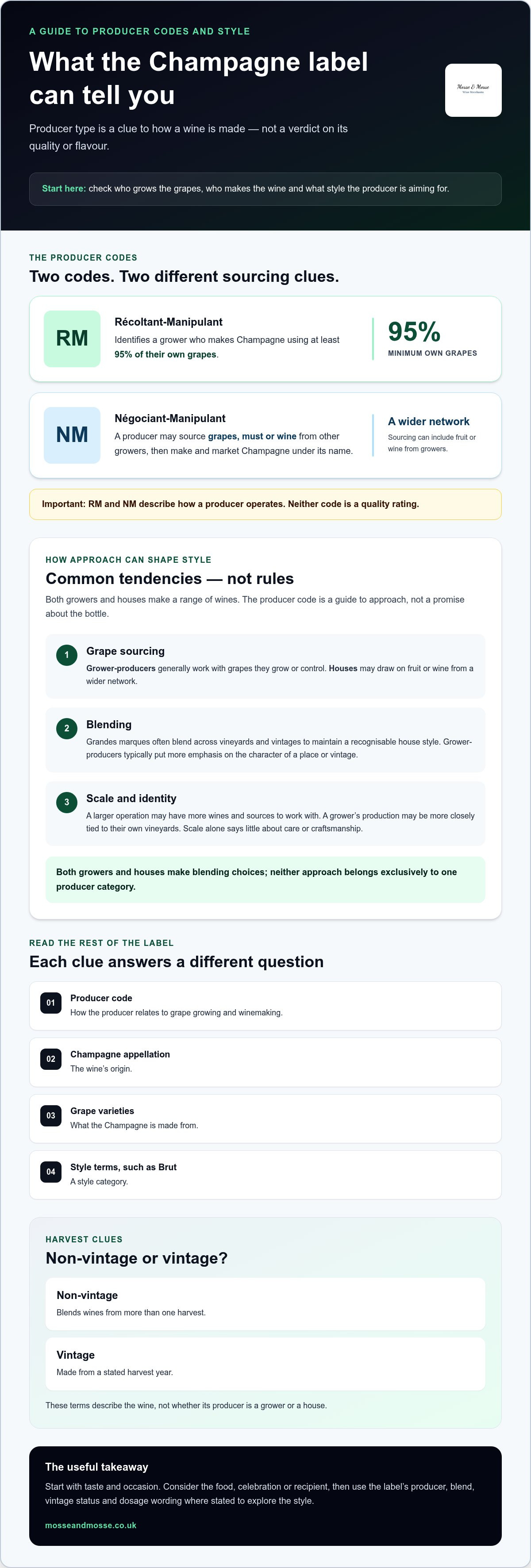
If labels and classifications leave you unsure where to begin, start with the producer code. RM identifies a grower-producer who makes Champagne using at least 95% of their own grapes. NM, the code used by most large houses, allows producers to source grapes, must or wine from other growers. Neither code is a quality rating.
These different approaches can influence a Champagne’s style. Grandes marques often blend across vineyards and vintages to maintain a recognisable house style, whilst grower-producers typically put more emphasis on the character of a particular place or vintage. There’s variation in both camps, so the producer code is a clue, not a verdict on what you’ll enjoy.
This guide explains how to compare the two, what to look for on a bottle and how to choose Champagne for a meal, celebration or gift.
Key Takeaways
- Compare grower Champagne vs big houses by producer approach and your own preferences, not prestige or scale alone.
- Grape sourcing and blending can shape a Champagne’s style, but individual producers don’t always fit the general pattern.
- Start with taste and occasion, then read the label for the producer, blend, vintage status and dosage where stated.
- Ayala Brut Majeur and Bollinger Special Cuvée are examples of house Champagnes that make the comparison more tangible.
Grower Champagne vs big houses: what does the distinction mean?
Grower Champagne is made by a producer who grows grapes and makes wine from them. A larger house is commonly a négociant, which can source grapes, must or wine from other growers. The distinction describes the producer’s role, not the wine’s quality. In the grower Champagne vs big houses comparison, the label helps explain who is behind the bottle, but it can’t tell you by itself whether you’ll enjoy the taste.
Growers grow the grapes; producers make and market the Champagne. It’s a useful starting point, although the roles can overlap. A grower-producer makes wine from grapes they cultivate, whilst a house may own vineyards as well as buy fruit. For more background on the term and its labelling, see this overview of Grower Champagne.
What does grower Champagne mean on a label?
Look for RM, short for Récoltant-Manipulant. This producer classification identifies a grower who makes Champagne from at least 95% of their own grapes. RM describes the producer’s relationship with grape growing and winemaking; it isn’t a tasting note or quality award.
Keep the label’s different clues distinct. The producer code tells you about the business model, the Champagne appellation identifies the wine’s origin, grape varieties describe what it’s made from, and terms such as Brut indicate a style category. Each answers a different question, so none is a shortcut for the others.
What makes a Champagne house different?
NM stands for Négociant-Manipulant. An NM producer may buy grapes, must or wine from growers, then make and market Champagne under its name. Larger houses often blend across vineyards and vintages to maintain a recognisable house style. This can offer continuity from bottle to bottle, but houses don’t all source or blend in the same way.
“Grower” and “big house” aren’t perfect opposites based simply on size. A grower may have a distinctive producer identity, whilst a house may own vineyards and have close relationships with growers. RM and NM describe how a producer operates; neither promises a particular flavour or quality. For a practical look at bottles across the category, explore the Champagne and sparkling wine selection.
How do grower and big-house Champagne styles differ?
Producer type can hint at how a Champagne is made, but it can’t predict the character of every bottle. Vineyard sources, blending decisions and choices in the cellar all matter. Treat the grower Champagne vs big houses comparison as a guide to approach, not a promise of a particular flavour or quality.
- Grape sourcing: Grower-producers generally work with grapes they grow or control; houses may draw on fruit or wine from a wider network. Different vineyard sources can bring different qualities to a blend.
- Blending: A producer may blend across sites or years, or choose a narrower selection. The choice affects the wine’s balance and expression, but neither approach belongs exclusively to one producer category.
- Scale: A larger operation may have more wines and sources to work with, whilst a grower’s production may be more closely tied to their own vineyards. Scale alone says little about care or craftsmanship.
- Producer identity: A grower’s name can draw attention to a particular estate and its choices. A house name may express a style shaped by blending decisions over time.
Can grower Champagne taste different from a house Champagne?
Yes, it can. Vineyard location, grape selection, blending and cellar decisions may all contribute to a wine’s individual expression. A Champagne made from a focused set of vineyard sources may present differently from one assembled across several sites, but that’s a possibility, not a rule. Both growers and houses make wines in a range of styles, so look beyond the producer category for clues about the bottle itself.
How do blending and house style affect the comparison?
Blending gives a producer room to shape a wine’s balance and identity. Some houses aim for a recognisable style from one release to the next; others take a different approach. Grower-producers also make blending choices, and their wines aren’t automatically single-vineyard or vintage-specific. Non-vintage Champagne blends wines from more than one harvest, whilst vintage Champagne is made from a stated harvest year. These terms describe the wine, not whether its producer is a grower or a house.
Producer type can inform style, but it can’t predict every bottle. If you’re choosing Champagne for a meal or celebration, talk with the team about your preferences and occasion to narrow down the style that feels right.
How to choose between grower Champagne and a big house
Start with the occasion, then work back to the bottle. The grower Champagne vs big houses decision is easier when you focus on the style you enjoy and the experience you want to create, rather than using producer size, price or reputation as a shortcut.
- Begin with taste and occasion. For an aperitif or celebration, decide whether you’d prefer a familiar style or the chance to discover a producer whose name is new to you. With a meal, consider how the Champagne will sit alongside the food. For a gift, the recipient’s preferences are a more useful guide than prestige alone.
- Use style clues to narrow the choice. Look for the grape blend and dosage wording where shown. These details help you understand the producer’s choices, although they can’t guarantee exactly how the wine will taste. Think about how you’ll serve it too: a Champagne chosen for a meal may suit a different style from one poured on its own.
- Read the rest of the label. Note the producer name and any producer classification, then check whether the Champagne is vintage or non-vintage and whether blend details are given. Compare bottles individually rather than assuming every grower or house follows the same approach.
Which Champagne suits your palate and occasion?
Would you prefer the reassurance of a familiar house style, or the pleasure of exploring an individual producer? Neither is automatically the better choice. If you know the recipient likes a particular sweetness level or grape blend, use that as a starting point. If you don’t, choose a bottle whose style and occasion feel like a thoughtful fit.
What should you compare on the label?
Start with the producer, then compare any stated blend, vintage information and dosage. Brut and other dosage terms describe sweetness categories, not quality rankings. Read these details together for a more useful basis for choosing than a famous name alone.
For a broader look at Champagne styles and bottles, explore our Champagne and sparkling wine selection. If you’re still deciding, talk with our team about your taste and occasion.
Explore Champagne with a knowledgeable independent merchant
Understanding the difference between grower Champagne and big houses is useful, but the right bottle depends on what you enjoy and the moment you’re marking. An independent merchant can help turn producer names and label details into a practical comparison, without treating one category as automatically superior.
How can a curated selection make the comparison easier?
A focused Champagne range lets you compare producers and styles in context, rather than relying on a label’s reputation alone. Ayala Brut Majeur and Bollinger Special Cuvée are examples of house Champagnes in the Mosse and Mosse range. Compare the details on each bottle, then narrow your choice by taste and occasion, whether you’re planning an aperitif, a meal or a celebration.
A useful recommendation starts with your preferences: the styles you usually enjoy, who’ll be sharing the bottle and what you’re serving. The Champagne and sparkling wine selection is a place to explore the category, whilst label details help you compare individual bottles.
Where can you get help choosing Champagne in Suffolk?
Mosse and Mosse is an independent wine merchant based in Suffolk, serving customers across the UK mainland. Based in Dennington, the business offers a personal perspective for customers choosing Champagne in Ipswich, Norwich, Bury St Edmunds, Sudbury, Stowmarket, Newmarket, Thetford, Diss, Attleborough, Southwold, Aldeburgh, Framlingham, Woodbridge, Long Stratton and Saxmundham. You don’t need to know every Champagne classification before you start; a sense of the style or occasion you have in mind is enough to begin a useful conversation.
Whether you’re selecting Champagne for a special meal, a celebration or a thoughtful gift, share what you enjoy and who the bottle is for. Discuss your Champagne choice with us.
Make your next bottle a personal discovery
Let your next Champagne be a small act of discovery. Rather than deciding that you’re a grower or house drinker, choose a bottle that gives you something to notice: its balance and texture, how it works with food, or how your impression changes as you enjoy it. Those details can tell you more about your preferences than a producer category alone.
Keep a note of what you liked, even if it’s only a few words. Was the Champagne crisp or generous? Did it suit the occasion, or would you choose something different next time? Building your own reference points makes the grower Champagne vs big houses question more personal and gives you a clearer starting point for future choices.
You don’t need to know every term before choosing well. Bring your curiosity and the occasion you’re planning, and start with what you enjoy. Talk with Mosse and Mosse about your Champagne choice.
Frequently Asked Questions
Is grower Champagne better than Champagne from big houses?
No, neither category is inherently better. The grower Champagne vs big houses choice depends on the individual wine and what you enjoy, not the producer code alone. A bottle from a large house may suit you beautifully, whilst a grower’s Champagne may appeal for different reasons. For a fair comparison, consider the bottle’s style and the occasion, then judge it by what’s in the glass.
What does RM mean on a Champagne label?
RM stands for Récoltant-Manipulant, a Champagne producer classification associated with a grower who makes wine using at least 95% of their own grapes. It helps identify the producer’s relationship to grape growing and winemaking, rather than describing flavour or quality. Treat RM as useful background when comparing bottles, not as a guarantee that you’ll prefer the Champagne to one made by a house.
Can grower Champagne be non-vintage?
Yes. Non-vintage describes a Champagne that blends wines from more than one harvest; it doesn’t tell you whether the producer is a grower or a house. A grower can make non-vintage Champagne, just as a house can make Champagne from a stated vintage. “NV” on a label indicates non-vintage status, whilst the producer’s classification is a separate clue to who made it.
Are Champagne houses more consistent than grower producers?
Not necessarily. Some houses aim for a recognisable style across releases, but this is a choice, not a certainty, and each producer works differently. Growers can also seek continuity in their wines, whilst harvest conditions and blending decisions may bring variation from one release to another. If you value a familiar profile, use a producer’s previous bottles as a guide, while allowing for differences between releases.
How do I choose a Champagne for a celebration or meal?
Start with the food, occasion and guests’ preferences, then use the bottle’s grape blend and dosage as clues to style. For a meal, consider whether you want Champagne alongside the dishes or served beforehand. For a celebration, think about the sweetness level your guests tend to enjoy. Customers choosing Champagne around Ipswich, Norwich, Bury St Edmunds, Sudbury, Stowmarket, Newmarket, Thetford, Diss, Attleborough, Southwold, Aldeburgh, Framlingham, Woodbridge, Long Stratton and Saxmundham can use the same approach.
Is grower Champagne always made from the producer’s own grapes?
No, not entirely. The RM classification means at least 95% of the grapes used are the producer’s own, so it doesn’t necessarily mean every grape was grown by that producer. RM signals a grower-producer model, but shouldn’t be taken to mean that every bottle is made exclusively from estate-grown fruit.


