

The answer to why Burgundy wine is so expensive lies in the tension between small, fragmented vineyards and demand from around the world. Burgundy produces 200 million bottles of wine each year, yet nearly one in two is exported, and England accounts for 17% of exported volume. The most sought-after wines come from limited plots, so even strong demand cannot quickly bring more bottles to market.
It’s understandable to wonder whether a Burgundy label alone explains the price. The fuller picture is more interesting: vineyard ownership is divided among many growers, production can be small, and wines from the region compete for attention in international markets. This article explains how those forces work together, why vintage conditions can add pressure, and what to consider when choosing a Burgundy to enjoy. Not every bottle has the same scarcity or appeal, and Burgundy offers a wide range of wines.
Key Takeaways
- Understand how vineyard parcels divided among many growers can limit the amount of wine available from an individual site.
- See why frost and other vintage conditions can sharply reduce yields and put pressure on prices.
- Use Burgundy’s four quality tiers, from Regional to Grand Cru, to make sense of the differences between wines.
- Recognise that international interest adds to competition for bottles from sought-after vineyards.
- When choosing a bottle, consider its appellation, producer and vintage together rather than relying on prestige alone.
Small, fragmented vineyards and limited production
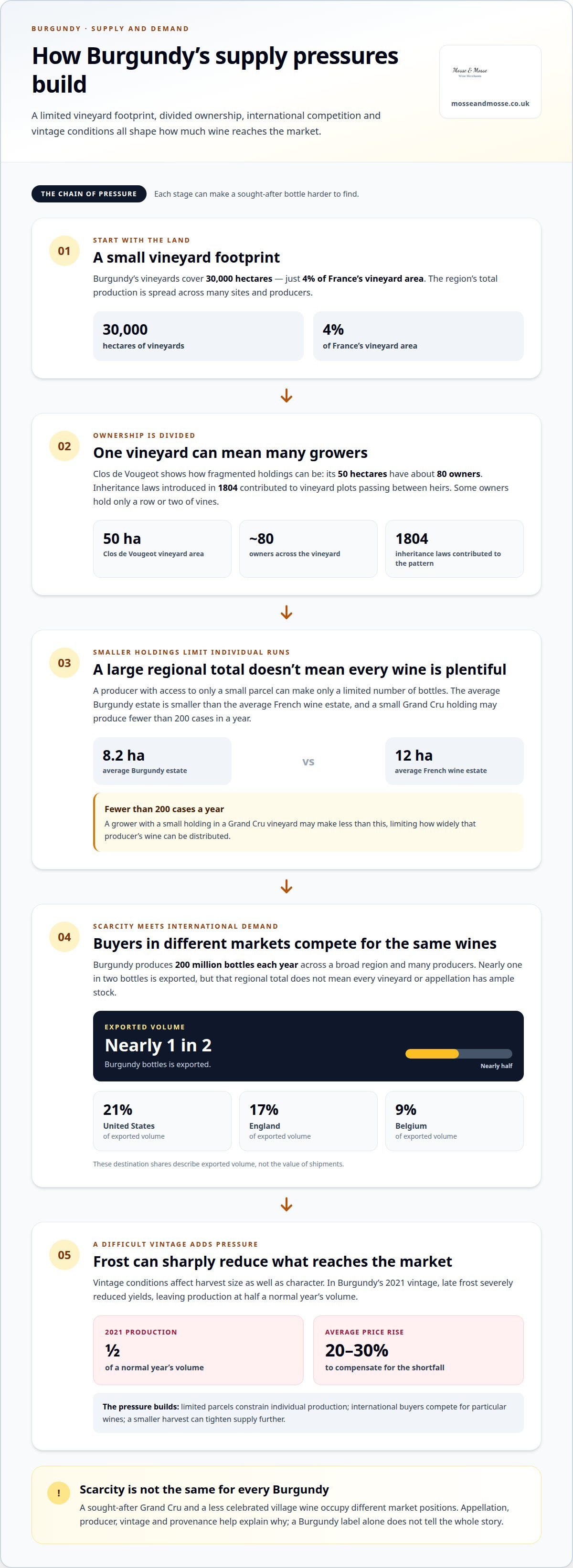
Burgundy’s vineyards cover 30,000 hectares, just 4% of France’s vineyard area. That limited footprint is divided among numerous growers, restricting the supply of individual wines.
Fragmented vineyard holdings
Fragmented holdings mean a vineyard is divided among separate owners rather than managed as one large estate. When a vineyard is divided among owners, an individual producer may have access to only a small parcel, which can limit the number of bottles they make.
Clos de Vougeot illustrates the scale of the division: its 50 hectares have about 80 owners. Napoleonic inheritance laws introduced in 1804 contributed to this pattern, as vineyard plots passed between heirs. Some owners hold only a row or two of vines, making each producer’s harvest and bottling run small.
The average Burgundy wine estate covers 8.2 hectares, compared with 12 hectares for a French wine estate. A grower with a small holding in a Grand Cru vineyard may produce fewer than 200 cases per year. That scale limits how widely a particular producer’s wine can be distributed.
Limited supply and global demand
Limited supply meets international demand when buyers compete for wines from particular villages and vineyards. Nearly one in two Burgundy bottles is exported, and England accounts for 17% of exported volume. This competition can make bottles from sought-after producers harder to find in the UK.
Burgundy produces 200 million bottles each year, but that total covers a broad region and many producers. It doesn’t mean every vineyard or appellation has ample stock. A small parcel of Gevrey or Chambertin, for example, cannot expand its output simply because interest rises. Mineral character and reputation may attract buyers, but the vineyard’s area still sets a physical limit.
Classified vineyard land prices
Classified vineyard land commands interest because its designation is tied to a specific site and reputation. Premier Cru vineyards account for 10% of Burgundy’s vineyard area, while Grand Cru vineyards account for 1%. That scarcity helps explain why classified plots can attract higher values than less prestigious land, although a direct price comparison with other wine regions depends on the land and classification being compared.
Romanée-Conti has no single price across all bottles: vintage, producer and provenance shape what collectors will pay, placing it at the rarefied end of the market.
Classification can also shape perceptions of a site. The label signals vineyard status, but the bottle’s price also reflects limited production and demand.
Burgundy wine exports and international demand
Burgundy’s reputation reaches well beyond France, connecting domaines with buyers in several markets. Bottles from a particular producer or appellation are divided between domestic and overseas customers, so international demand can affect how readily a sought-after wine appears at UK retailers.
The export destinations show how widely Burgundy is sought. The United States accounts for 21% of exported volume, whilst Belgium accounts for 9%. These figures describe volume, not the value of each shipment. They also show why demand isn’t shaped by one market alone: buyers in different countries compete for wines from the same region and producers.
Collector interest adds another layer. Names such as Domaine de la Romanée-Conti have international recognition, and buyers may seek specific vineyards, producers or vintages rather than Burgundy in general. That focus concentrates attention on a narrow range of wines, so a bottle with a strong reputation may attract more competition than another from the same region.
The Winedex Burgundy Index for the 40 most expensive wines rose by 359% between 2013 and 2023. This index tracks a defined group of high-priced wines, not every bottle from Burgundy. It illustrates how the top end can respond to collector demand and market attention, but it shouldn’t be treated as a guide to the movement of all regional, village or Premier Cru wines.
Terroir gives collectors another reason to distinguish between wines. The term describes how a vineyard’s location and growing conditions influence the wine. In Burgundy, Chardonnay from one site can express itself differently from Chardonnay grown elsewhere. This site-specific identity, combined with a domaine’s reputation, gives buyers more to pursue than a grape variety or regional name.
For UK buyers, the practical point is to distinguish broad regional demand from demand for a particular label. Burgundy’s international profile doesn’t make every wine equally scarce or sought after. A well-known Grand Cru and a less celebrated village wine occupy different market positions, even though both come from Burgundy. Producer, appellation, vintage and provenance help explain why.
International attention can make established names more competitive to buy, particularly when collectors seek specific bottles. But not every Burgundy is aimed at collectors, and reputation alone does not determine quality. Compare the appellation and producer to understand a wine’s standing, and stay open to lesser-known producers for another perspective on the region.
Why are Burgundy wines so expensive?
Vintage variation can put further pressure on Burgundy’s already limited supply. Climate conditions influence both the size and character of a harvest, changing what reaches the market.
Climate challenges and vintage variation
Vintage variation means that weather gives each harvest different growing conditions and yields. Burgundy’s 2021 vintage shows how sharply this can affect supply: late frost severely reduced yields, leaving production at half a normal year’s volume. Prices rose by an average of 20 to 30% to compensate for the shortfall, showing how a difficult harvest can affect buyers as well as growers.
A poor yield doesn’t automatically mean poor wine, just as a larger harvest doesn’t guarantee excellence. Conditions influence how much fruit producers can work with, while the vintage’s character depends on how the season unfolded. Burgundy’s exceptionally warm 2009 vintage offers a contrast to frost-hit 2021: the same region can produce markedly different styles and volumes across vintages.
That variation matters when comparing a village wine with a Premier Cru or Grand Cru. A small harvest from a prized appellation can intensify competition for its bottles. Montrachet, for example, is a Grand Cru name associated with white Burgundy, but its reputation does not override the effects of vintage or production volume.
White Burgundy also shows why vintage choice deserves attention. The 2022 vintage is identified as exceptional, while 2019 is described as ripe and precise. These descriptions help explain why buyers may seek one year’s style over another, rather than treating every recent release as interchangeable.
Producer reputation and wine prices
Producer reputation, vintage and scarcity work together. A recognised domaine can attract stronger demand, while a small harvest limits the bottles available. This combination helps explain why two wines from the same appellation can occupy different price positions, even when both carry the same village or Grand Cru designation.
Reputation isn’t a substitute for examining the vintage. A producer may be highly regarded, but frost-reduced yields in 2021 still meant less wine to sell. Conversely, a less celebrated producer can offer a rewarding bottle when the vintage and site align, so the famous name alone doesn’t tell you what’s in the glass.
For value, consider vintages that receive less attention. The 2014 white Burgundy vintage has been identified as a sleeper year, with strong value for bottles in their drinking window. The 2017 vintage has also been described as underrated. Looking beyond headline years can broaden your choices, particularly if you’re exploring village-level wines rather than chasing a famous Montrachet.
Why Burgundy wine is expensive
The question of why Burgundy wine is so expensive has no single answer. Its price reflects a combination of vineyard identity, classification, production choices and demand. Burgundy has over 400 documented soil types, giving winemakers many distinct sites to interpret. The result is a region where appellation and producer can matter as much as grape variety.
An appellation identifies where a wine comes from and the rules associated with that place. Burgundy has exactly 100 AOCs, while its wines sit within four tiers: Regional, Villages, Premier Cru and Grand Cru. These distinctions help buyers understand origin and status. They don’t make every bottle within a tier identical, since producer and vineyard still shape its character.
Consider the difference between Bourgogne and Meursault. Bourgogne wines can draw on grapes from across the region, while Meursault is a village appellation in the Côte de Beaune. A vineyard designation makes the origin more precise, but also ties the wine’s identity to a particular place. The label therefore tells buyers more than the grape variety alone.
Classification adds another layer. Premier Cru and Grand Cru identify vineyards with recognised status, and their limited area can heighten interest. For top Burgundy premiers crus and grands crus, yields can be 35-40 hectolitres per hectare. Yield describes the volume of wine produced from vineyard land. Lower output from a sought-after site can mean fewer bottles available to meet demand.
Climate shapes what winemakers can produce, though its effects vary between vineyards and years. A site’s soil, aspect and growing conditions influence the grapes, while the grower’s choices shape the finished wine. Burgundy’s varied soils help explain why neighbouring plots can produce distinct profiles, even when both are planted with Chardonnay or Pinot Noir.
When comparing labels, treat classification as a guide, not a guarantee that you’ll like the wine. A Grand Cru may carry greater status, but a well-made village wine may better suit a particular meal or palate. Bourgogne can also introduce you to the region, since it indicates a broader origin than a single named village.
Price pressure comes from several factors working together: a defined appellation, recognised classification, limited yields and a producer’s or site’s reputation. No single label explains every difference. Compare the appellation, classification and vintage for a clearer picture of what shapes a bottle’s market position.
If you’re weighing up Burgundy’s classifications and styles, talk through your wine choices with a specialist.
Mosse and Mosse: Champagne & Sparkling Wines
Mosse and Mosse also offers Champagne and sparkling wines for readers looking beyond Burgundy’s still wines. If you’re choosing a bottle for a celebration or exploring different styles, sparkling wine offers another way to discover France’s varied wine traditions. The range also includes white wine, giving you other styles to explore without focusing solely on Burgundy’s most sought-after appellations.
Understanding why Burgundy bottles command attention can help you decide what matters most: a particular producer, vineyard, vintage or simply a wine you’ll enjoy sharing. Mosse and Mosse offers wines for different occasions and preferences, including red and rosé wines.
For help choosing a wine to suit your occasion, contact Mosse and Mosse.
Choose your next bottle with confidence
Understanding why Burgundy wine is so expensive is a useful starting point, but the most rewarding choice is one that suits your taste, table and occasion. Rather than treating prestige as the only measure, consider what you want from the wine: something lively to enjoy now, a distinctive bottle to share, or a wine whose story captures your interest.
That approach turns a price puzzle into a personal exploration. Follow a style you already enjoy, discover an unfamiliar producer or choose another region. The aim isn’t to chase the most famous name; it’s to find a wine you’ll be glad to open and share.
There’s no single right route through the world of wine. Your preferences can change with the food, company and occasion, and each bottle can offer something new to appreciate. Let curiosity guide your next choice and focus on the pleasure it brings to your table.
For help deciding what to explore next, contact Mosse and Mosse. A little guidance can make your next bottle all the more enjoyable.
Frequently Asked Questions
Bordeaux has over 120,000 hectares under vine, giving buyers a much broader pool of wines and producers. A Médoc château can cover 70 hectares, a scale that contrasts with Burgundy’s small vineyard parcels. That difference helps explain why Bordeaux petits châteaux can offer more choice at lower price points.
Why is Meursault so expensive?
Meursault’s price reflects its recognised village appellation, producer reputation and demand for its white wines. The name identifies a specific origin rather than a broad regional Burgundy, and buyers may seek particular vineyards or domaines within it. Vintage and availability also shape a bottle’s price. When comparing Meursault, consider the producer and vintage alongside the appellation: the village name alone doesn’t make every bottle equivalent.
Why is Burgundy wine so expensive?
Why Burgundy wine is so expensive comes down to the value buyers place on specific origins and producers. A bottle can represent a particular appellation, vineyard and vintage, not simply Pinot Noir or Chardonnay. That specificity attracts drinkers and collectors, while limited quantities make popular labels harder to replace. Burgundy spans a wide range of wines, so its most prestigious bottles don’t represent every price or style.
How do small vineyard plots and limited production affect Burgundy wine prices?
Small plots limit how much wine a producer can make from an individual vineyard. A grower with only a small parcel cannot increase production to meet rising demand for that wine. Each producer’s release therefore differs in quantity and availability. If a bottle sells out, another from the same site may not appear until a later vintage, making the producer and vineyard name important details for buyers.
How do Burgundy’s appellation and classification rules influence wine prices?
Burgundy’s appellation and classification labels distinguish broad regional wines from village, Premier Cru and Grand Cru origins. This hierarchy helps buyers understand a wine’s stated place and vineyard status, and can influence demand, particularly for recognised sites. Classification doesn’t guarantee that a wine will suit every palate. Comparing producer, vintage and exact appellation gives a more useful picture than relying on classification alone.
What are the differences in price between Burgundy regional, village, Premier Cru and Grand Cru wines?
Prices can rise across the hierarchy, but producer and vintage also matter. These are examples for named wines, not fixed prices for every bottle at each level. Regional Burgundy has a broader origin and varies by producer.


