

Crémant de Bourgogne is a useful choice when you want French sparkling wine with a clear sense of place. The grapes and production area shape its style, so the label tells you more than whether the wine is white or rosé. If you’re choosing between blanc and blanc de blancs, the grape composition is the key distinction.
It’s easy to see why the choice can feel confusing. Crémant de Bourgogne and Champagne share grape varieties and a traditional production method, but their origins and appellations differ. Pinot Noir can bring structure and finesse, while Chardonnay contributes freshness and, with ageing, subtle brioche, butter and hazelnut notes.
This guide explores the grapes and areas behind Crémant de Bourgogne, compares its production with Champagne, and introduces wines to try. You’ll also find practical clues for choosing between blanc de blancs, blanc de noirs and rosé, helping you select a bottle to suit your taste and occasion.
Key Takeaways
- Use the grape blend to understand the style: Pinot Noir can bring structure, whilst Chardonnay often contributes freshness and subtle savoury notes.
- Read “blanc de blancs” and “blanc de noirs” as clues to the grapes used, not just the wine’s colour.
- Discover how Burgundy’s different production areas can shape sparkling wines from fresh and crisp to rounder and fuller.
- Learn why the traditional method links these wines with Champagne, while their origin and character remain distinct.
- Explore recommended bottles by style and tasting notes to find a sparkling wine that suits your palate and occasion.
Regional grape varieties and production areas
Grape choice gives each French sparkling wine its own character, while the region helps explain its style. On a bottle of Crémant de Bourgogne, grape names and terms such as “blanc de blancs” offer useful clues before you pour.
Grape varieties across Crémants
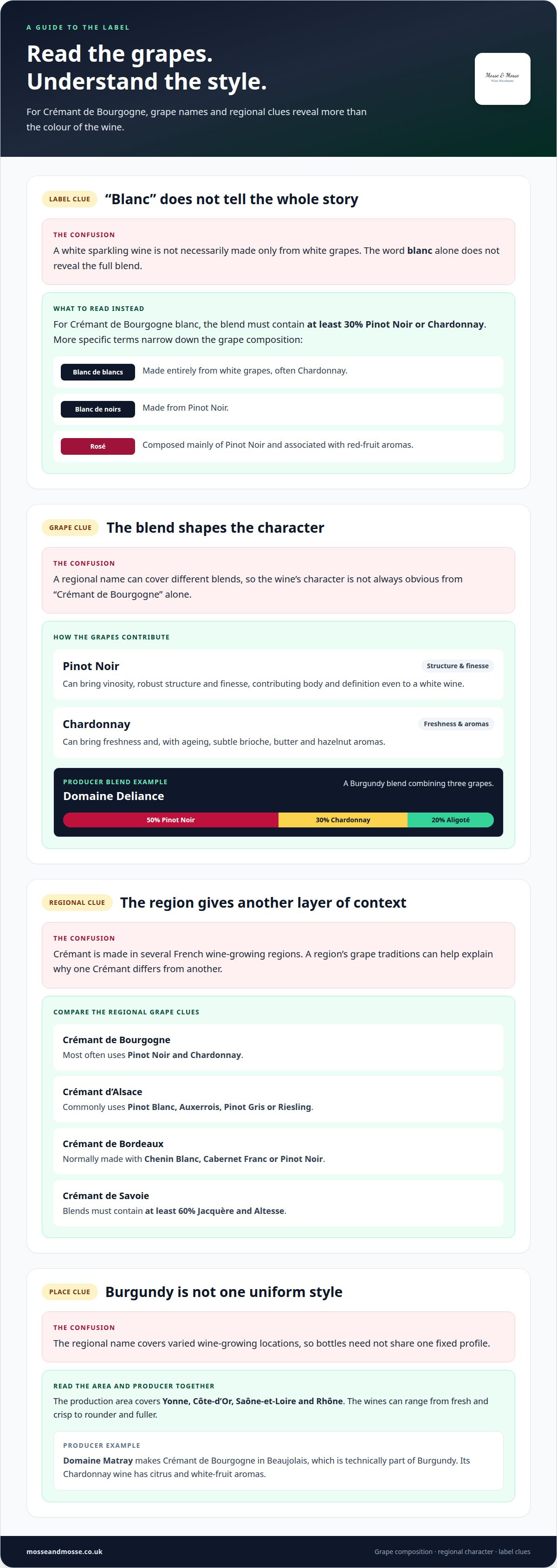
Crémant is produced in seven French wine-growing regions, each with its own grape traditions. Crémant de Bourgogne most often uses Pinot Noir and Chardonnay, whereas Crémant d’Alsace commonly uses Pinot Blanc, Auxerrois, Pinot Gris or Riesling. The regional name is a practical starting point when comparing sparkling wines.
Other regions show the range of styles. Crémant de Bordeaux is normally made with Chenin Blanc, Cabernet Franc or Pinot Noir. Crémant de Savoie blends must contain at least 60% Jacquère and Altesse. In Burgundy, Pinot Noir can give the wine vinosity, robust structure and finesse. It can therefore contribute body and definition, even when the finished wine is white.
Chardonnay and blanc composition
Chardonnay is a white grape that can bring freshness and develop subtle brioche, butter and hazelnut aromas. For Crémant de Bourgogne blanc, the blend must contain at least 30% Pinot Noir or Chardonnay. The word “blanc” alone, then, doesn’t tell you the full blend or mean that every grape is white.
More specific label terms narrow it down. Blanc de blancs is made entirely from white grapes, often Chardonnay; blanc de noirs is made from Pinot Noir. Rosé is composed mainly of Pinot Noir and is associated with red-fruit aromas. Domaine Deliance illustrates the flexibility of Burgundy blends: its wine combines 50% Pinot Noir, 30% Chardonnay and 20% Aligoté. The proportions give you a clearer idea of what lies behind the regional name.
Regional production areas
The production area for Crémant de Bourgogne covers Yonne, Côte-d’Or, Saône-et-Loire and Rhône. These parts of Burgundy include varied wine-growing locations, helping explain why the wines can range from fresh and crisp to rounder and fuller. The appellation encompasses different expressions rather than one uniform house style.
Beaujolais also belongs in this regional picture because it is technically part of Burgundy. Domaine Matray produces Crémant de Bourgogne there using Chardonnay, with citrus and white-fruit aromas. When comparing bottles, consider both the grape wording and the producer or area name. Together, they help distinguish a Chardonnay-led profile from a Pinot Noir blend and reveal more about the wine’s regional character.
Crémant de Bourgogne appellation and production area
Crémant de Bourgogne is a French appellation for white and rosé sparkling wines, created in October 1975. Its production area covers Yonne, Côte-d’Or, Saône-et-Loire and Rhône, giving this Burgundy wine a defined regional identity.
Production rules and vineyard requirements
Production rules connect the appellation to declared vineyard parcels and specific methods, helping buyers understand a bottle’s origin. Producers must declare vineyards for Crémant before the end of March. Burgundy has 11,000 parcels declared for Crémant, covering 2,500 hectares.
For Crémant de Bourgogne, grapes are hand-picked in whole bunches, and the second fermentation takes place inside the bottle. Éminent wines require 24 months of extended ageing after that fermentation. Grand Éminent requires 36 months of extended ageing, plus three months in bottle. These categories identify wines with distinct ageing requirements.
Regional and producer styles
Location and producer choices give Crémant de Bourgogne a range of styles, from fresh and crisp to rounder and fuller. The region’s stated ageing capacity is three to five years, while the Éminent categories have longer ageing requirements.
For food, pair blanc de blancs with fish or scallops, and blanc de noirs with meat or poultry. Rosé suits red-fruit desserts, ice cream, sorbets and petits-fours. Serve the bottle well chilled, and store it somewhere cool and dark, away from temperature changes. Champagne, by comparison, can only be produced within the Champagne appellation’s geographical area. Crémant de Bourgogne is a regional alternative, not Champagne under another name.
Production figures show how the category expanded: when Pierre du Couëdic was appointed in 2001, average annual Crémant de Bourgogne production ranged from 60,000 hl to 70,000 hl; by 2016, production reached 152,515 hl. The bottle-fermentation method also depends on adding yeasts and sugar, which generate the second fermentation inside the bottle.
Regional boundaries can make room for unexpected producers. Domaine Matray can produce Crémant de Bourgogne because Beaujolais is technically part of Burgundy. Together, these points show how production scale, method and geography shape the category, while its identity remains tied to Burgundy. The increase sits alongside the appellation’s defined production rules and regional character.
Sparkling wine or Champagne?
The closest comparison is with Champagne: Burgundy’s sparkling wines share grapes and vinification methods with it. The distinction is origin. Champagne refers to wine from the Champagne appellation, while the Burgundy name identifies a different French region.
Both wines use the traditional method, also known as méthode champenoise. A second fermentation takes place in the bottle, creating the bubbles, and both use the same pressing method. These shared techniques explain why Burgundy sparkling wine can feel familiar to Champagne drinkers, but the appellations aren’t interchangeable.
Grape choice creates another point of comparison. Chardonnay and Pinot Noir are used in both regions, so a blanc de blancs made from white grapes can offer a familiar reference point. Yet the words on the label describe grape composition, not Champagne origin. A bottle labelled blanc de blancs from Burgundy remains a Burgundy wine, even if its grapes and method echo Champagne.
Champagne grapes are harvested by hand as required by its AOC. Burgundy’s sparkling wine production also uses hand-picked, whole bunches, making harvesting another point of similarity. The regional names still matter: the growing area determines which appellation the wine can carry, while the producer’s choices shape the blend and resulting style.
For a buyer, this means the choice isn’t simply “Champagne or an imitation”. Burgundy offers a distinct regional expression made with a closely related approach. Identified as the Crémant most similar to Champagne, it’s a useful option if you enjoy shared grapes and vinification but want to explore another French appellation.
Other Crémants show why origin is a reliable guide to style, rather than a synonym for one method. Crémant de Bordeaux, for example, is normally made with Chenin Blanc, Cabernet Franc or Pinot Noir. Those grapes differ from the typical Burgundy pairing, even though both wines belong to France’s sparkling-wine family. A domaine’s name can add another clue, but the region and grape terms offer the clearest starting point.
Compare labels in this order: identify the region, note whether the wine is blanc de blancs or another style, then look at the named grapes. This simple approach separates shared production techniques from regional identity. It also helps explain why two sparkling wines can use the same method yet have different aromas, blends and appellation names.
Recommended Crémant de Bourgogne wines
For a first bottle, start with the grapes and tasting notes, then choose a style to suit your palate. Three useful names to explore are Crémant de Bourgogne Brut Cave des Grands Crus Blancs, Cave de Lugny Crémant de Bourgogne Blanc de Blancs NV and Domaine Deliance Crémant de Bourgogne.
For Chardonnay’s character: Crémant de Bourgogne Brut Cave des Grands Crus Blancs is made entirely from Chardonnay. Its notes of ripe peach, pear and apple sit alongside bready, yeasty aromas and a creamy, toasty core. This is a clear choice for readers drawn to white-fruit flavours with savoury, developed detail. The wine is listed at 12% alcohol and as suitable for vegetarians and vegans.
The Cave des Grands Crus Blancs bottling is a focused example of what a Chardonnay-led sparkling wine can offer. Choose it if you want to explore fruit and texture in the same glass, rather than relying on the label alone. Peach, pear and apple notes provide the fruit; yeasty and toasty character adds another layer. These tasting cues make it easier to decide whether the style fits your preferences.
For a blanc de blancs comparison: Cave de Lugny Crémant de Bourgogne Blanc de Blancs NV offers another way to explore white-grape sparkling wine. “Blanc de blancs” identifies a wine made entirely from white grapes, often Chardonnay. The name makes this bottle useful to compare with Cave des Grands Crus Blancs, whose Chardonnay composition is explicit.
For a broader blend: Domaine Deliance Crémant de Bourgogne combines 50% Pinot Noir, 30% Chardonnay and 20% Aligoté. That blend makes it a contrasting pick beside an all-Chardonnay wine. Pinot Noir contributes structure and finesse, while the Chardonnay and Aligoté give the blend a different balance. Its non-vintage designation also makes the label worth noting when comparing bottles.
Use these examples to make the choice practical. Pick Cave des Grands Crus Blancs for its stated peach, pear, apple and toasty notes. Choose Cave de Lugny to explore a blanc de blancs label, or Domaine Deliance to compare a three-grape blend. Chenin Blanc and Cabernet Franc point towards sparkling wines from Bordeaux, signalling a different regional style rather than another Burgundy recommendation.
Ready to choose a bottle for your table or occasion? Talk with us about choosing a sparkling wine.
Mosse and Mosse: Red Wine
Mosse and Mosse can help you explore French wine beyond this guide, whether you’re choosing sparkling wine for a celebration or white wine for the table. Its Champagne & Sparkling Wines selection offers different sparkling styles, while the white wine range gives you another direction when planning a meal.
If you’re drawn to Burgundy, consider how a bottle’s grapes, region and tasting notes suit your occasion. Those same clues can guide choices across sparkling and still wines, from a fresh aperitif to a wine served with dinner. Explore Mosse and Mosse’s selection, or get in touch to discuss your wine choices.
Choose a bottle for your next occasion
Let the occasion guide your next choice: sparkling wine to open with friends, or still wine to bring to the table. Exploring Crémant de Bourgogne can also lead you to other French styles, with grape, region and flavour offering useful clues as you decide what to pour.
Mosse and Mosse brings together Champagne & Sparkling Wines, white wine and red wine for different occasions and tastes. If you’re choosing a bottle to complement a meal or mark a celebration, get in touch to narrow down the style that feels right.
Contact Mosse and Mosse to discuss your wine choices, and enjoy discovering a bottle that makes the occasion your own.
Frequently Asked Questions
Blanc, Blanc de blanc?
“Blanc” identifies a white sparkling wine, while “blanc de blancs” specifies that it comes entirely from white grapes. On a label, the second term gives you a more precise clue about grape composition. For example, a Chardonnay blanc de blancs offers a focused way to explore this white-grape style. Check the producer’s description for the grape details, as the broader word “blanc” alone doesn’t tell you the full blend.
Does it spritz?
Yes, Crémant de Bourgogne is sparkling, with bubbles rather than the gentle fizz of a still wine. Carbon dioxide escapes as bubbles when the bottle is opened. For a simple serving idea, pour it as an aperitif before dinner or serve it to start a celebratory meal. Its sparkle suits a toast, while its regional character gives curious drinkers something to explore beyond the bubbles.
How much does a good Crémant cost?
There isn’t one fixed cost for a good bottle; the producer, grape blend, ageing and style all influence its position. A straightforward non-vintage wine and a bottle given longer ageing can represent different choices. For a UK purchase, compare like with like: check the appellation, producer and ageing category, then consider the style you want. That gives you a more useful basis for judging value than the word “Crémant” alone.
Is it a serious Champagne rival?
Yes, it can be a compelling alternative for drinkers who value traditional-method sparkling wine, but it isn’t Champagne. The two regions have their own appellations and identities, even when grapes and production techniques overlap. Assess each bottle on its own merits: consider the producer, blend and tasting notes, then choose for the occasion and your palate. A rival needn’t be identical to offer a satisfying glass in its own right.
Which Crémant is closest to Champagne?
Crémant de Bourgogne is identified as the Crémant most similar to Champagne. Shared grape varieties and vinification help explain the comparison, making it a natural starting point if you enjoy Champagne’s traditional-method style. The wines still come from different appellations, so expect regional character rather than an exact match. A bottle’s producer and blend can help you decide which expression best suits your taste.
How is Crémant de Bourgogne made?
It’s made using the traditional method: after the base wine is prepared, a second fermentation happens inside the bottle, producing bubbles. Yeast and sugar are added to generate this fermentation. The grapes are hand-picked in whole bunches, and pressing follows the same method as Champagne. The result is sparkling wine made through bottle fermentation, rather than carbonation added directly to the finished wine.


