

Understanding sulphites in wine starts with two useful facts: yeast produces small amounts during fermentation, so all wine contains some, and a label must say “contains sulphites” when the level is above 10 parts per million. Sulphites help protect wine from oxidation and spoilage, but some people, particularly those with asthma, can react to them. Evidence does not establish sulphites as the cause of wine headaches.
It’s understandable to check the label if wine seems to affect how you feel, or if “sulphite-free” sounds like a simple solution. This guide explains what sulphites do, which health concerns are recognised and what the evidence says about headaches. It also clarifies “sulphite-free” and “preservative-free” claims, helping you understand what they mean and choose wine more confidently.
Key Takeaways
- Yeast naturally produces sulphites during fermentation, so wine can contain them even when none have been added.
- In the UK, a wine label must say “contains sulphites” when the level is more than 10 parts per million.
- The European Food Safety Authority (EFSA) sets an acceptable daily intake of 0.7 mg per kilogram of bodyweight per day.
- Wine headaches aren’t established as being caused by sulphites; other factors may help explain why people feel unwell after drinking.
- “Sulphite-free” doesn’t necessarily mean zero sulphites: the term is defined as no more than 10 mg/l total sulphites and 5 mg/l free sulphites.
What are sulphites in wine and are they bad for you?
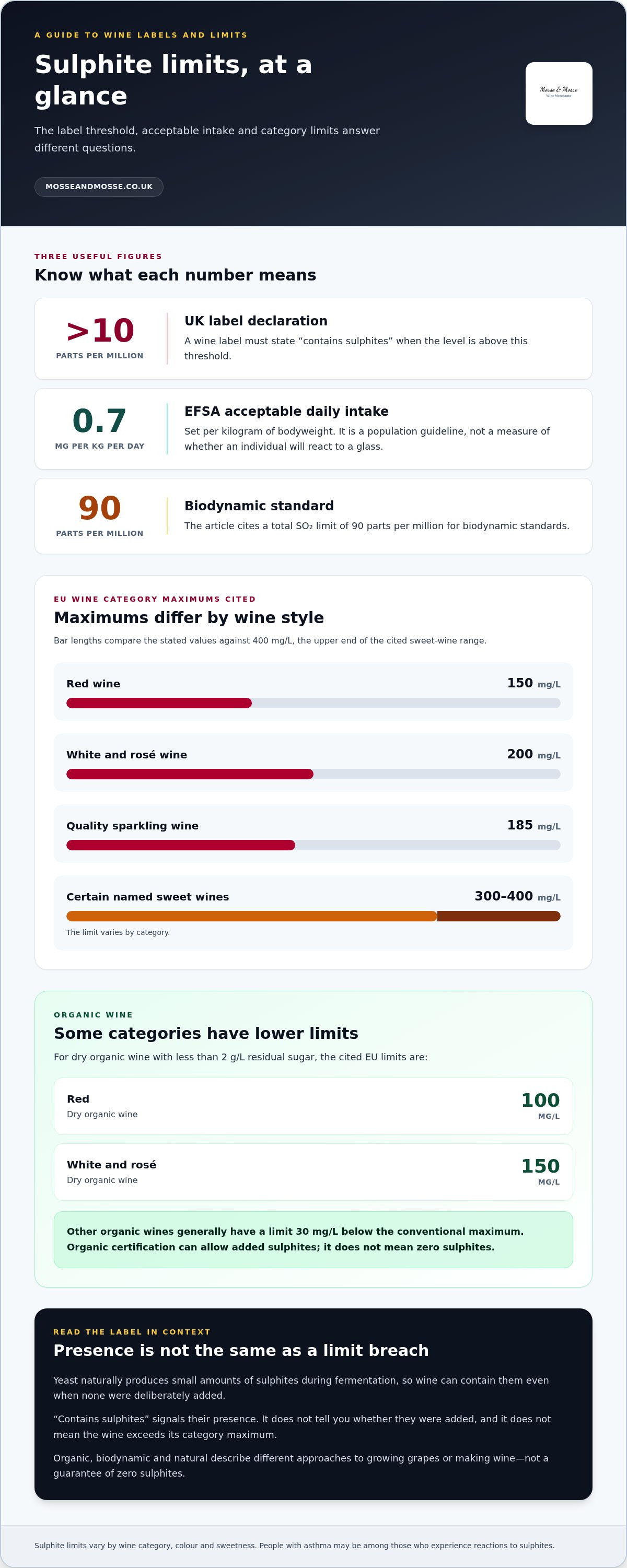
For UK readers, the sulphite declaration threshold is more than 10 parts per million. Category limits differ: EU wine standards set maximums of 150 mg/l for red wines and 200 mg/l for white and rosé wines.
Sulphites include sulphur dioxide and related compounds, used in wine to help limit oxidation and spoilage. Some people, particularly those with asthma, may experience reactions. The European Food Safety Authority (EFSA) sets the acceptable daily intake at 0.7 mg per kilogram of bodyweight per day. This is a population guideline, not a measure of whether an individual will react to a glass.
Fermentation naturally produces sulphites, so wine can contain them even when the winemaker hasn’t added any. “Sulphite” is also commonly spelled “sulfite”; both terms refer to the same group of compounds.
Sulphites in organic, biodynamic and natural wines
Organic, biodynamic and natural describe different approaches to growing grapes or making wine, not a guarantee of zero sulphites. Organic wines have stricter sulphite limits than conventional wines, while biodynamic standards set their own limits. Natural wines often have little or no added sulphur dioxide, but may be more sensitive to storage conditions. These distinctions help when comparing labels or looking for wine with less added preservative.
Added sulphites in organic wine
Organic wine can contain added sulphites under European legislation. Organic certification therefore does not mean that a producer has avoided sulphur dioxide entirely. It means the wine must meet the applicable organic production rules and limits. If you’re trying to reduce added sulphites, it’s important to distinguish “organic” from “no added sulphites”: the terms don’t mean the same thing.
Sulphite limits for organic wine
For dry organic wine with less than 2 g/L residual sugar, the cited EU limits are 100 mg/L for red and 150 mg/L for white and rosé. Other organic wines generally have a limit 30 mg/L below the conventional maximum. Organic wine rules can allow added sulphites, though limits vary. Biodynamic standards set total SO₂ at 90 parts per million. These limits vary by category, so colour and sweetness both matter.
UK legal limits for wine sulphites
For wine sold in the UK, labels must state “contains sulphites” when the wine contains more than 10 parts per million. The category maximums cited for EU wine are 150 mg/l for red, 200 mg/l for white and rosé, and 185 mg/L for quality sparkling wine. Certain named sweet wines have limits ranging from 300 to 400 mg/L, depending on category. A label declaration signals the presence of sulphites, not that the wine exceeds its category limit.
Organic certification changes the permitted maximum; it doesn’t remove sulphites altogether. A dry organic red and a sweet wine, for example, fall under different limits. When considering health concerns, distinguish a regulated label declaration from personal sensitivity. The amount of sulphites in a wine and an individual reaction are separate questions.
What sulphites are and their role in winemaking
Sulphites are a family of sulphur-based compounds used to protect wine. Their use helps winemakers manage oxidation, unwanted microbes and stability from fermentation through to bottling.
What sulphites are
Sulphites is the general name for sulphur dioxide and related compounds found in wine. Yeast naturally produces small amounts during fermentation, and winemakers can also add sulphur dioxide at particular stages. This means wine can contain sulphites even when none were deliberately added. On a label, “contains sulphites” indicates their presence, not how they entered the wine.
Sulphur dioxide exists in different forms, including free and bound SO₂. Free SO₂ is the portion available to protect wine, while some sulphur dioxide binds with other wine components. This balance helps explain why a single total figure doesn’t describe every wine’s preservative effect. Acidity matters too: at pH 3.5, wine has about twice as much molecular SO₂ as at pH 3.8 when total free SO₂ is the same.
Sulphites’ role in winemaking
Winemakers use sulphites mainly to limit oxidation and help prevent spoilage. Oxygen can alter a wine’s colour and aromas, while unwanted bacteria can affect its flavour or stability. Sulphur dioxide helps manage these risks and protect the qualities the winemaker wants to preserve. It’s a practical winemaking choice, not an ingredient intended to create a particular taste.
The amount used and when it is added depend on the wine and its condition. A winemaker may consider acidity, sweetness, microbial risk and oxygen exposure. Sweet wines, for instance, can present different stability challenges from dry wines. Sulphite additions must also remain within the applicable category limits. These factors help explain why sulphur dioxide levels can vary between wine styles.
Sulphur dioxide in winemaking
Sulphur dioxide, written as SO₂, is the main form of added sulphite used in winemaking. Its preservation role has a long history: a German decree in 1487 allowed winemakers to burn sulfured wood chips in barrels. Winemakers have also added sulphur dioxide since the 1800s. These examples show how producers have used sulphur to protect wine through changing cellar practices.
SO₂ can help protect wine, but reducing additions calls for careful management of other risks. Clean equipment, sound grapes, controlled temperatures and limited oxygen exposure all support stability. Filtration can also reduce microbes before bottling. These measures can complement or reduce the need for sulphites, but they don’t guarantee that every wine can be made without them. The approach depends on the wine’s condition and intended style.
For someone sensitive to sulphites, these winemaking choices put a label into context. “Contains sulphites” doesn’t say whether they were added, how much free sulphur dioxide remains or whether another factor could contribute to headaches. Producers balance preservation, style and applicable limits, while fermentation naturally produces sulphites. That balance is central to making and keeping wine stable.
Do sulphites cause headaches?
Evidence does not show that sulphites cause headaches, although some people experience reactions. Wine is only one possible source: foods such as dried apricots can contain higher sulphite concentrations.
If you notice headaches after drinking, the “contains sulphites” statement alone doesn’t establish the cause. Alcohol, the amount consumed and individual sensitivity may all be relevant, so the label threshold is not a diagnosis.
Who may react to sulphites
People with asthma are the group most associated with sulphite reactions. Estimates suggest 3-10% of people with asthma experience adverse reactions after consuming sulphites. Sensitivity can also affect people without asthma, but the EU recognises potential problems for up to 1% of the population. A reaction may occur within 15 minutes of consuming too many sulphites. The available facts describe adverse reactions, not a specific symptom list.
That distinction matters: a headache after wine doesn’t by itself identify sulphites as the trigger. Sulphites also occur in foods, so reactions may follow exposure beyond wine. Dried apricots, for example, can contain up to 2000 milligrams per kilogram. If a reaction follows a particular drink or food, record what was consumed and when; this can help identify a pattern without assuming the cause.
Sugar, alcohol and sulphite levels
Less sugar or higher alcohol doesn’t automatically mean fewer sulphites. Sulphite levels depend on winemaking choices and wine category, rather than a simple sugar-to-sulphite or alcohol-to-sulphite formula. Sweetness can matter to permitted limits: EU still white and rosé wines with at least 5 g/L sugar may contain up to 250 mg/L total SO₂. That is a category maximum, not a prediction for each bottle.
Red wines can contain up to 150 milligrams per litre, while white and rosé wines can contain up to 200 milligrams per litre under the cited EU limits. White, sweet and sparkling wines are also described as more likely to contain sulphites than red wines. These comparisons don’t prove that colour or sweetness causes headaches.
Food comparisons provide context, but units matter. Dried apricots’ stated maximum is measured per kilogram; wine figures are measured per litre. Some foods can contain sulphite concentrations up to 10 times higher than wine, yet a person’s exposure depends on what they eat and drink. Comparing a food’s concentration directly with a wine figure can therefore mislead.
For someone sensitive to sulphites, choosing wine with less added sulphur dioxide may help avoid a known trigger. However, “contains sulphites” only indicates that the wine exceeds the labelling threshold. It doesn’t reveal the precise concentration or prove that sulphites caused a headache. Tracking what you drank and ate, and when symptoms occurred, is a clearer starting point than relying on colour, sugar or alcohol alone.
Definitions of sulphite-free and preservative-free wine
“Sulphite-free” doesn’t always mean zero sulphites: fermentation produces some naturally. In this guide, the term means no more than 10 mg/l total sulphites and 5 mg/l free sulphites. Understanding sulphites in wine starts with separating a measured limit from a claim that none were added.
Identifying sulphites on wine labels
Look for “contains sulphites” on the label: UK wine labels must carry this statement when levels exceed 10 parts per million. It signals that sulphites are present above the declaration threshold, but doesn’t show their exact concentration or whether they were added. Naturally occurring sulphites can form during fermentation, even when no sulphur dioxide was added by the winemaker.
Labels may say “sulphite-free” or “no added sulphites”, but these phrases describe different things. “Sulphite-free” refers to the total and free sulphite limits used here; “no added” describes the winemaking process. A wine labelled “no added sulphites” may still contain compounds formed naturally during fermentation. When understanding sulphites in wine, check whether the label describes a measured level or a production choice.
Sulphite-free and low-sulphite wines in the UK
Wines made with little or no added sulphur dioxide are available in the UK, including some natural wines. That doesn’t guarantee zero sulphites, since fermentation produces them naturally. Natural wines may also be more sensitive to storage conditions. This distinction matters if you’re seeking less added preservative rather than the absolute absence of sulphites.
“Low-sulphite” is a broad description, not the same as a specific certification. A bottle without “contains sulphites” may be at or below 10 parts per million, but that doesn’t prove it contains none. Conversely, a declaration doesn’t reveal whether the wine is close to the threshold or contains a higher level.
“Preservative-free” also deserves a careful reading. Sulphur dioxide helps preserve wine, while naturally occurring sulphites may remain even when none has been added. The phrase shouldn’t be treated as proof that no preservative-related compounds are present. As with still wine, judge sparkling wine by its label wording, not its style or bubbles.
To compare bottles, check whether the label declares sulphites, whether any were added during winemaking, and what total or free level a claim refers to. These are separate details. Dried fruit can also contain sulphites, so a wine label won’t tell you about exposure from the rest of your diet.
If you’d like help interpreting wine-label wording as you choose a bottle, ask us about sulphite labels.
Mosse and Mosse: Red Wine
Mosse and Mosse offers a considered selection of red wine, white wine, Champagne and sparkling wines for different tables and occasions. If you’re comparing labels after reading about sulphites, use each bottle’s wording to guide your choice. Wine colour or style alone doesn’t establish its sulphite content.
For a crisp white or celebratory sparkling wine, explore the range and compare the details given for each bottle. If you’d value a personal steer on choosing wine to suit your taste or meal, Mosse and Mosse can help you explore the options without treating a particular style as a guarantee of sulphite content.
Contact Mosse and Mosse or visit mosseandmosse.co.uk to explore the wines.
Choose a wine that suits your next occasion
Understanding sulphites in wine can help you make considered choices, but enjoyment matters too. Think about the occasion, the food you’re serving and the styles you already love. These are useful starting points when choosing a bottle, alongside any label details that matter to you.
Mosse and Mosse offers red wine, white wine, Champagne and sparkling wines. Each brings a different character to a meal or gathering, so choose according to your taste rather than assumptions about colour or style. If you’re exploring something new, a personal conversation can help narrow down options for the occasion and flavours you enjoy.
Take the next step at your own pace. Contact Mosse and Mosse to discuss your wine choice, and find a bottle to enjoy at your next table or celebration.
Frequently Asked Questions
What Are Sulfites (SO₂) in Wine?
Sulphites are sulphur-based compounds; SO₂ is the abbreviation for sulphur dioxide, a form used in winemaking. “Sulfite” is the usual American spelling, while “sulphite” is standard in British English. On a bottle, “contains sulphites” signals their presence above the labelling threshold, but doesn’t say whether they were added or how much free SO₂ remains. Those details are distinct from the simple label declaration.
Are organic or natural wines sulphite-free?
No. Organic wines may contain added sulphites within the limits for their category, and fermentation can produce sulphites even when none are added. “Organic” describes a regulated production method; “natural” is used more broadly and doesn’t, by itself, give a measured sulphite level. When comparing bottles, distinguish organic certification from a claim about added sulphur dioxide, then read the specific wording on each label.
Are red wines lower in sulphites than white wines?
Under the cited EU category limits, red wine has a lower permitted maximum than white and rosé wine, but that doesn’t mean every red contains less. Red wines contain natural antioxidants and may need less sulphur dioxide for protection. The actual amount depends on the grapes, winemaking and storage needs. Colour alone can’t establish which of two bottles contains less sulphite.
What do low sulphur and no added sulphur wines taste like?
No single flavour identifies a low-sulphur or no-added-sulphur wine. Taste depends on the grape variety, growing region, fermentation and the winemaker’s choices. Less sulphur dioxide can mean less protection against oxidation, making handling and storage more important to how the wine develops. Compare the wine’s style and tasting description rather than expecting “no added sulphur” to indicate a particular flavour.
What are sulphites in wine and how do they form?
Sulphites may occur naturally in wine or enter it through additions during production. Yeast produces small amounts of sulphur dioxide as grapes ferment, so fermentation itself can create sulphites. A wine described as having no added sulphur dioxide may still contain naturally formed sulphites. This distinction helps when a label describes the winemaking method rather than giving a measured amount.
Why are sulphites added to wine?
Winemakers add sulphur dioxide to help protect wine from oxidation and spoilage. Oxygen exposure, for example, can change a wine’s colour and aromas, while unwanted bacteria can affect its condition. Producers manage additions alongside cellar practices such as limiting oxygen exposure and keeping equipment clean. The aim is to preserve the wine’s intended character, not create a flavour associated with sulphites.


