

Have you ever tucked away a special bottle of Burgundy for a milestone celebration, only to find its vibrant character has vanished by the time you pull the cork? It is a heartbreaking moment that every collector dreads, particularly when you are managing a growing collection within the constraints of a modern UK home. You want to honour the heritage of the liquid inside the glass, yet the conflicting advice surrounding kitchen racks and domestic fridges makes it difficult to feel certain about your methods.
We understand that anxiety because we share your passion for the craft. We have spent decades as an independent family business sourcing exceptional labels, and we believe that understanding how to store wine is just as vital as the selection process itself. Our guide will show you how to protect your investment so that every bottle of Bordeaux or Burgundy reaches its magnificent potential. We will explore the critical danger zones of heat and light, clarify which vintages are destined for the cellar, and provide practical tips to maintain the integrity of your collection without needing a professional subterranean vault.
Key Takeaways
- Identify the "four enemies" of wine preservation, including heat, light, vibration, and humidity, to protect the integrity of your most prized bottles.
- Learn how to store wine effectively in a standard UK home by identifying the coolest, darkest spots, such as a north-facing cupboard or the space under your stairs.
- Discover why the kitchen fridge is unsuitable for long-term ageing and how to maintain the ideal 12°C "sweet spot" for maturation.
- Understand the regional nuances of your collection, including why delicate Red Burgundy requires more careful temperature management than robust Bordeaux.
- Gain the confidence to identify the perfect "drinking window" for your bottles, ensuring you enjoy every vintage at its absolute peak.
The Golden Rules: Understanding the Environmental Factors of Wine Storage
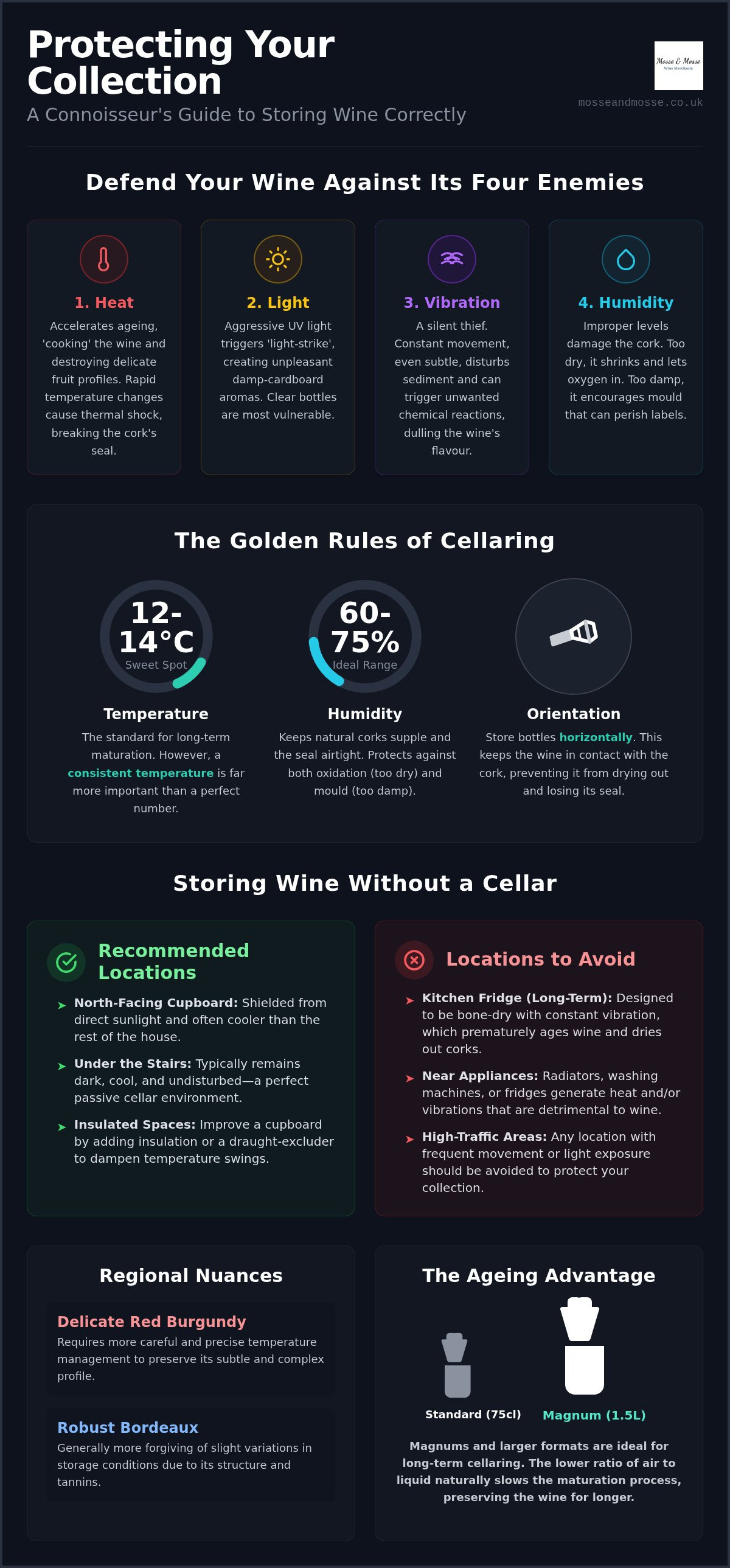
To truly master The Golden Rules: Understanding the Environmental Factors of Wine Storage, you must first understand the biological and chemical fragility of what's inside the bottle. We often describe wine as a living thing; it breathes, evolves, and eventually reaches a peak before declining. To protect this journey, you must defend your collection against the "four enemies": heat, light, vibration, and fluctuating humidity. Knowing how to store wine properly is the difference between a sublime experience and a wasted investment.
Whilst many experts debate the exact degree, 12°C to 14°C is widely accepted as the standard for long-term maturation. It's cool enough to slow down the ageing process without halting it entirely. However, we always tell our clients that consistency is far more valuable than a perfect number. A steady 15°C in a dark cupboard is infinitely better for your Bordeaux than a space that swings between 10°C and 20°C. Vibration is also a silent thief, as even subtle, constant movement can disturb sediment and trigger unwanted chemical reactions that dull the wine's flavour profile.
UV light is particularly aggressive. It triggers a reaction in the wine's amino acids, creating "light-strike" which results in unpleasant, damp-cardboard aromas. This is why dark green or amber glass is your first line of defence, though it's never a substitute for a pitch-black environment. Clear bottles, often used for whites or rosés, are the most vulnerable and require the most protection.
Temperature and the Alchemy of Ageing
Heat acts as a catalyst, accelerating chemical reactions that should take decades into just a few months. If you store your bottles in the kitchen, perhaps above the fridge or near a radiator, you risk "cooking" the wine. This destroys the delicate fruit profiles we love in a Côte d'Or Burgundy. Thermal shock occurs when rapid temperature changes cause the liquid to expand and contract against the cork, potentially breaking the seal and inviting oxidation.
Humidity and the Health of the Cork
Natural corks require a specific environment to remain effective. We recommend maintaining a humidity level between 60% and 75% to keep the cork supple and airtight. If the air is too dry, the cork shrinks and allows oxygen to seep in. Conversely, excessive dampness can lead to mould growth. Whilst this doesn't always ruin the wine, it will certainly perish the labels and damage the bottle's provenance. Learning how to store wine with alternative closures, such as screwcaps or glass stoppers, is slightly simpler as they aren't sensitive to humidity, but the liquid still requires protection from heat and light.
Practical Home Solutions: Where to Keep Your Bottles Without a Cellar
Most of us don't have the luxury of a 19th-century limestone cellar. In a typical UK semi-detached or terraced home, you must be a bit more creative when deciding how to store wine. The goal is to find the most stable environment available. Look for a north-facing cupboard or the space under your stairs; these areas often remain significantly cooler than the rest of the house because they are shielded from direct sunlight and central heating hubs.
Whilst it's tempting to use the kitchen fridge, this is a mistake for long-term ageing. Domestic fridges are designed to be bone-dry and vibrate constantly, which can prematurely age a fine bottle and cause the cork to lose its elasticity. Instead, focus on horizontal orientation. Keeping the wine in contact with the cork prevents it from drying out and losing its airtight seal. If you're serious about longevity, consider Magnums & Larger Formats. The lower ratio of air to liquid in these larger vessels naturally slows down the maturation process, making them ideal for long-term keeping.
Creating a Passive Cellar Environment
You can improve a standard cupboard by adding simple insulation or a draught-excluder to the door. This helps dampen the temperature swings mentioned in the previous section. Once your space is ready, use wine racks to organise your Bordeaux and Burgundy by region or vintage. This prevents unnecessary handling of the bottles. Be mindful of where you place your racks; proximity to a washing machine or high-traffic hallway can introduce vibrations that disturb the delicate sediment in older reds.
When to Invest in Professional Wine Refrigeration
If your collection grows beyond a dozen precious bottles, you might consider a dedicated maturation cabinet. Unlike a service fridge, these units maintain high humidity and use specialised compressors to eliminate vibration. For those with high-value investments, professional bonded storage is the safest route for provenance. If you're unsure which path is right for your collection, feel free to get in touch for bespoke advice on managing your home storage.
Regional Nuances: Storing Burgundy, Bordeaux, and Fortified Wines
Not all bottles share the same resilience. A delicate Red Burgundy from the Côte d'Or reacts differently to its environment than a thick-skinned Cabernet from Bordeaux. When you are deciding how to store wine, you must account for these structural differences. Pinot Noir's thinner skin makes it a "canary in the coal mine" for storage errors; it is the first to lose its ethereal aromatics if the temperature spikes. In contrast, the robust tannins and higher extract in Bordeaux act as a natural preservative, allowing these wines to endure longer maturation periods with greater stability.
White wines require even stricter vigilance regarding light exposure. White Burgundy needs absolute darkness to preserve its crystalline golden hue and complex mineral profile. Even a few hours of direct UV exposure can dull the vibrant acidity of a fine Chardonnay. For those collecting Port, the rules shift again. Whilst Vintage Port must lie horizontally to keep its natural cork hydrated, many Tawny styles use T-stoppers and are perfectly comfortable standing upright on your shelf.
Burgundy vs Bordeaux: A Storage Comparison
Understanding the chemical makeup of these regions helps you prioritise your storage space. Côte de Nuits wines are particularly prized for their ageing potential due to their exceptional structure and concentration of fruit. The following table highlights why these two iconic regions demand slightly different expectations:
| Feature | Burgundy (Pinot Noir) | Bordeaux (Cabernet/Merlot) |
|---|---|---|
| Tannin Level | Low to Medium | High |
| Acidity | High | Medium to High |
| Ideal Ageing Window | 5 to 20+ years | 10 to 50+ years |
Champagne and Fortified Wines
The internal pressure in Champagne & Sparkling Wines keeps the cork sufficiently hydrated, meaning vertical storage is often acceptable for short periods, though we still recommend horizontal racks for prestige cuvées. Port is remarkably resilient; a Tawny Port can last several weeks once opened because of its controlled oxidation during barrel ageing. If you are curating a collection that spans these diverse regions, consult us for a bespoke storage plan to ensure every bottle is protected according to its unique needs.
The Connoisseur’s Approach: Ageing, Appreciation, and Service
At Mosse and Mosse, we believe the true joy of wine lies in the patience of the pour. Whilst the technicalities of temperature and humidity are vital, the ultimate goal is the sensory reward of a bottle opened at its absolute zenith. We often see enthusiasts fall into the trap of supermarket impulse buys, which rarely offer the structural integrity required for maturation. Instead, we advocate for buying wine online with a focused plan. Our philosophy is that learning how to store wine isn't just about protection; it's about the appreciation of "slow wine" and ensuring every bottle tells its full story.
Understanding the "drinking window" is perhaps the most crucial part of the connoisseur’s journey. Every vintage we source comes with a predicted lifespan; a period where the primary fruit and secondary tertiary notes find a perfect, harmonious balance. If you've mastered how to store wine correctly, the ritual of decanting becomes far more satisfying. Proper horizontal storage allows sediment to settle in a way that makes the final service clean and rewarding, revealing the full complexity of a well-rested Bordeaux. It's about drinking better, not more, by respecting the liquid's heritage.
Storing Wine for Major Milestones
Planning for life's great celebrations requires foresight. If you're managing Wedding & Party Wine, we recommend securing your stock at least six months in advance to allow the wine to recover from "travel shock" before the big day. It's also wise to keep a simple inventory log. This prevents you from "losing" precious bottles in the back of a rack until they're past their prime. When choosing wines for a child's birth year or a milestone anniversary, look for vintages with high acidity and tannin, as these provide the structural bones needed to age gracefully for two decades or more.
Consulting the Experts
Building a collection is a personal journey, and we pride ourselves on being more than just a retailer. We act as your professional partners in preservation. A personal relationship with an independent merchant provides access to bespoke advice that can save you from costly storage mistakes. We're always here to help you decide which bottles to drink now and which to hide away for the future. Contact our experts for personalised guidance on building your collection.
Securing the Future of Your Collection
Protecting a fine bottle is an act of respect for the vineyard and the vigneron who crafted it. By mastering the environmental balance of temperature and humidity, you've already taken the most important step in preserving the integrity of your cellar. Whether you're finding the perfect dark corner under your stairs or managing the specific needs of a delicate Red Burgundy, your commitment to these principles will be rewarded when the cork finally comes out. Learning how to store wine isn't just a technical necessity; it's the final chapter in a bottle's long journey from the soil to your glass.
As independent family-led experts with decades of heritage, we're here to ensure your collection reaches its magnificent potential. We specialise in sourcing well-regarded Burgundy and Bordeaux and offer a personalised service with UK-wide delivery to help you build a cellar of true distinction. If you have questions about a specific vintage or need help planning for a milestone, we're only a message away. Speak to the Mosse and Mosse team for expert wine advice and curation. We look forward to helping you discover wines that are truly worth the wait.
Frequently Asked Questions
Can I store wine in a regular kitchen fridge for a few weeks?
You can safely store wine in a regular kitchen fridge for a few days, but we advise against keeping it there for several weeks. Domestic fridges are designed to remove moisture, which can eventually dry out a natural cork. Constant vibration from the compressor also agitates the liquid, potentially muting the delicate aromatics of a fine Burgundy. If you are learning how to store wine for the long term, a cool cupboard is a much safer bet.
Does wine really need to be stored horizontally if it has a screwcap?
No, wine with a screwcap does not require horizontal storage to maintain its seal. The primary reason for lying a bottle down is to keep a natural cork in contact with the liquid, preventing it from drying out and allowing oxygen ingress. Since screwcaps and glass stoppers provide a mechanical seal, these bottles can stand upright without any risk to the wine's integrity or ageing potential, making them easier to organise in limited spaces.
What is the ideal temperature for storing both red and white wine together?
The ideal compromise for storing both red and white wine together is 12°C. Whilst we serve them at different temperatures, they mature best at the same steady, cool level. Consistency is the most important factor when deciding how to store wine at home. Avoid any area where the temperature fluctuates, as these swings are far more damaging to the liquid's structure than a slightly higher, but stable, baseline temperature of 14°C.
How can I tell if a bottle of wine has been 'cooked' by heat during storage?
You can often identify 'cooked' wine by looking at the cork and the clarity of the flavours. If the cork is slightly pushed out of the neck or there is sticky residue under the capsule, the wine has likely expanded due to heat. On the palate, heat-spoiled wine loses its fresh fruit character, replaced by stewed, pruney, or flat flavours. This is why avoiding radiators and kitchen appliances is absolutely essential for long-term preservation.
Is it worth ageing inexpensive supermarket wines?
Most inexpensive supermarket wines are crafted for immediate enjoyment and lack the structural tannins or high acidity required for graceful ageing. Storing these bottles for several years often results in a loss of fruit rather than a gain in complexity. We suggest focusing your ageing efforts on well-regarded regions like Bordeaux or Burgundy, where the heritage and production methods are specifically designed to reward those who wait for the wine to reach its full potential.
How long can I store an opened bottle of Port?
The shelf life of an opened bottle of Port depends entirely on the style. A Tawny Port, which has already seen years of controlled oxidation in wood, can remain delicious for up to eight weeks if kept in a cool spot. However, a Vintage Port is much more fragile once the cork is pulled. It begins to fade within two to three days, so we recommend enjoying it shortly after decanting to appreciate its full aromatic profile.


