
What makes a virtual wine tasting work isn’t the amount of technical detail, but whether people feel welcome to join in. Planning corporate wine tasting events UK-wide means balancing different levels of wine knowledge with the practicalities of getting wine to colleagues in separate locations. A thoughtful selection can still fall flat if attendees are left watching passively or aren’t sure what to prepare.
A polished event doesn’t need to be complicated. Put participation first, then choose a format and wines that help the group enjoy the experience together. A guided tasting can provide structure, while a bring-your-own-wine approach can simplify preparation for some teams.
This guide compares virtual tasting formats and sets out a practical route from choosing an approach to briefing attendees and arranging wine. You’ll also find ways to make the conversation welcoming for newcomers and wine enthusiasts alike. With a clear plan and carefully selected wines, a remote gathering can feel personal and easy to follow.
Key Takeaways
- Discover how corporate wine tasting events uk can bring distributed colleagues or clients together when meeting in person isn't practical.
- Compare guided tastings, themed flights, informal socials and quiz-led sessions to match the occasion and your team's preferred level of interaction.
- Use a simple planning sequence to shape the event, select wines and brief attendees on joining details and what to prepare.
- Help guests take part by sharing glassware guidance and optional food suggestions in advance.
- See how Mosse and Mosse's hand-selected wines and corporate gifting experience can support your plans for a remote event.
What are virtual corporate wine tasting events, and when do they work?
A virtual corporate wine tasting is a live or guided wine experience that people attend remotely, usually from home or separate workplaces. It might be led by a wine professional, follow prepared prompts or give colleagues a shared theme for tasting and conversation. For businesses planning corporate wine tasting events uk-wide, this format brings together people who can’t easily meet in the same room.
Remote doesn’t have to mean passive. Build in opportunities to compare impressions, ask questions and respond to one another instead of filling the session with a long presentation. A structured tasting gives the event a clear sequence for looking, smelling and tasting. A social session puts conversation first, while a more educational format can spend longer on wine styles, regions and terminology. A well-paced agenda offers context without turning a team gathering into a lecture.
Wine tasting has its own history, methods and vocabulary. The history and methodology of wine tasting can provide background if you’re planning an educational element. For a workplace event, specialist detail should support the group’s enjoyment, not become a test of expertise.
Which business occasions suit a virtual wine tasting?
Consider a remote team social, a client get-together or a seasonal celebration. Match the style to the purpose: choose a relaxed session for informal conversation, an educational approach for guests curious about wine, or a light-hearted quiz for a group that enjoys a friendly challenge. Before deciding, think about attendees’ experience, where they’ll be joining from and what will help everyone take part comfortably. A shared theme gives newcomers an easy way in while leaving room for experienced tasters to share their views.
What makes a remote tasting feel welcoming?
Start with plain English and offer specialist terms as optional context. Invite people to describe what they notice rather than asking them to identify a particular grape or region. Open questions such as “What stands out to you?” encourage conversation without suggesting there’s one correct answer. Share the running order and joining details in advance, and let guests know they can participate at their own pace.
An inclusive virtual tasting gives everyone an easy way to notice, describe and discuss the wine, whatever their experience. That keeps the focus on shared discovery and makes the event feel like a gathering, not an exam.
Which virtual corporate wine tasting format fits your team?
Start with the purpose. A client event may benefit from a considered, guided experience; a team celebration might call for more conversation and less instruction. For corporate wine tasting events uk-wide, choose a format that gives attendees a clear way to join in without making the occasion feel like another work presentation.
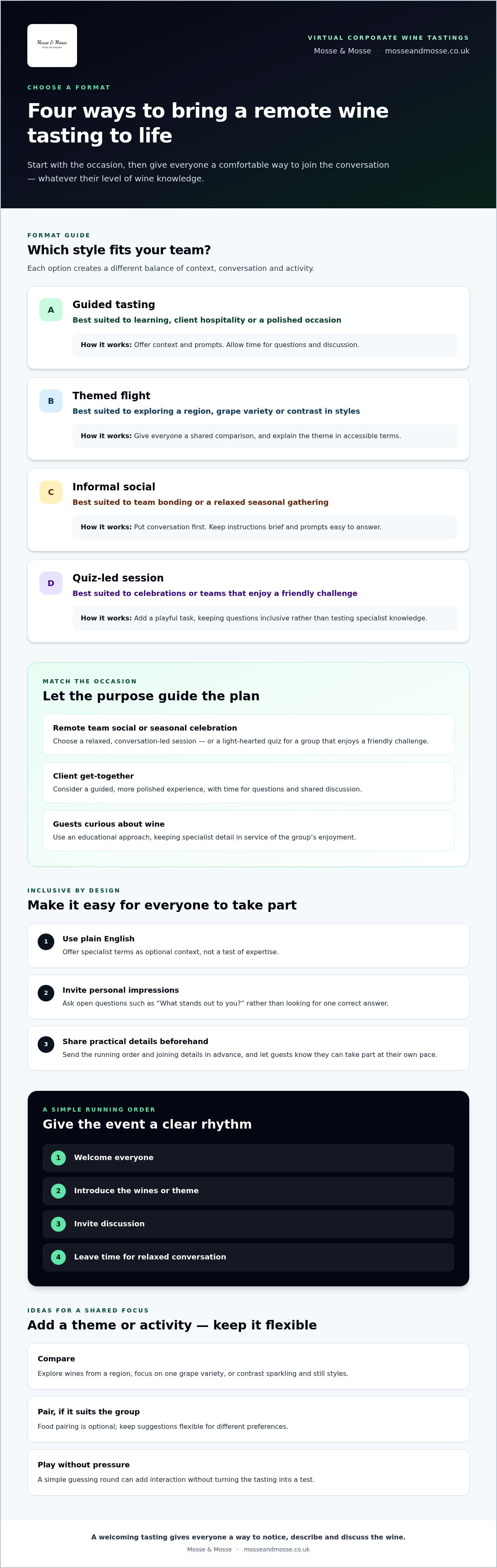
| Format | Best suited to | Participation and planning |
|---|---|---|
| Guided tasting | Learning, client hospitality or a more polished occasion | Offers context and prompts; allow time for questions and discussion. |
| Themed flight | Exploring a region, grape variety or contrast in styles | Gives the group a shared comparison; explain the theme in accessible terms. |
| Informal social | Team bonding or a relaxed seasonal gathering | Centres on conversation; keep instructions brief and prompts easy to answer. |
| Quiz-led session | Celebrations or teams that enjoy a friendly challenge | Adds a playful task; keep questions inclusive rather than testing specialist knowledge. |
Guided tasting or informal virtual social?
A guided structure suits guests who want context, such as what to notice in a wine or how two styles differ. An informal social uses less instruction and gives colleagues more room to chat. Either format can feel personal rather than webinar-like with a short agenda: welcome everyone, introduce the wines or theme, invite discussion, then leave time for relaxed conversation.
Should you add a theme, food pairing or team activity?
A theme gives the group a shared point of interest. Compare wines from a region, explore one grape variety, or contrast sparkling and still styles. For a celebratory occasion, a selection from the Champagne and sparkling wine range can provide a natural focus. Food pairing is optional, so keep suggestions flexible for different preferences. A simple guessing round can add interaction without turning the session into a test.
Organisers arranging wine for attendees may also find GOV.UK’s guidance on UK wine trade regulations useful background on sourcing and distribution. For help choosing wine for a business occasion, talk to the Mosse and Mosse team.
How to organise the wine, attendees and running order
A clear plan makes a remote tasting easier to coordinate, particularly when guests are joining from separate addresses. For corporate wine tasting events uk-wide, settle the practical details early so the wine, invitations and session work together.
- Set the objective. Decide whether the gathering is for team connection, client hospitality, learning or a seasonal celebration. Use that purpose to guide each later choice.
- Choose the format. Match the session to the occasion and attendees. A guided event needs room for explanation and questions; a social session needs prompts that get people talking.
- Select the wines. Choose a coherent line-up with contrasts that give guests something to notice and discuss. A curated mixed case can introduce different styles while keeping the selection connected. Mosse & Mosse’s “The Sunday Six” is a mixed case of six 75 cl bottles, with Picpoul de Pinet, Ochoa Blanco, Solas Syrah Viognier, Côtes du Rhône Les Forots, Château du Moulin Rouge and St Sidoine Rosé. It costs £89.95 per case. If wine is also a gift, explore corporate and private wine gift boxes for the occasion.
- Brief guests. Send the date, joining details, wine list and a simple tasting note template in advance. Include glassware guidance and optional food suggestions, but don’t make specialist equipment or food essential. Make clear that guests can join the conversation without drinking.
- Run the session. Welcome everyone, introduce the wines, invite guests to share impressions and leave space for conversation. A short running order helps the event move along without making it feel rigid.
How should organisers choose wines for a remote group?
Choose wines that suit the event and offer a point of comparison, such as different styles within a broad theme. For a beginner-friendly group, keep the selection manageable and provide plain-English descriptions. If attendees are spread across the UK, gather recipient names and delivery addresses early so you can plan the arrangements. Mosse & Mosse delivery is £9.95 to UK mainland, free on orders over £150, 2-3 working days, an adult aged 18 or over must sign for delivery.
What should guests receive before the event?
Make preparation simple by sending the wine list, joining instructions, glassware suggestions and any optional food ideas together. A tasting note can ask guests to jot down what they notice about aroma, flavour and finish, without requiring specialist vocabulary. Remind them that the aim is to share impressions, not to finish every pour.
For help selecting wines for a business gathering or gift, speak with Mosse and Mosse about your plans.
How Mosse & Mosse can support your corporate wine plans
Mosse & Mosse is an independent fine-wine merchant in Suffolk, trading since 1999. For businesses organising their own virtual event, the team can help with wine selection and gifts to accompany the occasion. Tim Mosse buys and sources the wines, while Sam Mosse leads retail and customer service.
The business focuses on hand-selected wines by the case, with an Old-World focus, alongside corporate wine gifts and Christmas boxes. Its curated selection can help organisers consider how wine style, region and occasion fit together, whether the plan is a shared tasting or a gift for colleagues or clients. This is particularly useful when guests will receive wine at separate addresses. Delivery terms apply to the UK mainland: £9.95 to UK mainland, free on orders over £150, 2-3 working days, an adult aged 18 or over must sign for delivery.
What can a specialist wine merchant contribute?
A good selection starts with the purpose: a celebratory toast, a regional theme or a comparison of different styles. A specialist wine merchant can help you think through those choices and select wines that feel connected to the occasion, rather than assembling unrelated bottles. Champagne and sparkling wine can suit a festive event or business milestone. Corporate wine gifts and Christmas boxes can also complement an event or mark the season.
What information should you include in an enquiry?
A few clear details make it easier to discuss suitable options. Share:
- The occasion and what you want the wine to contribute.
- Who will attend, including how familiar they are with wine.
- Preferred styles or regions, and any theme you have in mind.
- Whether guests are in one place or joining from separate locations.
- Whether you’re sourcing wine for the event, arranging gifts, or both.
These details help focus the wine-sourcing conversation on your plans. If you’re organising the tasting yourself, keep the event format and hosting arrangements separate from the wine selection. Tell us about your corporate wine plans and the team can discuss your requirements.
Shape your next corporate wine experience
A remote wine event gives colleagues or clients a reason to pause, share impressions and enjoy something together, even when they’re in different places. Start by turning the occasion into a clear brief: what should guests take away from it, and what kind of wine will help create that atmosphere? Keep the plan centred on people, not perfection.
For corporate wine tasting events uk-wide, thoughtful wine sourcing can make the experience feel considered from the invitation to the final glass. Whether you’re planning an engaging session, choosing wines for guests or pairing the event with a business gift, a clear idea of your aims will help bring the details into focus.
Tell us about your corporate wine plans, including the occasion, preferred styles and where attendees will be joining from. Mosse & Mosse can discuss wine options to suit your plans. A little care at the outset can help make your gathering warm, distinctive and enjoyable for everyone involved.
Frequently Asked Questions
Can a virtual corporate wine tasting work for people who know very little about wine?
Yes. Beginners can enjoy corporate wine tasting events uk-wide when the focus is curiosity rather than getting answers “right”. A short wine list with plain-English descriptions gives guests something to refer to if conversation stalls. Make it clear that anyone can simply listen or contribute when they feel comfortable. The shared occasion matters more than knowing wine terminology.
How many wines should a virtual corporate tasting include?
There’s no fixed number that suits every event. Consider how much time you want to leave for conversation and how much background each wine needs. If the group is new to tasting, a shorter line-up can keep the experience approachable; a broader flight may suit guests keen to explore contrasts. Set the running order before inviting attendees, then tell them what they’ll be tasting so expectations are clear.
Can attendees join a virtual wine tasting from different locations?
Yes. Attendees can join remotely from separate locations using the platform chosen by the organiser. Businesses in Ipswich, Norwich, Bury St Edmunds, Sudbury, Stowmarket, Newmarket, Thetford, Diss, Attleborough, Southwold, Aldeburgh, Framlingham, Woodbridge, Long Stratton and Saxmundham can plan for colleagues to take part from different addresses. Wine delivery is £9.95 to UK mainland, free on orders over £150, 2-3 working days, an adult aged 18 or over must sign for delivery.
What should guests have ready for an online wine tasting?
Guests can take part with ordinary wine glasses, a glass of water and somewhere to jot down a few impressions. Share any food suggestions as optional, so people can choose what suits them. If attendees don’t have the selected wines, let them know whether they can still join the discussion without tasting. Keeping preparation simple helps the event feel accessible rather than like a formal class requiring special equipment.
How can a virtual wine tasting feel more interactive than a video call?
Give attendees a small role, such as choosing which wine best fits a theme or sharing one word that describes a first impression. A co-ordinator can follow the chat and bring quieter contributions into the conversation without putting anyone on the spot. If the group is large, invite comments in turn or use a quick poll. This gives the call a shared focus beyond simply watching a screen.
Can a company send wine as part of a virtual corporate event?
Yes. Wine can be part of an event or a separate corporate gift, and Mosse & Mosse provides corporate wine gifts and curated cases. For recipients at different addresses, gather names and delivery details early and plan around the delivery window. Delivery is £9.95 to UK mainland, free on orders over £150, 2-3 working days, an adult aged 18 or over must sign for delivery. Guests can take part without drinking.


