The most famous label on the table isn't always the finest champagne in the room. It's a truth that seasoned hosts quietly know, yet choosing wedding champagne still sends most couples spiralling into a fog of unfamiliar terminology, nagging anxiety about quantities, and the creeping suspicion they're paying a premium for a name rather than what's actually in the bottle.
That feeling is entirely understandable. The Champagne region alone produces thousands of cuvées, each with its own character, and the difference between a Brut Non-Vintage and a Prestige Cuvée isn't always explained in a way that actually helps you make a decision. You deserve better than a guess.
This guide cuts through the noise with the clarity of a connoisseur and the warmth of a trusted friend. You'll learn how to decode the key styles and classifications, calculate exactly how much you need without a drop of waste or a moment of panic, and discover why prioritising boutique quality over mass-market branding so often delivers a more memorable toast for your guests. From understanding dosage levels to exploring the theatre of a magnum, everything you need to plan your wedding drinks with genuine confidence is right here.
Key Takeaways
- Choosing the right wedding champagne is less about recognising the label and more about understanding the style, dosage, and character that will genuinely delight your guests.
- Calculating your drinks order doesn't have to be guesswork — a clear bottle-per-head formula, broken down by arrival drinks, the toast, and the evening, keeps your budget in control without running short.
- Serving temperature and glassware matter more than most couples realise; small adjustments at the point of service can transform how even a mid-range sparkling wine is received.
- Boutique houses and personalised curation consistently outperform mass-market names when it comes to character and value — a principle that underpins the Mosse and Mosse wedding consultation service.
- A magnum isn't merely a larger bottle; it's a statement of generosity and occasion that can elevate the theatre of your celebration in a way no standard pour quite matches.
Selecting the Perfect Wedding Champagne: Quality Over Branding
Wedding champagne should do two things simultaneously: it should feel celebratory and generous, and it should actually taste wonderful. Those two goals aren't always served by reaching for the most recognisable label on the shelf. A great wedding sparkler balances crowd-pleasing accessibility with genuine character, the kind of wine that prompts guests to lean across the table and ask, "What are we drinking?"
The answer to that question rarely begins with a household name.
At Mosse and Mosse, the guiding philosophy is straightforward: the quality in the bottle matters far more than the prestige of the label on the outside. It's a principle that consistently rewards couples who are willing to look slightly beyond the obvious choices. Smaller, boutique Champagne houses invest their resources in viticulture and winemaking rather than global advertising campaigns, and that difference is perceptible in the glass.
Central to understanding any Champagne producer is the concept of terroir, the combination of soil composition, microclimate, and topography that gives a wine its distinctive personality. The Champagne region is not a monolith; the chalky slopes of the Montagne de Reims produce wines with entirely different characteristics to those from the Côte des Blancs or the Aube. A boutique house that farms a specific parcel of land expresses that terroir with a clarity and honesty that a large négociant blending from hundreds of sources simply cannot replicate.
Understanding Brut, Rosé, and Vintage Styles
Choosing between styles is easier once the core distinctions are clear:
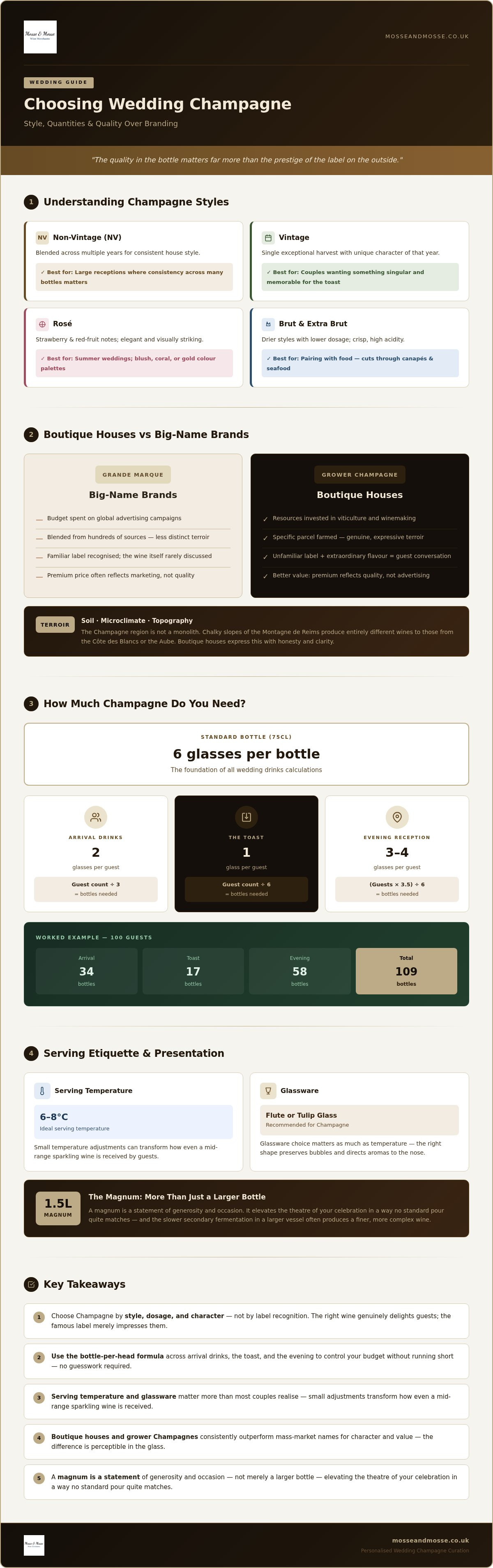
- Non-Vintage (NV): Blended across multiple years to achieve a consistent house style. Reliable, approachable, and well-suited to large receptions where consistency across many bottles matters.
- Vintage: Produced from a single exceptional harvest, it carries the unique character of that year. Ideal for couples who want something genuinely memorable and singular for their toast.
- Brut and Extra Brut: Drier styles with lower dosage levels. Their crisp acidity makes them the preferred pairing alongside food, cutting through rich canapés and seafood without competing with the flavours on the plate.
Explore the Champagne and Sparkling Wines selection at Mosse and Mosse to see how these styles are represented across their curated range.
Why Boutique Houses Often Outshine Big Names
Grower Champagne, wine produced and bottled by the same estate that owns and tends the vineyards, has become one of the most exciting conversations in the drinks world. These producers don't have the marketing budgets of the grandes marques, but they don't need them. Their wines speak with a specificity and sense of place that mass-market blends rarely achieve.
For your guests, that specificity becomes a talking point. A bottle with an unfamiliar label and an extraordinary flavour creates genuine curiosity and conversation, which is exactly the atmosphere you want at a wedding reception. The Wedding and Party Wine service at Mosse and Mosse is built precisely around this principle: personalised curation that prioritises what's in the glass over what's printed on the label.
Calculating Quantities and Managing Your Wedding Drinks Budget
The logistics of a wedding drinks order are where good intentions most often unravel. Couples spend weeks deliberating over the right bottle, then place an order based on instinct and hope. The result is either an embarrassing shortfall mid-reception or a van full of unopened cases being returned the following week. Neither outcome is necessary.
The Bottle Math: How Much Do You Really Need?
A reliable calculation starts with a simple framework, applied in phases:
- Arrival drinks: Allow 2 glasses per guest. A standard 75cl bottle yields approximately 6 glasses, so divide your guest count by 3 to find the number of bottles required for this phase.
- The toast: Budget 1 glass per person. Divide your guest count by 6 for the bottle count.
- Evening reception: This varies considerably depending on whether you're serving a full dinner, canapés only, or extending into a late-night party. A working estimate of 1 to 1.5 bottles per person across the full evening is a sensible starting point for a sit-down dinner with wine service.
- The 10% buffer: Always add a tenth to your final total. Enthusiastic pouring, a generous sommelier, or a few unexpected plus-ones can erode a tight calculation quickly.
For the toast itself, consider the theatre of ordering in magnums and larger formats. A magnum holds 1.5 litres, the equivalent of two standard bottles, and it's not merely a practical choice. There's a ceremony to opening a magnum that a 75cl bottle simply can't replicate. The slower secondary fermentation inside a larger vessel also benefits the wine itself, preserving freshness and developing greater complexity over time.
Balancing the Budget Without Compromising on Flavour
A common misconception is that a tighter budget demands a cheaper wedding champagne across the board. It doesn't. A more intelligent approach is to split the order strategically.
Reserve your premium selection for the toast, the moment guests are paying attention and the wine will be sipped slowly and appreciated. For the arrival drinks and the extended evening service, a beautifully crafted Crémant d'Alsace or Crémant de Bourgogne from a quality producer delivers exceptional value without any compromise on character. These wines are made using the same traditional method as Champagne, and in skilled hands they're genuinely impressive in the glass.
A high-quality Non-Vintage Champagne is also frequently the smarter choice over a budget Vintage. The blending expertise required to produce a consistent, crowd-pleasing NV is considerable, and the result tends to be more reliably enjoyable across a large guest list than a Vintage that may be more demanding or polarising in its character.
Ordering through an independent merchant rather than a supermarket or wholesale warehouse brings a practical advantage that's easy to overlook: personalised guidance on quantities and styles, combined with national UK delivery that takes the logistical burden entirely off your plate. Mosse and Mosse offer exactly this through their Wedding and Party Wine service, curating an order that reflects your guest profile, your menu, and your budget rather than simply pointing you towards whatever is overstocked. If you'd like a drinks plan built around your specific day, get in touch with the team to discuss your requirements.
Serving Etiquette: From Reception Drinks to the Wedding Toast
Selecting exceptional wedding champagne is only half the work. How it's served determines whether those carefully chosen bottles reach their potential or quietly disappoint. Temperature, glassware, and timing are not minor details; they're the difference between a toast that guests remember and one that simply passes.
Temperature and Glassware: Getting the Details Right
The single most common serving error at weddings is chilling Champagne too aggressively. Straight from an ice bucket packed with ice and no water, bottles can drop well below 6°C, at which point the aromatics are effectively shut down. You're tasting cold rather than wine. The ideal serving temperature for most styles sits between 8°C and 10°C, cold enough to preserve the effervescence and freshness, but warm enough to let the nose open up and express itself.
Using ice buckets correctly makes a genuine difference. Fill them with a mixture of ice and cold water rather than ice alone. The water conducts temperature far more efficiently, chilling the bottle evenly without the risk of over-refrigerating. Keep labels above the waterline to protect them, particularly if you're serving something special where presentation matters.
On glassware, the tulip glass has largely superseded the traditional flute for good reason. Its gently widened bowl concentrates aromatics in a way the narrow flute simply can't, allowing the wine's character to breathe and develop in the glass. The coupe remains a beautiful choice for vintage-themed celebrations where the visual spectacle is part of the occasion, but accept the trade-off: it releases carbonation quickly and the aromatics dissipate fast. For a long reception where guests are holding their glasses for some time, the tulip is the more forgiving and rewarding option.
Timing the Pour: Reception, Speeches, and Beyond
Never pour the toast more than ten minutes before the speeches begin. Champagne poured and left standing loses its effervescence and warms in the glass; by the time the first speaker rises, guests are lifting a flat, tepid drink rather than something worth raising. Coordinate with your venue staff so that pouring begins precisely when the MC signals the speeches are imminent.
The transition from sparkling wine to still wines during the wedding breakfast deserves the same attention. A clean break works better than an awkward overlap; clear the Champagne flutes before still wine is poured, and brief your front-of-house team accordingly. It signals a natural shift in the rhythm of the meal and prevents guests from mixing styles in the same glass.
For the top-up during the wedding breakfast, a light touch is the right approach. Topping up a glass that still has wine in it is considered poor etiquette in formal service; wait until the glass is nearly empty before offering more. It also gives you far better control over your overall quantities, which matters when you've calculated your order carefully.
When handling magnums and larger formats, assign a specific member of staff to each bottle. A 1.5-litre magnum is considerably heavier than a standard bottle, and pouring from one with confidence requires practice. A cloth wrapped around the neck, a steady two-handed grip, and a slow, controlled pour prevent spills and ensure the theatre of the moment lands as intended rather than becoming a source of anxiety.
If you'd like guidance on how to brief your venue team or structure your service plan around your drinks order, speak to the team at Mosse and Mosse for personalised advice tailored to your day.
Personalised Curation: The Mosse and Mosse Wedding Service
There's a meaningful difference between buying wedding champagne and having it chosen for you by someone who genuinely understands both the wine and the occasion. The Wedding and Party Wine service at Mosse and Mosse is built on exactly that distinction. It's not a dropdown menu or an algorithm. It's a conversation.
The founders' deep specialisation in Burgundy and Bordeaux informs every aspect of how they approach sparkling selections. An intimate knowledge of terroir, of how specific soils and microclimates shape flavour, translates directly into an ability to identify Champagne and sparkling wines that carry genuine character rather than simply a recognisable name. That expertise isn't incidental. It's the foundation on which every recommendation is built.
Bespoke Consultations for Your Special Day
The consultation process begins with your specific circumstances: your menu, your guest profile, your personal tastes as a couple, and the overall tone of the celebration you're planning. A relaxed outdoor summer wedding calls for entirely different choices than a formal winter dinner. Mosse and Mosse work through those variables with you, matching styles and producers to the details of your day rather than offering a one-size-fits-all package. Customers who've used the service consistently highlight the attentiveness of that approach, noting that the guidance feels personal rather than commercial.
Beyond the Bubbles: A Complete Wedding Portfolio
Sourcing everything from a single trusted merchant brings a practical clarity that couples often underestimate until they're managing three separate suppliers in the weeks before the wedding. Alongside the sparkling selection, Mosse and Mosse offer a considered range of red wines and white Burgundies that sit beautifully alongside a wedding breakfast, allowing you to build a coherent drinks journey from arrival to the final toast without the inconsistency of mixing sources.
For the wedding party itself, their Corporate and Private Wine Gift Boxes and Wine Hampers make a thoughtful and genuinely impressive gift for bridesmaids and best men, the kind of gesture that reflects the care you've brought to every other element of the day.
The relationship doesn't have to end when the last glass is poured, either. A merchant who knows your palate is invaluable for anniversary celebrations, and the team at Mosse and Mosse are very much open to being the wine partner you return to year after year. Start the conversation about your wedding drinks order and discover what a genuinely personalised service feels like.
Your Perfect Wedding Champagne Awaits
Choosing wedding champagne with genuine confidence comes down to three things: understanding what's in the bottle rather than what's on the label, calculating your quantities with a clear formula rather than guesswork, and serving what you've chosen with the care it deserves. Get those three elements right, and your guests will remember the drinks as warmly as the ceremony itself.
Mosse and Mosse have been curating exceptional French wines for couples since 1999, with a family-led approach that puts your specific day at the centre of every recommendation. Their bespoke consultation service draws on deep expertise across top French estates, and UK-wide mainland delivery means the logistics are handled for you.
You don't have to navigate this alone. Get in touch with the team at Mosse and Mosse to start building a drinks order that genuinely reflects your celebration. The right bottles are out there; it's simply a matter of finding the right guide to help you choose them.
Frequently Asked Questions About Wedding Champagne
How many bottles of Champagne do I need for 100 wedding guests?
For 100 guests, you'll need roughly 17 bottles for arrival drinks (2 glasses per person), 17 bottles for the toast (1 glass per person), and around 100 to 150 bottles if you're serving sparkling wine throughout a full sit-down dinner. That gives you a working total somewhere between 134 and 184 bottles before adding your 10% buffer. Round up generously; running short mid-reception is far more costly than returning a few unopened cases.
Is it better to serve Champagne or Prosecco at a wedding?
Neither is universally better; it depends on your priorities. Champagne, made using the traditional method with extended lees ageing, offers greater complexity, finer bubbles, and a depth of character that Prosecco, produced using the tank method, typically doesn't match. That said, a well-chosen Prosecco Superiore from a quality producer can be genuinely impressive for arrival drinks, particularly at relaxed summer celebrations. The smarter approach is often to serve a quality Crémant or Prosecco on arrival and reserve Champagne for the toast itself.
What is the best temperature to serve wedding Champagne?
Serve wedding Champagne between 8°C and 10°C. Below that range, the aromatics close down and you're essentially tasting cold rather than wine. Above 12°C, the bubbles become coarser and the freshness fades quickly. Chill your bottles in ice buckets filled with a mixture of ice and cold water rather than ice alone; water conducts temperature more evenly and prevents over-chilling. A bottle placed in a properly prepared ice-and-water bucket reaches the ideal temperature in around 20 to 30 minutes.
Can I use English Sparkling Wine instead of Champagne for the toast?
Absolutely, and it's a choice that increasingly impresses guests who encounter it for the first time. English sparkling wines from chalk-rich counties share genuine geological similarities with the Champagne region, and the finest examples from established producers are genuinely world-class. They're also a thoughtful conversation piece at the table. The key is to select from a reputable producer rather than assuming any English sparkling wine will do; quality varies considerably, so seek guidance from a specialist merchant before committing to a large order.
How far in advance should I order my wedding Champagne?
Ordering at least eight to twelve weeks before your wedding date is strongly advisable, particularly for larger guest lists or if you're sourcing from boutique producers with limited stock. Popular cuvées from smaller grower houses can sell out quickly, and leaving your order until the final few weeks risks losing your first choice entirely. If you're ordering magnums or larger formats, allow additional lead time; these are produced in smaller quantities and aren't always held in immediate stock. Confirm current delivery timescales directly with your merchant when you place the order.
Should I choose a Brut or a Demi-Sec Champagne for my guests?
Brut is the right choice for the vast majority of wedding receptions. Its dry profile and crisp acidity work well alongside food, canapés, and the wide range of palates you'll find across a large guest list. Demi-Sec, with its noticeably higher residual sugar, suits a very specific context: it pairs beautifully with dessert or a wedding cake, and some couples choose it specifically for that moment. If you're planning a single style for the whole celebration, Brut is the more versatile and crowd-pleasing option by a considerable margin.


