

Champagne is better cool than ice-cold. For a dependable chill, stand the bottle in a bucket of ice and water for 20 to 30 minutes; if you’re short on time, spinning it in salted ice water can cool it much faster, so keep a close eye on it. That’s the practical starting point for how to properly chill Champagne without muting the aromas or leaving it too cold to enjoy.
When guests are waiting, it’s tempting to reach for the freezer. But a sudden deep chill can mute the aromas and character of a carefully chosen bottle. Aim for a refreshing chill that keeps the Champagne lively and expressive.
Here, you’ll find clear steps for using an ice-and-water bucket and the spinning method, plus simple ways to avoid over-chilling. The same approach works for other sparkling wines, helping each bottle arrive at the table lively, aromatic and ready to pour.
Key Takeaways
- Aim for a cool, not icy, pour; fuller-bodied, vintage, rosé and older Champagnes can show better at a slightly warmer serving temperature.
- For a rapid chill, spin the bottle in salted ice water and monitor it closely so it doesn’t become too cold.
- For a steadier approach, use a bucket with equal parts ice and water, submerging most of the bottle as it chills.
- Skip the freezer as your usual method: gradual chilling helps preserve Champagne’s aromas and character.
- Choose the chilling method around the bottle’s starting temperature and the time you have before serving.
What about chilling Champagne and other sparkling wines with the spinning method?
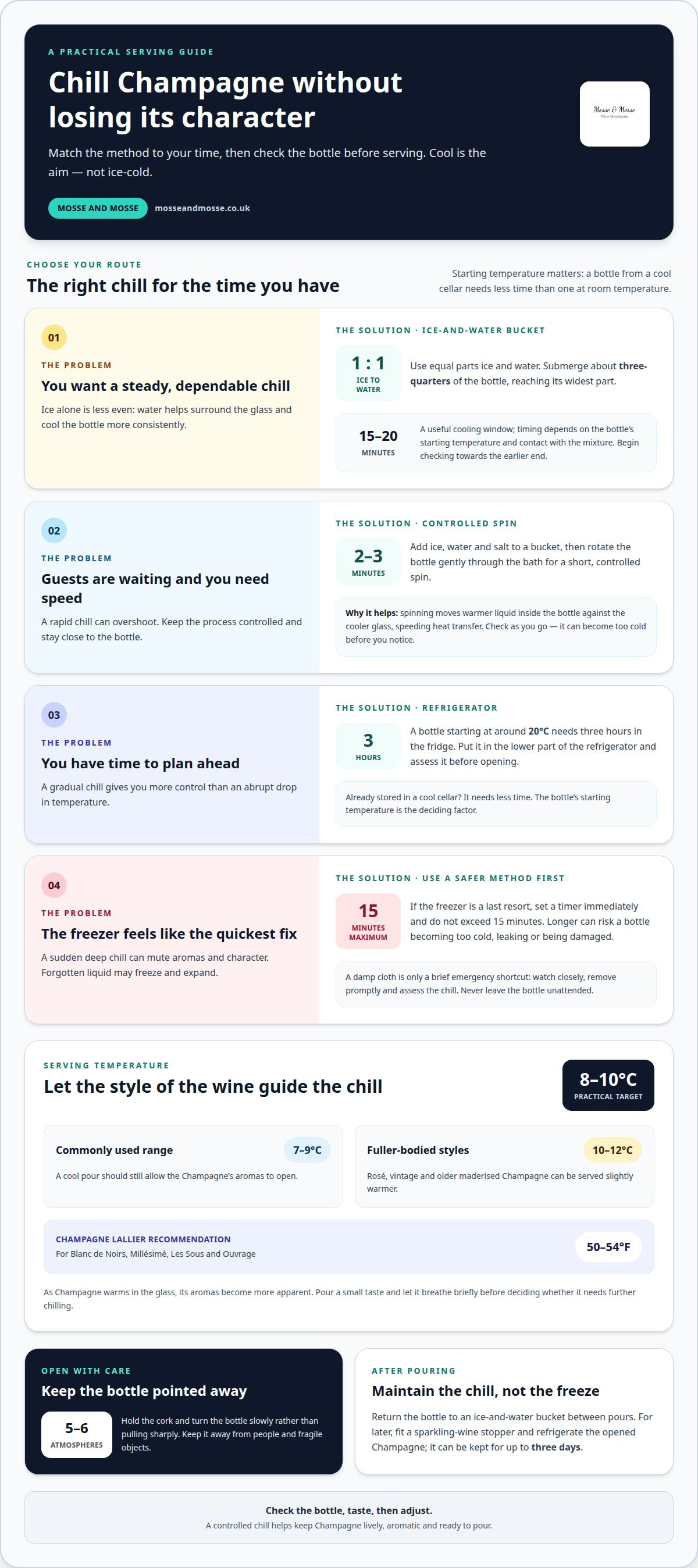
- Use a short, controlled spin when the bottle needs a rapid chill. Add ice, water and salt to a bucket, then rotate the bottle gently through the bath for 2-3 minutes. Learning how to properly chill champagne with this method means controlling both movement and time. Spinning moves warmer liquid inside the bottle against its cooler glass, speeding heat transfer. Check the temperature as you go; the bottle can become too cold before you notice.
- Set the serving temperature by cuvée, rather than treating every Champagne alike. A practical target is 8-10°C, while another commonly used range is 7-9°C. Fuller-bodied bottles, including rosé, vintage and older maderised Champagne, can be served at 10-12°C. Serving Champagne ice cold can prevent its aromas from opening properly, so the ideal chill depends on the wine’s style.
- Allow for the character of the bottle. Champagne Lallier recommends 50-54°F for Blanc de Noirs, Millésimé, Les Sous and Ouvrage. These recommendations show why different cuvées may call for different serving temperatures. As Champagne warms in the glass, its aromas become more apparent. Pour a small taste first, then let it breathe briefly before deciding whether it needs further chilling.
- Choose the fridge when you have time to plan. A Champagne bottle starting at room temperature, around 20°C, needs three hours in the fridge to chill. Put it in the lower part of the refrigerator a few hours before serving, then assess its temperature before opening. A bottle already stored in a cool cellar needs less time; its starting temperature is the deciding factor.
- Open the chilled bottle steadily, keeping it pointed away from people and fragile objects. Champagne contains 5-6 atmospheres of pressure, so hold the cork and turn the bottle slowly rather than pulling sharply. After pouring, return the bottle to an ice bucket to maintain its temperature. To keep opened Champagne for later, fit a sparkling-wine stopper and refrigerate it; it can be kept for up to three days. This is a practical final step in how to properly chill champagne and serve it at its best.
Avoiding the freezer and over-chilling
- Choose a refrigerator or an ice-and-water mixture before reaching for the freezer. Champagne’s aromas can be muted when it’s served ice cold, so a rapid, uncontrolled chill can take away some of the detail you want to taste. If guests are expected soon, prepare a bucket instead and monitor the bottle as it cools. That gives you more control over its temperature than leaving it forgotten behind a freezer door.
- Keep the freezer as a last resort, and set a timer immediately if you use it. The practical advice is to limit Champagne’s freezer time to 15 minutes maximum. A bottle left longer can become too cold, and forgotten liquid may freeze and expand. That creates a risk of leakage or damage to the bottle, while the sudden change in temperature does little to help the wine’s aromas.
- Use the wet-towel method only as a brief emergency shortcut. If you need a quick shortcut, a damp cloth around the bottle may help it cool faster in the freezer, but keep a close eye on it. Remove it promptly, dry the glass and assess the chill before opening. Don’t treat the towel as permission to leave the bottle unattended; it helps speed cooling, but it doesn’t remove the risk of forgetting Champagne in the freezer.
- Check the bottle before serving instead of relying only on time. A vintage Champagne you want to enjoy slowly may benefit from a gentler chill than one you’re serving as a brisk, refreshing aperitif. If it feels too cold, let it stand briefly before pouring so its temperature can rise naturally in the glass. Don’t add ice to the wine: melting water dilutes it and changes its balance.
- Keep a bottle cool between pours without returning it to the freezer. Set it in an ice-and-water bucket during drinking, then take it out once the serving is finished. This steadier approach helps maintain a pleasant chill for guests and avoids repeated swings between freezing and warming. If you’re choosing a bottle for an occasion, get in touch with Mosse and Mosse for a considered Champagne recommendation.
Chilling Champagne in an ice-and-water bucket
- Choose a bucket deep enough to hold the bottle upright, with room for the ice-and-water mixture. Add equal parts ice and water, filling the bucket to roughly an inch below the rim. Water surrounds the glass and cools it more evenly than ice alone. Leave the neck accessible so you can lift the bottle out easily. This is a reliable way to properly chill Champagne without using the freezer.
- Lower the bottle into the bucket until about three-quarters of it is submerged. Make sure the ice and water reach the widest part of the bottle, where most of the wine sits. If the bottle floats or leans, adjust the mixture so it rests securely. Keep the label above the waterline if you want it dry, and don’t force the bottle against the bucket’s base.
- Allow the bottle time to chill in an ice-and-water bath, checking it before serving. This is useful when you have time before guests arrive and want a steady chill. An ice-water bath can cool Champagne in 15-20 minutes, depending on its starting temperature and contact with the mixture. Begin checking towards the earlier end of that window. The practical answer to how to properly chill champagne is to monitor the bottle, not simply follow a timer.
- Lift the bottle carefully and assess its temperature before serving. Wipe it dry and pour a small taste. If it still feels too warm, return it to the bucket briefly; if it’s too cold, let it stand. A quick taste helps you judge whether the aromas are opening as you like, rather than aiming for the coldest possible pour.
- Keep the bucket beside the table once the bottle is ready. Returning Champagne to the ice and water between pours helps maintain its chill, while leaving it on the table allows it to warm. The contents of an ice bucket stay at 4°C for two and a half to two and three-quarter hours. Add ice if the bath loses its cooling effect, and keep the bottle stable as you do so.
- Take the bottle’s starting temperature into account. Champagne from a cool cellar needs less chilling than a bottle kept at room temperature. An ice bucket is useful before serving and during dinner, keeping the bottle close at hand. Don’t put ice directly into the wine: melting water dilutes it instead of cooling the bottle evenly.
Chilling Champagne and sparkling wine
- Plan based on the bottle’s starting temperature and when you’ll serve it. A bottle from a cool cellar needs less chilling than one kept in a warm room. Use an ice bucket when you’re serving soon; choose the fridge for a slower chill planned ahead. The same approach works for other sparkling wines. Taste and adjust to the wine’s style.
- Choose a serving temperature that lets the wine’s character show. Champagne is commonly served around 8-10°C, while fuller-bodied vintage and rosé styles can be served at 10-12°C. Sparkling wines vary in sweetness, body and structure, so avoid assuming every bottle needs the same deep chill. If the first pour seems too cold, give it time in the glass before judging its aromas.
- Use the fridge for steady cooling, and place the Champagne bottle somewhere it won’t be knocked over. If you plan to open it soon, keep it refrigerated for only a few days. For a bottle you won’t open for a week or longer, store it in a cool place outside the fridge. Short-term chilling and longer-term storage are different tasks.
- Pick an ice bucket when serving is close and the fridge hasn’t had enough time. Fill it with ice and water, then lower the bottle into the mixture. Start checking before the full 30 minutes, especially if the wine was already cool. A smaller bottle or one taken from a cellar may reach serving temperature sooner than a warm bottle, so respond to its condition.
- Keep sparkling wine chilled between pours, rather than leaving it beside a warm table or in direct sunlight. Return the bottle to the ice bucket after serving, and pour measured glasses so it spends less time outside the chill. If the bottle has been opened, use a sparkling-wine stopper and refrigerate it. Champagne can be kept for up to three days with a stopper. For help choosing a bottle for your table, ask for a Champagne recommendation.
A constant underground cellar at 10-11°C can make extra chilling unnecessary. A horizontal ice bath cools wine in 11-13 minutes; enough salt can chill it in 6-8 minutes.
Mosse and Mosse: Champagne & Sparkling Wines
Mosse and Mosse offers a range of Champagne and sparkling wines for celebrations, dinners and thoughtful gifts. If you’re choosing a bottle and weighing up its style for a particular occasion, the range gives you a place to begin. The right choice is one you’ll enjoy serving at its recommended temperature, allowing its character and aromas to show.
Mosse and Mosse offers personalised service to help you select a bottle for your plans. Once you’ve chosen, chill it gradually and follow the steps above to avoid serving it too cold.
For help choosing Champagne or sparkling wine, contact Mosse and Mosse.
Make your next bottle part of the occasion
Knowing how to properly chill Champagne helps you give a carefully chosen bottle the attention it deserves. For your next gathering, consider the occasion and the style of wine you’d enjoy sharing. A relaxed supper, a celebratory toast or a thoughtful gift may each call for a different choice.
Mosse and Mosse offers Champagne and sparkling wines, as well as red and white wines. To choose a bottle for a particular occasion, consider its character, your menu and the company around the table. Find a wine that suits the moment, then serve it with care.
Contact Mosse and Mosse to discuss a Champagne, sparkling wine or another bottle for your plans. May your next pour be a memorable one.
Frequently Asked Questions
How long does Champagne take to chill in an ice bucket?
Allow 20 to 30 minutes for Champagne in an ice-and-water bucket before serving. The bottle’s starting temperature affects how quickly it cools: one taken from a cool cellar needs less time than one kept at room temperature. Begin checking before the end of that window, especially if the bottle is already cool. Lift it out when it reaches a pleasant serving chill, rather than leaving it in automatically.
What is the ideal serving temperature for Champagne in Celsius?
A useful serving target for Champagne is 8-10°C. Fuller-bodied styles, including vintage and rosé Champagne, can be served slightly warmer, at 10-12°C, so their aromas have room to develop. If you’re serving a bottle with a particularly rich style, avoid judging it straight from a very cold bucket. Let the first glass warm briefly and notice how its fragrance and flavour change.
What is the fastest safe way to chill a bottle of Champagne?
Spinning the sealed bottle in salted ice water is a rapid method, taking about 2-3 minutes to bring wine towards cellar temperature. Rotate it gently and start checking promptly, because Champagne can become too cold just as quickly as it cools. This is best for a last-minute serving, not unattended chilling. Once cool, dry the bottle and open it carefully, keeping the cork under control.
What is the correct ice-to-water ratio for chilling Champagne?
Use equal parts ice and water in the bucket, filling it to roughly an inch below the rim so there’s room for the bottle and less risk of spilling. Aim to submerge about three-quarters of the bottle. The water carries the chill around the glass while the ice keeps the bath cold, providing more even contact than ice cubes alone.
Can you chill Champagne in the freezer, and for how long?
The freezer isn’t the recommended way to chill Champagne, as it’s easy to forget the bottle or leave it too cold. If you use it in a pinch, limit the time to 15 minutes maximum and set a timer before placing the bottle inside. If you use a wet cloth, keep an eye on the bottle and remove it promptly.
Does Champagne need to be chilled before opening?
Yes. Chill Champagne before opening so it’s closer to serving temperature when poured. If the bottle is at room temperature, allow time in the fridge or use an ice-and-water bath shortly before serving. A properly chilled bottle is easier to serve at its best, while excessive cold can mask aromas. If it gets too cold, let it stand briefly before opening.


