

Crémant can rival Champagne for finesse and enjoyment, but the two are not identical. Both are made using the traditional method, with a second fermentation in the bottle and ageing on the lees. Champagne comes from a defined French region, while Crémant is made in other French regions and Luxembourg. So, is Crémant as good as Champagne? It can be an excellent choice if you enjoy elegant sparkling wine and want to explore different regional styles.
Champagne is a familiar benchmark because of its strong sense of place and recognisable grape varieties. Crémant offers a broader regional journey, from crisp, lively Alsace styles to Burgundy wines that may feel closer to Champagne. Local grapes give each style its own character. This guide explains how Crémant’s grapes and regional styles compare with Champagne, what to look for when choosing a bottle, and how to make the comparison an enjoyable tasting.
Key Takeaways
- Both wines use the traditional method, but their regional origins and ageing requirements set them apart.
- Explore how local grapes give Crémant styles from Alsace, Burgundy and the Loire their distinctive character.
- Use grape varieties as a guide: Champagne centres on familiar varieties, while Crémant can showcase a wider regional mix.
- Discover bottles to try and what to notice in their blends, lees ageing and flavour profiles.
- Choose according to the style you enjoy, whether that’s Champagne’s classic expression or Crémant’s varied regional character.
What is the difference between Crémant and Champagne?
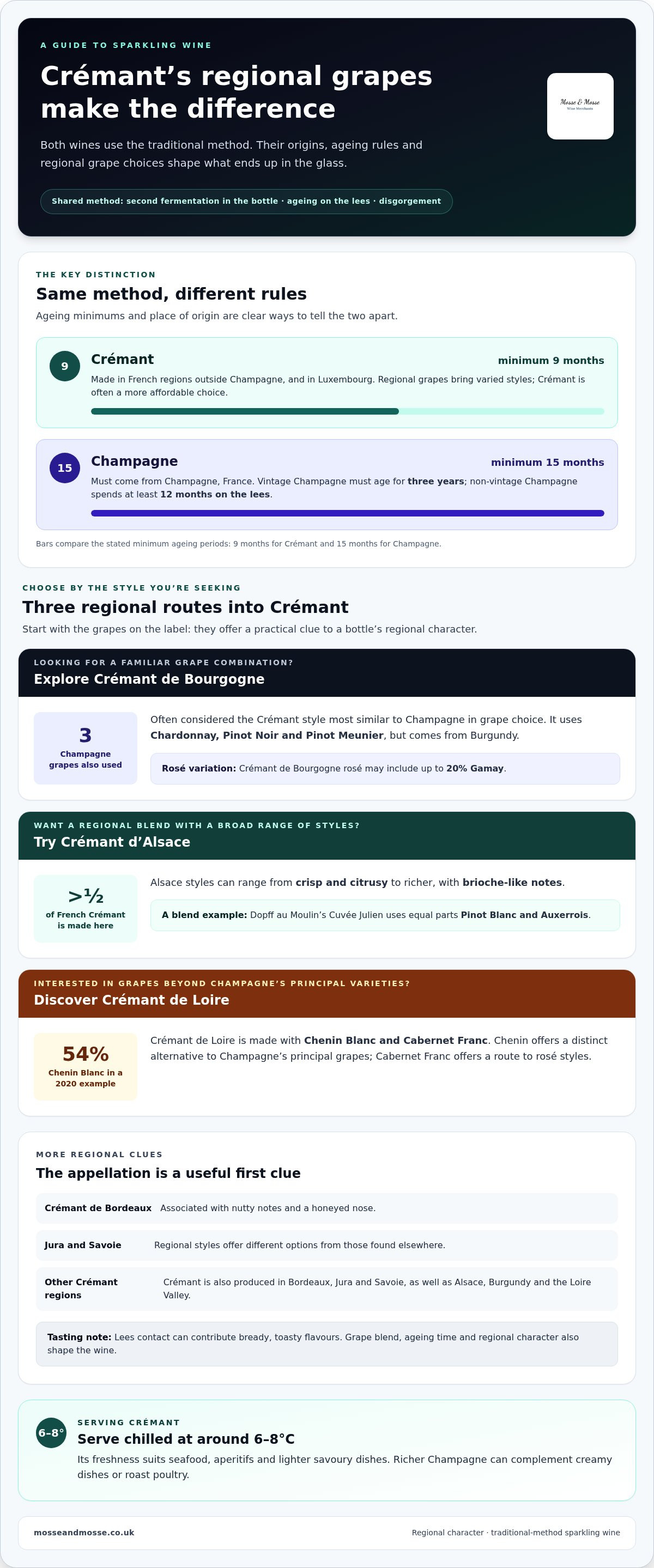
Both are traditional-method sparkling wines, but their origins and ageing rules differ. Crémant has a minimum ageing period of nine months; Champagne must age for at least 15 months, or three years for vintage Champagne.
Crémant production
Crémant is sparkling wine produced in French regions outside Champagne, as well as Luxembourg. Crémant de Bourgogne comes from Burgundy, while Crémant de Loire represents the Loire Valley. The grapes are harvested by hand, then undergo a second fermentation in the bottle. The wine ages on its lees before disgorgement, a process that can develop texture and bready, toasty flavours.
That traditional method gives Crémant finesse, although it tends to have less intensity and structure than Champagne. Styles vary with their region and grapes, so a bottle from Burgundy may feel different from one made in the Loire Valley. Crémant is often a more affordable choice, making it worth exploring for quality and regional character rather than treating it as a Champagne imitation.
Champagne production
Champagne can only be produced in France’s Champagne region under its AOC designation. Its principal grapes are Chardonnay, Pinot Noir and Pinot Meunier. After the first fermentation, producers add a mixture that triggers a second fermentation inside each bottle. The wine then ages on its lees and is disgorged before its final preparation for release.
Champagne’s minimum ageing period is 15 months, with vintage bottles requiring three years. Non-vintage Champagne must spend at least 12 months ageing on lees. Longer ageing can contribute to the wine’s developed, toasty character, alongside fruit notes. Its regional origin, production rules and ageing requirements distinguish it from Crémant, and Champagne often costs more.
Both wines share the key traditional-method stages: a second fermentation in the bottle, lees ageing and disgorgement. This differs from Prosecco, whose second fermentation takes place in a tank. Lees contact can contribute bready, toasty notes, while the grape blend and ageing time also shape a wine’s character. Crémant’s AOC status means it cannot be produced in Champagne or labelled as Champagne.
Does Crémant undergo the same traditional-method ageing requirements as Champagne? No. Crémant has a minimum ageing period of nine months, compared with 15 months for Champagne; vintage Champagne must age for three years.
Serve Crémant chilled at around 6-8°C. Its freshness suits seafood, aperitifs and lighter savoury dishes, whilst richer Champagne can complement creamy dishes or roast poultry.
| Wine | Origin | Method | Minimum ageing | Typical distinction |
|---|---|---|---|---|
| Crémant | French regions outside Champagne and Luxembourg | Second fermentation in bottle | Nine months | Regional variety and often lower price |
| Champagne | Champagne, France | Second fermentation in bottle | 15 months | Defined regional style and longer minimum ageing |
Choose Crémant for regional variety and value, or Champagne for its specific origin and more extended ageing rules.
Crémant’s grape varieties and regional styles
Crémant is not a single, uniform style: its region and grape varieties shape each bottle’s character. Unlike Champagne, which comes from the Champagne region, Crémant is produced across France and Luxembourg, including Alsace, Burgundy, Bordeaux, the Loire Valley, Jura and Savoie. This variety gives sparkling-wine drinkers distinct regional styles to explore.
Crémant d’Alsace is a useful starting point for comparing regional styles. More than half of French Crémant is made in Alsace, and the wines can range from crisp and citrusy to richer, with brioche-like notes. One example is Dopff au Moulin’s Cuvée Julien, made with equal parts Pinot Blanc and Auxerrois. Pinot Blanc gives a regional clue, while the blend shows how producers can combine varieties within one appellation.
Crémant de Bourgogne is often considered the style most similar to Champagne. It uses Chardonnay, Pinot Noir and Pinot Meunier, grapes that also feature in Champagne, although the wines come from a different region. Burgundy’s Crémant can therefore appeal to drinkers seeking a familiar grape combination in a different regional expression. Rosé Crémant de Bourgogne may also include up to 20% Gamay, adding another route into the appellation’s style.
In the Loire Valley, Crémant de Loire is made with Chenin Blanc and Cabernet Franc. Chenin provides a distinct alternative to Champagne’s principal grapes, while Cabernet Franc offers a route to rosé styles. A 2020 Crémant de Loire example contains 54% Chenin Blanc, illustrating how prominently a regional variety can feature in a blend. Crémant de Bordeaux, by contrast, is associated with nutty notes and a honeyed nose.
Jura and Die offer a different option, with regional styles that differ from those found elsewhere. Across regions, grape variety, blending and winemaking decisions influence flavour and texture, so the appellation on the label is a practical first clue. Crémant de Bourgogne and Crémant d’Alsace are recognised value-focused styles, but no single appellation suits every palate or ranks as universally best.
Which Crémant appellations are most prestigious, such as Crémant de Bourgogne or Crémant d’Alsace? Both are well-known styles, and Burgundy Crémant is often the closest match to Champagne in grape choice. The best fit depends on whether you prefer a familiar blend or the distinctive character of another region.
- Choose Crémant de Bourgogne for Chardonnay and Pinot Noir, or rosé with possible Gamay.
- Try Crémant d’Alsace for regional blends such as Pinot Blanc and Auxerrois.
- Explore Crémant de Loire for Chenin Blanc and Cabernet Franc.
To make a tasting flight from contrasting French regions, consider discussing sparkling wine choices.
Grape varieties used in Champagne and Crémant
Grape variety offers a useful clue to a sparkling wine’s flavour and structure. Champagne relies principally on Chardonnay, Pinot Noir and Meunier, while Crémant reflects the grapes grown in its French region. Cava offers another comparison: this Spanish sparkling wine usually draws on Macabeo, Xarel-lo and Parellada. These differences help explain why wines made using similar methods can still have distinct characters.
In Champagne, Pinot Noir, Chardonnay and Pinot Meunier account for 99% of grapes used. Chardonnay can bring freshness and citrus character; Pinot Noir contributes body and red-fruit notes, while Meunier can offer fruitiness. Producers blend varieties to balance these elements, although the proportions vary by wine. Reading the grape details on a label can help you anticipate whether a Champagne leans towards crisp citrus, ripe fruit or a fuller profile.
Crémant d’Alsace shows how regional grape choices can shape style. Dopff au Moulin’s Cuvée Julien combines equal parts Pinot Blanc and Auxerrois. The example highlights why the word Crémant alone doesn’t tell you which grapes shape the wine: the appellation and producer matter. Alsace bottlings range from fresh and crisp to richer, with brioche-like notes, so the blend is a useful starting point, not a guarantee of flavour.
Crémant de Bordeaux has a different tasting cue: its wines are associated with nutty notes and a honeyed nose. The precise blend is not a reliable shortcut to that profile, so consider the region and tasting description together. In Crémant du Jura, only white Crémant is permitted. Terroir describes how a vineyard’s growing conditions shape its grapes; in Jura, the regional setting and the producer’s grape selection both contribute to the wine’s character.
Cava is made mostly in Catalonia, Spain, from varieties including Macabeo, Xarel-lo and Parellada. Its profile is generally dry and citrus-led, with green apple and pear flavours. That offers a different route to freshness from Champagne’s classic trio, and a useful point of comparison with French sparkling wines. Grape names are worth noticing: they give a quick indication of regional identity before you taste.
For a tasting comparison, serve Champagne, an Alsace Crémant and Cava side by side. Notice the fruit first, then the texture and finish. These simple steps help reveal how grape choice and origin influence each wine. A Chardonnay-led Champagne, a Pinot Blanc blend from Alsace and a Macabeo-based Cava each offer a different expression of sparkling wine, even before producer choices come into play.
Recommended Champagne and Crémant wines
A useful tasting comparison starts with wines that show clear differences in grape blend, region and lees ageing. These examples provide three distinct reference points: a Champagne blend, a Chenin-led Crémant de Loire and a Pinot Noir Crémant de Bourgogne rosé. Taste them side by side, rather than treating the label or price as a shortcut for quality.
Montaudon Brut Champagne
Montaudon Brut offers a Champagne blend of 40% Pinot Noir, 35% Chardonnay and 25% Meunier. That combination gives you a practical way to consider how the region’s familiar grape varieties work together. As you taste, note the fruit first, then the texture and any bread or toast aromas from lees ageing. This creates a baseline for comparing Crémant made with grapes from other regions.
Gratiën & Meyer 2020 Crémant de Loire
This Crémant de Loire is made with 54% Chenin Blanc and spent 30 months on the lees. Chenin makes it a particularly useful contrast with the Champagne blend: it highlights a Loire grape rather than relying on the classic Champagne trio. Taste for the wine’s balance and finish, then compare its lees-derived aromas with the Montaudon. The extended lees ageing makes this a strong example for examining how time can shape traditional-method sparkling wines.
Bruno Dangin 2020 Cuvée Rosé Extra Brut Crémant de Bourgogne
Made from 100% Pinot Noir, this Crémant de Bourgogne rosé offers a focused comparison with Champagne’s Pinot Noir-based blends. Its stated drinking window extends to 2030, a useful detail when considering how a vintage bottle may be enjoyed over time. Look for the contribution of Pinot Noir, then compare its expression with the same grape in the Montaudon blend. The wines differ in region, blend and style, despite sharing a grape.
For a tasting at home, pour small samples in the same order: Champagne first, then the Loire Crémant, followed by the Burgundy rosé. Use the same glass style and serving conditions, and note the fruit, acidity, texture and finish of each. This simple approach makes regional differences easier to spot and helps you decide whether you prefer Champagne’s blend, Chenin Blanc’s Loire expression or Pinot Noir’s rosé character.
These bottles are examples for comparison, not a ranking. Their different blends and ageing histories give you distinct reasons to taste each one. Choose the Montaudon to explore a Champagne blend, the Gratiën & Meyer for Chenin and lees ageing, or the Bruno Dangin for single-variety Pinot Noir rosé. Together, they make a focused tasting of three sparkling wines.
Mosse and Mosse: Red Wine
Mosse and Mosse can help you find sparkling wines to suit your tastes. If you enjoy Champagne’s familiar grape blends or want to explore other styles, browse its Champagne and sparkling wines. The selection also includes white wine, an option for a tasting that compares different wine styles.
Think about what you enjoyed most: crisp citrus notes, richer texture or aromas developed through lees ageing. Those preferences can help narrow down what to try next. Mosse and Mosse’s personal service can help turn your tasting notes into a choice that suits your table or occasion.
For help choosing your next bottle, contact Mosse and Mosse or visit mosseandmosse.co.uk.
Choose the bottle that suits your occasion
The most rewarding choice is the one that fits the occasion and the people around your table. Rather than treating the label as the whole story, consider the experience you want: a familiar celebratory pour or the chance to discover a regional style. That’s the practical answer to whether Crémant is as good as Champagne: quality matters, but personal preference makes the comparison.
If you’re planning a meal or gathering, choose a bottle to suit the food and mood. A relaxed tasting can make the decision more enjoyable: pour two contrasting styles, notice which aromas and textures appeal, and let your palate lead. You don’t need one favourite for every occasion. Exploring different wines is part of the pleasure.
Mosse and Mosse can help you find a bottle for your next table or celebration. Contact Mosse and Mosse to talk through your choice, and enjoy discovering the style you love.
Frequently Asked Questions
What is Crémant?
Crémant is sparkling wine made in France and Luxembourg, with French examples named for their regional appellations. A bottle labelled Crémant d’Alsace, for instance, comes from Alsace, while Crémant de Bourgogne points to Burgundy. The term describes a family of regional wines, not one grape or flavour profile. For a first taste, choose a region, then compare its white and rosé styles.
Comparing Styles: What’s the Difference?
The differences in the glass come mainly from the region, grape blend and producer’s choices. If you’re wondering, “Is Crémant as good as Champagne?”, consider what you value: Champagne’s regional character or the variety of Crémant styles. For a practical comparison, taste both with the same food, such as plain salted crisps, then note the fruit, acidity and texture. This helps separate the wine’s character from the influence of food.
Do Crémant wines keep in the cellar like Champagne?
Cellaring potential depends on the individual wine, not simply on whether its label says Crémant or Champagne. Read the producer’s drinking guidance and consider the vintage, grape blend and ageing before release. Store bottles away from light, heat and temperature swings, and keep them away from strong-smelling goods. If you’re buying Crémant to drink later, choose a bottle with a stated drinking window.
Which is most similar to Champagne?
Crémant de Bourgogne is generally the closest match, particularly when its blend uses Chardonnay and Pinot Noir. For a useful tasting, compare a white Crémant de Bourgogne with Champagne made from similar grapes. If you’re asking, “Is Crémant as good as Champagne for this style of tasting?”, compare the aroma, texture and finish for yourself. Similar varieties offer a helpful starting point, but the wines are not identical.
What is Crémant and how is it made?
Crémant is French or Luxembourgish sparkling wine made using the traditional method. The producer first makes still base wine, then starts a second fermentation inside the sealed bottle, creating the bubbles. The wine ages on its lees, which can add savoury, bready aromas. Finally, disgorgement removes the lees before the bottle is prepared for release. Regional grape choices shape the final style.
How is Crémant made differently from Champagne?
The core bottle-fermentation process is shared, but the wines differ in origin, permitted regional grapes and ageing rules. Crémant comes from regions outside Champagne, so its grape mix can reflect Alsace, Burgundy or the Loire. Minimum ageing is nine months for Crémant and 15 months for Champagne; vintage Champagne must age for three years. These distinctions affect identity and production, not an automatic quality ranking.


