
What if the most intimidating wine region on earth is actually one of the simplest to understand? Standing before a wine merchant's shelf lined with cryptic French nomenclature, bewildered by thousands of individual climats, it is entirely natural to feel out of your depth. If you have ever hesitated to explore for fear of paying good money for something disappointingly lean or acidic, this beginner's guide to burgundy wine is written specifically for you.
Burgundy is not an impenetrable enigma; mastering just two core grape varieties and four logical classification tiers unlocks everything. We promise that with a few straightforward insights, you can bypass the pretension, avoid costly missteps, and select bottles you will genuinely relish. In this guide, we demystify traditional French labels, explain the real meaning of terroir, and reveal the approachable, hidden-gem sub-regions offering remarkable character and value for your glass.
Key Takeaways
- Master the Two Essential Grapes: Understand how Pinot Noir and Chardonnay express distinct soils and microclimates through unadulterated, single-varietal winemaking.
- Demystify the Four-Tier Hierarchy: Learn how the classification pyramid functions, remembering that Burgundy classifies the precise vineyard parcel rather than the estate.
- Uncover Exceptional Value: Use this beginner's guide to burgundy wine to look beyond the most famous slopes toward the Côte Chalonnaise and Mâconnais for approachable, characterful drinking.
- Prioritise the Producer Over the Plot: Discover why a dedicated grower's craftsmanship often matters far more to your palate than an illustrious vineyard name alone.
- Serve with Complete Assurance: Pick up practical temperature guidelines and label-decoding tips to ensure every bottle opens at its aromatic best.
Decoding Burgundy Wine: The Two Essential Grapes and Terroir Philosophy
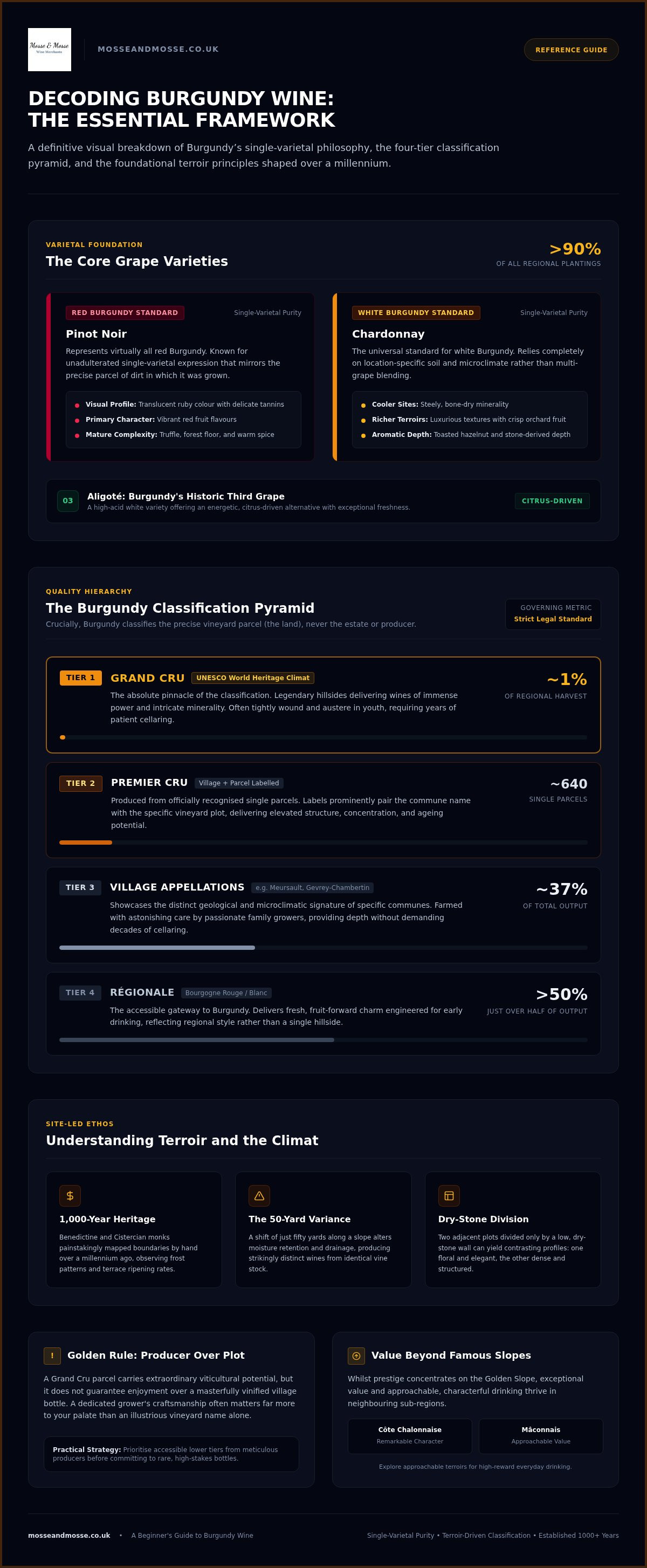
Burgundy, or Bourgogne to the French, is an eastern viticultural corridor defined by single-varietal purity. Unlike Bordeaux, which relies on multi-grape blends, Burgundy produces wines almost entirely from just one red grape and one white grape. Where New World regions promote the grape variety printed prominently across the label, Burgundy elevates origin above all else. In the historic Burgundy wine region, the grape is merely an unadorned lens reflecting the specific patch of dirt where it grew.
This philosophy hinges on terroir, the intimate harmony between limestone bedrock, marl composition, hillside gradient, sunlight exposure, and local microclimate. A change of just fifty yards along a slope alters moisture retention and drainage, producing noticeably different wines from identical vines. For any beginner's guide to burgundy wine, grasping this site-led ethos is the cornerstone to understanding why these bottles taste the way they do.
Pinot Noir and Chardonnay: The Twin Pillars of the Region
These two noble varieties account for over 90% of all vines planted across Burgundy:
- Pinot Noir: Represents virtually all red Burgundy. It yields a translucent ruby colour, delicate tannins, and vibrant red fruit, developing savory aromas of truffle, forest floor, and spice as it matures.
- Chardonnay: Forms the standard for white Burgundy. Depending on where it is grown, it ranges from steely, bone-dry minerality to luxurious textures laced with crisp orchard fruit and toasted hazelnut.
- Aligoté: Burgundy's historic third grape. This high-acid white offers an energetic, citrus-driven alternative that delivers wonderful freshness.
The Concept of Climat: Why Every Single Hillside Matters
A Burgundy climat is a precisely delineated vineyard parcel possessing its own unique geological, topographical, and climatic personality.
Over a thousand years ago, Benedictine and Cistercian monks painstakingly tended these limestone hillsides, observing how seasonal frost settled or how fast grapes ripened on distinct terraces. They mapped these boundaries by hand. Two adjacent plots separated only by a low, dry-stone wall can yield remarkably contrasting bottles. One may deliver bright, floral elegance, whilst the other produces dense, structured depth. That precise individuality is what makes this corner of France endlessly captivating.
The Burgundy Classification System: Understanding the Four Quality Tiers
Burgundy organises its wines into a strict four-tiered pyramid. This legal hierarchy regulates vineyard boundaries, maximum permitted yields, and production standards. Crucially, the system rates the land rather than the producer or the chateau. A Grand Cru designation reflects extraordinary viticultural potential, but it doesn't guarantee your personal enjoyment over a well-made village wine. In this beginner's guide to burgundy wine, our advice is clear: explore accessible, well-crafted lower tiers before committing to rare, high-stakes bottles.
Régionale and Village: The Approachable Gateway to Burgundy
Regional bottlings, labelled simply as Bourgogne Rouge or Bourgogne Blanc, represent just over half of regional production. They offer fresh, fruit-forward charm perfect for early drinking. Village appellations, which account for roughly 37% of Burgundy's output, showcase the distinct geological signature of specific communes such as Meursault or Gevrey-Chambertin. Passionate family growers often farm these plots with astonishing care, outperforming expectations and delivering remarkable depth without demanding decades of cellar patience.
Premier Cru and Grand Cru: Rarity, Prestige, and Complexity
Premier Cru wines originate from roughly 640 officially recognised single parcels. The label prominently pairs the village name with the individual vineyard, yielding enhanced structure, concentration, and ageing potential. Grand Cru sits at the absolute pinnacle, representing barely one percent of Burgundy's total harvest.
Celebrated globally within the UNESCO World Heritage listing for Burgundy's climats, these legendary hillsides deliver wines of immense power and intricate minerality. You don't need to dive into Grand Crus straight away; youthful top-tier wines often taste tightly wound and austere, requiring years of patient cellaring to unlock their layered aromas. If you would like guidance finding expressive bottles ready to enjoy today, you can always get in touch with Tim Mosse for personalised cellar advice.
Navigating Burgundy's Sub-Regions: From Crisp Chablis to the Golden Slope
Burgundy stretches roughly 140 miles from the cool northern valleys near Auxerre down towards Lyon. Subtle climatic shifts and fractured geological fault lines reshape the character of the wines completely as you travel south. For any practical beginner's guide to burgundy wine, mapping these sub-regions turns what feels like an overwhelming labyrinth into an intuitive journey.
Chablis and the Côte d'Or: Heritage, Minerality, and Prestige
Chablis sits isolated in the far north, shaped by cool breezes and ancient Kimmeridgian limestone packed with fossilised marine shells. This soil yields pure, steely Chardonnay defined by crisp green apple notes and saline tension, rarely clouded by new oak.
Further south lies the celebrated Golden Slope, or Côte d'Or. Its northern sector, the Côte de Nuits, represents the spiritual heartland of Pinot Noir. It delivers profound, structured reds boasting black cherry, spice, and extraordinary longevity. Immediately below it, the Côte de Beaune sets the benchmark for rich, multidimensional dry whites, alongside graceful, floral reds that charm early in their evolution.
Côte Chalonnaise and Mâconnais: The Savvy Beginner's Secret
Venturing slightly beyond the famous Golden Slope reveals Burgundy's greatest hidden values. The undulating Côte Chalonnaise serves as a brilliant training ground for newcomers. Communes like Mercurey produce crunchy, bright red-berried Pinot Noir, whilst Rully crafts mineral-driven whites without inflated collector mark-ups.
Further south in the sun-drenched Mâconnais, warmer conditions produce rounder, orchard-fruited Chardonnay with luscious texture. Forward-thinking family growers here produce expressive wines that easily rival more celebrated northern addresses. If you want to sample these rewarding districts without guesswork, reach out to Mosse and Mosse to curate a bespoke mixed case tailored to your palate.
How to Read Burgundy Labels, Serve Confidently, and Begin Your Collection
The cardinal rule of Burgundy is straightforward: producer reputation matters far more than the vineyard name printed across the label. A meticulous, quality-driven vigneron working an unassuming village plot will almost always outshine a careless producer sitting on prestigious Grand Cru terroir. As you conclude this beginner's guide to burgundy wine, learning to decode bottle anatomy and serve each glass properly will ensure every cork you draw delivers complete satisfaction.
Decoding the Bottle Label: Estate Grown versus Negociant
Start by checking where the wine was bottled. The phrase Mis en bouteille au domaine (or à la propriété) confirms that the grower tended the vines, made the wine, and bottled it on site. Respected négociant merchants purchase fruit or barrels across diverse appellations to produce polished, consistent bottlings, yet boutique family domaines offer an intimate snapshot of individual dedication. Track the names of producers you love; an exceptional grower produces captivating wine even in modest vintages.
Serving, Glassware, and Food Pairing for Maximum Enjoyment
Thoughtful serving brings these delicate wines into vivid focus. Red Burgundy flourishes slightly cool at 14°C to 16°C in generous, balloon-shaped glasses that concentrate its fragile violet and red-cherry aromas. Don't serve white Burgundy straight from an icy fridge; drinking it at 10°C to 12°C allows complex stone fruit, limestone minerality, and subtle oak spice to breathe. At the table, red Pinot Noir cuts cleanly through roasted duck, wild mushrooms, and feathered game, whilst white Chardonnay harmonises beautifully with roast chicken, buttery Dover sole, and creamy local cheeses.
Curating Your Personal Burgundy Journey with Expert Guidance
Exploring this historic region is vastly more enjoyable with genuine, independent guidance rather than facing faceless supermarket aisles alone. A specialist merchant can introduce you to rising stars and assemble a balanced tasting flight tailored precisely to your taste. Explore our foundational guide to red Burgundy for deeper varietal insights. When you are ready to begin, Contact Mosse and Mosse for friendly consultation and bespoke mixed cases delivered across the UK mainland.
Taking Your Next Step into Burgundy Wine
Burgundy should never feel like an exclusive club behind closed doors. By focusing on the pure varietal expressions of Pinot Noir and Chardonnay, respecting the four-tier classification, and seeking out dedicated producers in overlooked sub-regions, you now hold the keys to this legendary landscape. As this beginner's guide to burgundy wine demonstrates, choosing an unforgettable bottle isn't about unravelling endless jargon; it's simply about trusting authentic craftsmanship over prestige alone.
At Mosse and Mosse, we take genuine pleasure in bringing that craftsmanship directly to your glass. As an independent boutique merchant based in Suffolk, we personally curate authentic grower Burgundies and cellar-worthy formats, assembling tailored mixed cases delivered safely across the UK mainland. Whether you want to explore approachable regional gems or lay down bottles for special occasions, honest guidance makes all the difference. Speak with our Suffolk wine specialists to curate your Burgundy selection and begin uncorking with absolute confidence.
Frequently Asked Questions About Burgundy Wine
Why is Burgundy wine generally more expensive than Bordeaux?
Land scarcity and extreme vineyard fragmentation drive Burgundy prices higher. Unlike sprawling Bordeaux châteaux covering vast contiguous estates, an average Burgundy domaine manages barely 8.5 hectares divided among multiple tiny parcels. High global demand chasing modest yields from celebrated limestone slopes creates intense competition. While top Côte d'Or crus command substantial premiums, exploring less heralded southern communes provides beginners with superb drinking without excessive cost.
Is all red Burgundy made exclusively from Pinot Noir?
Virtually all red Burgundy is made purely from Pinot Noir, though minor historical exceptions exist. Gamay is permitted in regional blends like Bourgogne Passe-Tout-Grains, and the rustic César grape survives in tiny northern pockets around Irancy. However, as highlighted in this beginner's guide to burgundy wine, every classified Village, Premier Cru, and Grand Cru red bottle you encounter will be 100% Pinot Noir.
What is the difference between Chablis and white Burgundy?
Chablis is white Burgundy, but it represents an entirely distinct stylistic expression of Chardonnay. Positioned far to the north on fossil-rich Kimmeridgian clay and limestone, Chablis produces bone-dry, unoaked wines defined by bracing acidity, green apple, and flinty salinity. Conversely, white Burgundy from the central Côte de Beaune enjoys warmer conditions and subtle oak maturation, yielding richer textures reminiscent of stone fruit and toasted nuts.
Can beginners enjoy Burgundy wine without keeping a cellar?
Yes, many Burgundy appellations are crafted for immediate drinking pleasure upon release. Regional appellations, sunny Mâcon whites, and juicy Côte Chalonnaise reds show glorious fruit and balance in their youth without requiring cellaring. For wine lovers across Ipswich, Norwich, and Bury St Edmunds, Mosse and Mosse hand-selects approachable grower bottles that taste delicious now, removing the need for long-term temperature-controlled storage.
How do I choose between a negociant wine and a domaine bottling?
Choose domaine bottlings when you want distinctive artisan character, and established négociants for dependable regional consistency. A domaine wine indicates the vigneron grew the grapes, made the wine, and bottled it on the estate. Historic négociants purchase grapes or barrels across multiple growers to blend larger cuvées. Both have merit, but boutique domaine bottlings often deliver an authentic sense of place that passionate collectors cherish.
What does 'climat' mean on a Burgundy wine label?
A climat is an officially delineated vineyard parcel with unique geological, topographical, and microclimatic qualities recognised for centuries. When a specific climat name appears beneath the village on a label, all the grapes were harvested exclusively from that named plot. Following this beginner's guide to burgundy wine, spotting a climat is a dependable signpost for pinpointing characterful single-vineyard and Premier Cru expressions.


