
What if sounding knowledgeable about wine had less to do with memorising grape names and more to do with noticing what’s in your glass? If you’ve ever struggled to describe a wine beyond “I like it”, unfamiliar terms can make a simple conversation feel like a test. The good news is that learning how to sound knowledgeable about wine starts with a few clear observations, not a perfect vocabulary.
This guide shows you how to describe a wine naturally, understand useful terms and ask better questions, whether you’re choosing a bottle or chatting over dinner. You’ll learn to notice features such as acidity, tannin and body, then turn them into straightforward descriptions. We’ll also look at how grape and region can guide a conversation, using Burgundy and Bordeaux as examples, and how a wine merchant can help you choose a style you’re likely to enjoy.
Key Takeaways
- Learn how to sound knowledgeable about wine by sharing a clear impression rather than reaching for elaborate tasting notes.
- Connect grape, region and winemaking style to understand what may shape a wine’s character.
- Use tasting descriptors to express an impression, not as proof that a flavouring ingredient was added.
- Practise by noting two observations and comparing them with someone else’s. There’s no need to bluff if your impressions differ.
- Explore contrasting styles over time, and ask a wine merchant for a recommendation that suits what you enjoy.
How to sound knowledgeable about wine starts with noticing the basics
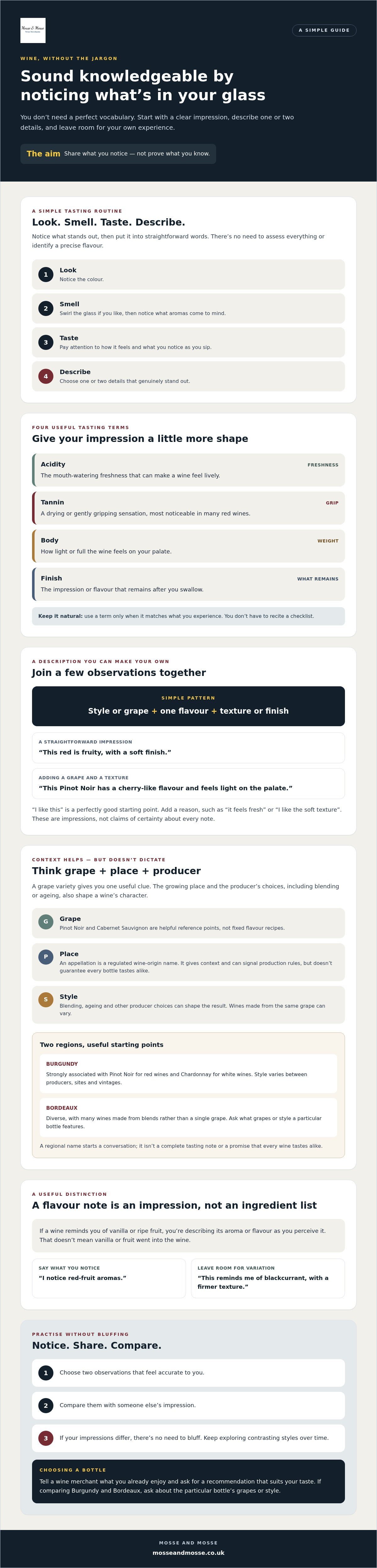
You don’t need specialist credentials to speak confidently about wine. Start with what you can observe, then describe one or two details that genuinely stand out. “I like this” is a perfectly good starting point. Add a reason, such as “it feels fresh” or “I like the soft texture”, and you’ve given someone a clearer sense of your taste.
A straightforward tasting routine is look, smell, taste, describe. First, notice the colour. Swirl the glass if you like, smell the wine, then take a sip and pay attention to its texture and finish. The aim isn’t to produce an elaborate tasting note. It’s to find words that help someone else understand your impression.
What should you notice when tasting wine?
Ask yourself a few simple questions: Does the wine feel lively or soft? Is it light or weighty? Does a particular fruit or other aroma come to mind? You don’t need to assess everything, and you don’t need to identify a precise flavour. Choose one or two details you can describe clearly.
- Acidity is the mouth-watering freshness that can make a wine feel lively.
- Tannin, most noticeable in many red wines, creates a drying or gently gripping sensation.
- Body describes the wine’s weight on your palate, from light to full.
- Finish is the impression or flavour that remains after you swallow.
Use these terms only when they match your experience, rather than reciting them as a checklist. If you’re curious about more aroma and flavour words, this glossary of wine tasting descriptors offers possibilities to explore.
How to turn a first impression into a useful description
Try this simple pattern: style or grape + one flavour + texture or finish. Instead of saying only “It’s nice”, you might say, “This red is fruity, with a soft finish.” If you know the grape, add it: “This Pinot Noir has a cherry-like flavour and feels light on the palate.” You’re describing an impression, not claiming certainty about every note.
Want to explore that example? Explore red Burgundy from the Côte d’Or as one route to understanding red Burgundy. Compare what you notice in different wines, and keep the words that feel accurate to you. That’s how to sound knowledgeable about wine without pretending to know more than you do.
Use wine terms accurately by connecting grape, region and style
A grape variety gives you one useful clue, but it doesn’t dictate exactly how a wine will taste. The growing place and the producer’s choices, such as blending or ageing, also shape the result. Purdue’s overview of wine appreciation likewise connects wine style with grape-growing, winemaking and region.
One distinction helps avoid a common misunderstanding: a tasting descriptor records an impression, not proof that an ingredient was added. If a wine reminds you of vanilla or ripe fruit, you’re describing its aroma or flavour as you perceive it. That doesn’t mean vanilla or fruit went into the wine.
An appellation is a regulated wine-origin name. It identifies where a wine comes from and can signal rules associated with its production. The name gives context, not a guarantee that every bottle will taste alike.
How grape varieties help you describe a wine
Pinot Noir and Cabernet Sauvignon can be helpful reference points, but they aren’t fixed flavour recipes. One Pinot Noir might seem light and savoury, while another feels more concentrated. A Cabernet Sauvignon may seem structured, but the impression can vary with region and winemaking. Try phrases such as “I notice red-fruit aromas” or “this reminds me of blackcurrant, with a firmer texture”. That leaves room for your own experience without presenting it as fact.
Why Burgundy and Bordeaux are useful examples
Regional names help place a wine in context. Burgundy is strongly associated with Pinot Noir for red wines and Chardonnay for white wines, though style varies between producers, sites and vintages. Bordeaux is also diverse, with many wines made from blends rather than a single grape. “Bordeaux” can be a useful starting point for a conversation, but it isn’t a complete tasting note.
If you’d like to explore the regional context, browse this Burgundy wine selection from the Côte de Beaune. For Bordeaux, ask what grapes or style a particular bottle features rather than assuming every wine from the region is alike. Connect what you notice with what you know, while leaving room for variation.
If you’re choosing between Burgundy and Bordeaux styles, ask Mosse and Mosse for a recommendation based on the wines you already enjoy.
Sound natural about wine: avoid jargon, bluffing and common misconceptions
You don’t need memorised facts or an elaborate tasting note to sound informed. A short, honest observation often makes for a better conversation than a string of specialist terms. The aim of learning how to sound knowledgeable about wine is to communicate what you notice and stay curious about what you don’t know.
Keep personal preference separate from production details. “I like this because it feels fresh” is a useful personal response, but it doesn’t establish the wine’s grape variety, origin or winemaking method.
Which wine phrases help, and which can sound forced?
Use everyday words such as fresh, rounded or drying when they genuinely fit your experience. Precise language is helpful; jargon used only to impress can make a simple point harder to follow. Describing a wine as having “notes of vanilla” means it reminds you of that aroma, not that vanilla was necessarily added.
Compare “This has a beautifully integrated, tertiary profile” with “I find it rounded, with a savoury finish.” The second gives someone a clear impression and leaves room for discussion. You can qualify a subjective observation, too: “I get a hint of spice, though I’m not sure what’s behind it.”
How to respond when you do not recognise a wine
Not recognising a grape, place or label is no reason to bluff. Ask a question that opens the conversation:
- “Do you know which grapes are used in this?”
- “Where does this wine come from?”
- “What sort of food would you serve with it?”
These questions show interest, not inexperience. If you’re choosing a bottle, asking a wine merchant for context or a recommendation is a practical way to learn. Try: “I usually enjoy lighter reds. Is there something similar here?” You don’t need to know the answer before you ask.
For a recommendation grounded in what you enjoy, ask Mosse and Mosse about finding a wine to suit your taste.
Practise talking about wine and choose your next bottle with confidence
Confidence grows through practice, not by testing yourself against one bottle or trying to guess the “right” answer. Taste contrasting styles over time and notice what changes. A lighter red beside a fuller one, for example, can help you recognise differences in body and texture more clearly than tasting either in isolation.
A simple way to practise describing wine
After tasting, jot down two observations. If you know the grape or region, include it, then add an aroma and a structural feature, such as freshness, tannin or body. Keep it brief: “Pinot Noir, red-fruit aroma, light on the palate.” Later, compare your notes with a different style and look for similarities or contrasts. Your descriptors are personal observations, not a pass-or-fail test.
Sharing impressions with someone else can help you notice more. They may pick up something you missed, or use different words for a similar sensation. Neither response needs to be wrong. The point is to become more aware of what you enjoy and how you describe it.
How a wine merchant can help you keep learning
A recommendation is easier to tailor when you share a little context. Before asking, consider the occasion, the food, styles you tend to enjoy and your budget. You could say, “I’m looking for a red for dinner, usually prefer lighter styles, and would like to try something a little different.” Or ask for a bottle that offers a useful comparison with one you already know.
If you’re choosing online, the same approach can help you buy wine online with confidence: focus on the style you want and the details that matter to you, rather than feeling you need to recognise every name on the page. Mosse and Mosse is an independent wine merchant based in Suffolk, with a particular focus on Burgundy and Bordeaux, curated wines and personalised service. Its selection includes individual bottles and mixed cases, and its team can help you explore styles that suit your preferences.
Ready to explore a style that suits your taste? Talk to Mosse and Mosse about wine.
Put your wine confidence into practice
Knowing how to sound knowledgeable about wine isn’t about memorising facts or naming every aroma. It’s about noticing a few details, choosing clear words and being honest about what you enjoy. A grape or region can offer helpful context, but your own impressions matter too.
Keep it simple: describe one or two things you notice, stay curious when a wine is unfamiliar and ask questions that help you find a style you’ll enjoy. Taste contrasting wines over time, and your vocabulary will grow naturally. There’s no need to bluff or turn every glass into a test.
If you’d like guidance with your next choice, Mosse and Mosse is an independent Suffolk wine merchant with a particular focus on Burgundy and Bordeaux. Its curated wines and personalised service can help you explore bottles and styles with confidence. Talk to Mosse and Mosse about choosing a wine that suits your preferences.
Trust your palate, ask what you’re curious about and enjoy discovering what’s in your glass.
Frequently Asked Questions
How do you sound knowledgeable about wine if you are a beginner?
Start with what you genuinely notice, then describe it simply. You might mention the wine’s colour, a fruit aroma or whether it feels light or full-bodied. You don’t need to identify every grape or region. Saying “I find this fresh and easy to drink” is more helpful than repeating terms you’re unsure about. Confidence comes from clear observations and curiosity, not pretending to know more than you do.
What are the basic words to describe wine?
Useful starting words include fresh for lively acidity, drying for the sensation of tannin, and light or full-bodied for the wine’s weight on your palate. You can also describe colour, aroma, flavour and finish. Pick one or two details that stand out rather than listing every possible impression. For example, “It’s fruity, with a fresh finish” gives a clear picture without elaborate tasting jargon.
What does tannin mean in wine?
Tannin is a compound found in grape skins, seeds and stems, and it can also come from oak ageing. In a wine, you may notice it as a drying or slightly gripping feeling in your mouth, particularly with some red wines. Describing a wine as “firm” or “soft” in tannin can help explain its texture. The sensation varies, so use the term only if it matches what you feel.
Do you need to know wine regions to talk about wine?
No. You can talk about what you smell, taste and enjoy without knowing where a wine comes from. Learning a little about regions can add useful context: Burgundy is associated with Pinot Noir and Chardonnay, while Bordeaux is known for diverse wines, including blends. Treat a region as a helpful clue, not a guarantee that every bottle will taste the same. Asking where a wine is from is a good way to learn.
Is expensive wine always better?
No. A higher price doesn’t guarantee that a wine will suit your taste or the occasion. What you enjoy depends on your preferences, and a wine’s style, producer and origin can all be relevant when choosing. Rather than assuming price equals quality, consider what you like, what you’re serving it with and the style you want. If you’re unsure, ask a wine merchant to suggest an option that fits your preferences and budget.
What should you say when you do not know much about the wine?
Be honest and ask a specific question. Try, “I haven’t tasted this before. Do you know which grapes it uses?” or “What food would you pair with it?” You could also explain a style you already enjoy and ask for a recommendation. Mosse and Mosse is an independent Suffolk wine merchant with a focus on Burgundy and Bordeaux. It serves customers in Ipswich, Norwich, Bury St Edmunds, Sudbury, Stowmarket, Newmarket, Thetford, Diss, Attleborough, Southwold, Aldeburgh, Framlingham, Woodbridge, Long Stratton and Saxmundham.


