
What if the most impressive-looking bottle on the shelf is actually the one you should avoid? It's a common trap for many enthusiasts. You see a gold-embossed crest and a prestigious-sounding name, yet you still feel that nagging anxiety about overpaying for a mediocre vintage. Learning how to read a french wine label isn't about memorising every tiny plot of land in Europe; it's about understanding the map of terroir that the French have spent centuries perfecting. We've all felt that confusion between producer names and complex regions, wondering if a village-level wine is actually worth the investment.
We believe that true quality speaks for itself, far beyond the reach of clever marketing. This guide will help you master the art of deciphering those cryptic terms so you can confidently select the finest bottles from Burgundy, Bordeaux, and beyond. We'll break down the hierarchy of quality and the relationship between the land and the label. By the end, you'll be able to identify a high-quality bottle at a glance, ensuring you feel like an informed connoisseur whenever you browse a curated collection for your next special occasion.
Key Takeaways
- Understand the significance of AOP and AOC designations to verify the geographic origin and strict production standards of your bottle.
- Distinguish between a Domaine, Château, and Maison to identify if the wine was grown and bottled on a single estate or curated by a merchant.
- Navigate the complex hierarchy of Burgundy and Bordeaux by focusing on terroir and specific vineyard parcels rather than just the grape variety.
- Learn how to read a french wine label in seconds using a simple checklist that prioritises region, producer, and vintage.
- Decipher the "Cru" classifications to identify high-quality growth tiers and ensure you are getting true value for your investment.
The Anatomy of a French Wine Label: Essential Terms and Regulations
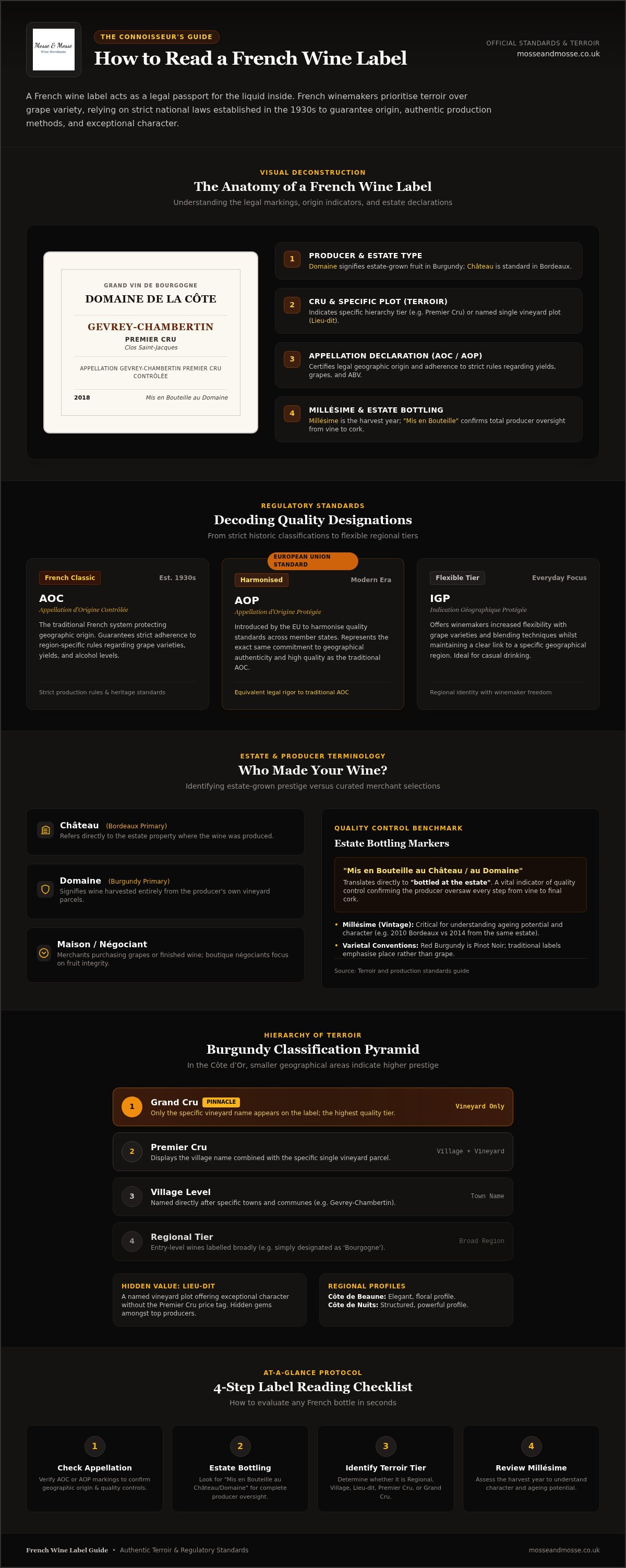
A French wine label acts as a legal passport for the liquid inside. It tells you exactly where the grapes were grown and who turned them into wine. Understanding how to read a french wine label starts with recognising that every word is there for a reason, governed by strict national laws. These regulations ensure that when you buy a bottle from a specific region, it meets the traditional standards of that area. We've spent years studying these nuances to ensure our curated selection reflects true quality rather than just a famous name.
AOP vs AOC: Decoding the Quality Standards
You'll likely see either AOC (Appellation d’Origine Contrôlée) or AOP (Appellation d’Origine Protégée) on your bottle. The AOC is the traditional French system established in the 1930s to protect geographical origin. In recent years, the European Union introduced the AOP designation to harmonise standards across member states. Whilst you'll still see AOC on many classic bottles, they represent the same commitment to quality. These labels guarantee that the wine follows specific rules regarding grape varieties, yields, and alcohol levels. For more casual, everyday drinking, you might find IGP (Indication Géographique Protégée), which offers winemakers more flexibility whilst still maintaining a clear link to a specific region.
Producer Terminology: Château, Domaine, and Négociant
The name of the producer is often the most reliable indicator of what's in the glass. In Bordeaux, you'll almost always see the word "Château," referring to the estate where the wine was made. In Burgundy, the term "Domaine" is more common, signifying that the wine comes from the producer's own vineyards. Both terms imply a level of heritage and personal connection to the land that we value deeply in our selection process.
Sometimes you'll see a "Maison" or "Négociant" name. These are merchants who buy grapes or finished wine from various growers to bottle under their own label. While some large-scale merchants focus on volume, many boutique négociants produce exceptional wines by sourcing from the best small-scale growers. We often prefer these smaller operations where the focus remains on the fruit's integrity.
Look for the phrase "Mis en Bouteille au Château" or "au Domaine." This translates to "bottled at the estate," which is a vital marker of quality control. It means the producer oversaw every step from the vine to the final cork. Finally, the "Millésime" or vintage date tells you the year the grapes were harvested; this is essential for understanding the wine's ageing potential and character. A 2010 Bordeaux, for example, will offer a completely different experience to a 2014, even from the same producer.
Regional Identification: Navigating Burgundy and Bordeaux Labels
French winemakers believe the land speaks louder than the grape. If you're holding a bottle of Red Burgundy, you're drinking Pinot Noir, yet that variety is rarely mentioned. This focus on terroir is why learning how to read a french wine label is so rewarding. It allows you to move beyond basic categories and understand the specific personality of the wine. Whilst the labels may look similar at a distance, the logic behind them differs significantly between the two most famous regions.
Decoding the Côte d’Or: Villages and Vineyards
In the Côte d’Or, the label detail increases as the quality level rises. You'll navigate a strict hierarchy where the smaller the geographical area mentioned, the higher the prestige. Labels from the Côte de Beaune often suggest a more elegant, floral profile compared to the structured power of their northern neighbours in the Côte de Nuits. Look for a "Lieu-dit," which is a named vineyard plot that provides exceptional character without the Premier Cru price tag. These are often hidden gems amongst a producer's wider collection.
- Regional: Labelled simply as 'Bourgogne'.
- Village: Named after specific towns like Gevrey-Chambertin.
- Premier Cru: Includes the village name plus a specific vineyard.
- Grand Cru: Only the vineyard name appears, signifying the pinnacle of quality.
Bordeaux Classifications: From Cru Bourgeois to First Growth
In Bordeaux, the estate name (the Château) takes centre stage. Understanding how to read a french wine label from this region requires looking past the gold foil to the specific classification level. On the Left Bank, you'll find the Médoc and prestigious communal appellations like Margaux. Spotting "Grand Vin" on the label tells you it's the producer's lead wine, whilst "Cru Bourgeois" is a reliable indicator of everyday excellence. These estates are rigorously tested for quality, offering a fantastic way to enjoy the region's heritage without overpaying. If you're building a collection for a special event, we can guide your selection to ensure every bottle hits the mark.
Deciphering the Hierarchy: Cru Classifications and Quality Tiers
The word "Cru" often creates the most confusion when learning how to read a french wine label. Literally translating to "growth," it refers to a specific vineyard or estate recognised for its superior quality. In Bordeaux, the 1855 Classification remains a permanent fixture on labels, ranking estates from First to Fifth Growth. However, you must be careful with the term "Grand Cru" as its meaning shifts depending on the post code. In Saint-Émilion, it's a broad classification that covers many estates, whereas in Burgundy, it represents the absolute pinnacle of a single, tiny vineyard's output.
Premier Cru and Grand Cru: The Peak of Burgundy
On a Burgundy label, the hierarchy is visual and tells a story of prestige. For a Premier Cru, you'll see the village name followed by the vineyard name. For a Grand Cru, the vineyard name stands alone, often in larger type, as the village name is considered secondary to the fame of the plot itself. It's a bold statement of terroir. We've found that a Premier Cru from a truly exceptional producer often outperforms a generic Grand Cru from a less meticulous maker; the producer's skill is the final ingredient that brings the land to life.
Special Classifications: Vieilles Vignes and Beyond
You might spot "Vieilles Vignes" on a bottle, a term we particularly admire for the depth it brings to the glass. While there's no legal minimum age, it generally refers to vines over 30 or 40 years old. These older plants produce fewer grapes, but the fruit they do yield is incredibly concentrated and complex. Similarly, "Cuvée" indicates a specific blend or a specially selected batch that the winemaker felt deserved its own bottling, often representing the best of their cellar.
Understanding how to read a french wine label also applies to your celebrations. When looking at Champagne & Sparkling Wines, the label provides vital clues about the style and sweetness. Terms like "Brut" or "Extra Brut" tell you the wine is dry, whilst a vintage year indicates the grapes all came from a single, exceptional harvest rather than a blend of years. If you're looking for a specific profile for a wedding or private event, contact us for expert advice on selecting the perfect tiers for your guests.
Putting Knowledge into Practice: Choosing Your Next French Favourite
Once you've mastered the basics of how to read a french wine label, the process of selection becomes instinctive. You can quickly scan any bottle for the three essential pillars: region, producer, and vintage. This quick assessment tells you almost everything you need to know about the style and quality before the cork is even pulled. We always suggest looking at the alcohol by volume (ABV) as a final practical check. A wine at 12.5% usually offers a leaner, more acidic profile, whilst one reaching 14.5% suggests a fuller body and riper fruit from a warmer climate or a particularly sunny vintage.
Style Clues Hidden in Plain Sight
The region name is your most reliable guide to the grape variety. If you see Chablis on the label, you're drinking Chardonnay. If it's Sancerre, it's Sauvignon Blanc. Beyond the variety, look for production terms like "Sur Lie" (aged on lees), which hints at a creamy, bready texture and extra depth. The vintage is equally vital; it tells you if the wine is in its youthful, fruit-forward phase or if it has the structure required for long-term cellarage. We've seen how a few years of patience can transform a tightly wound Bordeaux into something truly sublime.
Building Your Collection with Confidence
For special celebrations or grand events, we often recommend Magnums & Larger Formats. These bottles don't just look impressive on a well-set table; the larger volume of wine relative to the air in the neck means they age more gracefully and slowly. It's a choice that marks you out as a true connoisseur who understands the science of the cellar.
When you're buying wine online, it's easy to get lost in generic algorithms and supermarket-style filters. We believe that a personal consultation is far more valuable for finding your next favourite. Whether you're exploring our curated mixed cases to discover new terroirs or hunting for a specific rare vintage, we're here to help you look past the label to the heart of the wine. Recording your favourites helps you identify patterns in your preferred terroirs, making each future selection even more rewarding.
Elevating Your Selection Beyond the Label
You now possess the tools to look past glossy marketing and identify the true character of a bottle. By understanding the hierarchy of Cru classifications and the weight of regional heritage, you can navigate even the most complex collections with total confidence. Mastering how to read a french wine label is ultimately about connecting with the producer's philosophy and the unique terroir of the land. It's the difference between simply buying a bottle and investing in a sensory experience that tells a story of a specific place and time.
As an independent Suffolk-based merchant, we've spent over 25 years specialising in the nuances of Burgundy and Bordeaux. We take pride in helping our clients find hidden gems that offer exceptional value. Whether you are planning a wedding or simply looking to refine your private cellar, we provide a personalised service for private events and weddings. We invite you to discuss your French wine preferences with our expert team. Let's work together to find a bottle that perfectly matches your taste and occasion. Happy exploring.
Frequently Asked Questions
Do French wine labels always show the grape variety?
French labels rarely show the grape variety, as the focus is on the terroir and AOC regulations. For instance, a Red Burgundy is always Pinot Noir, yet you won't find that variety's name on the bottle. This is why learning how to read a french wine label is vital for enthusiasts in Suffolk. The exception is the Alsace region or wines labelled as IGP, where the grape variety is often displayed to help you identify the style.
What is the difference between a Château and a Domaine on a wine label?
The term "Château" is almost exclusively used in Bordeaux to describe a wine estate with its own vineyards and cellar. In contrast, "Domaine" is the preferred term in Burgundy. Both indicate that the wine was produced on a specific property rather than blended by a large-scale merchant. Whether you're browsing our collection in Norwich or Bury St Edmunds, these terms act as a seal of authenticity and a commitment to estate-based quality.
Is a Grand Cru wine always better than a Premier Cru?
While a Grand Cru sits at the top of the official hierarchy, it isn't always superior to a Premier Cru. The producer's skill and the specific vintage play a massive role in the final glass. We've often found that a Premier Cru from a meticulous maker can offer more depth and pleasure than a generic Grand Cru. It's about finding the right balance between the land's potential and the winemaker's dedication to their craft.
What does "Mis en Bouteille au Château" mean?
This phrase translates to "bottled at the estate" and is a key indicator of quality control. It means the producer handled everything from the harvest to the final corking on their own property. This ensures the wine hasn't been transported in bulk, which can sometimes affect its integrity. It's a marker we look for when curating our list for clients in Newmarket and Woodbridge, as it guarantees a direct link to the source.
Why do some French labels have a specific vineyard name while others only show the village?
The presence of a vineyard name indicates a higher level of classification within the AOC system. A label showing only a village name, like Margaux or Gevrey-Chambertin, means the grapes could come from anywhere within that town's boundaries. When a specific vineyard or "Lieu-dit" is named, it signifies a unique plot of land with distinct characteristics. Understanding how to read a french wine label helps you spot these specific sites that offer more concentrated and complex flavours.
How can I tell if a French wine is dry or sweet from the label?
You can identify the sweetness by looking for specific French terms. "Sec" means dry, "Demi-Sec" is off-dry, and "Moelleux" or "Doux" indicates a sweet dessert style. For Champagne, the scale is slightly different; "Brut" is the standard for dry, whilst "Extra Brut" or "Brut Nature" suggests even less residual sugar. If you're planning a wedding in Southwold or Aldeburgh, checking these terms ensures your selection perfectly matches your menu and guest preferences.


