
If you’ve ever stood before a shelf of dust-covered bottles and felt that familiar pang of indecision, you’re certainly not alone. The debate of burgundy vs bordeaux is the oldest rivalry in the wine world, yet the complex labelling laws and high stakes can make even a seasoned enthusiast feel out of their depth. It’s easy to worry that you’re paying for a famous château name rather than a wine you’ll truly enjoy, or to wonder why one region insists on blending grapes whilst the other focuses on a single, singular variety.
We believe that choosing wine should be a pleasure, not a puzzle. Our goal is to give you a clear framework for your next purchase by exploring the essential differences in grapes, philosophy, and flavour profiles. You'll learn how the structured, architectural power of a Bordeaux blend compares to the intimate expression of a Burgundian "climat." We will also share our favourite food pairings and the secrets to hunting for genuine value, giving you the confidence to choose a bottle that perfectly suits your cellar and your table.
Key Takeaways
- Master the core geographic split and understand why one region relies on complex blending whilst the other champions the purity of a single grape variety.
- Explore how history and inheritance laws created the striking contrast between grand, aristocratic estates and intimate, fragmented vineyard plots.
- Use our practical palate guide to settle the burgundy vs bordeaux dilemma, helping you choose between structured power and delicate, evolving perfume.
- Discover why prioritising producer quality over famous labels is the most effective way to secure exceptional value for your cellar or table.
- Learn how to pair these distinct styles with food to ensure every bottle you open delivers a truly memorable sensory experience.
The Fundamental Divide: Grapes, Terroir, and Style
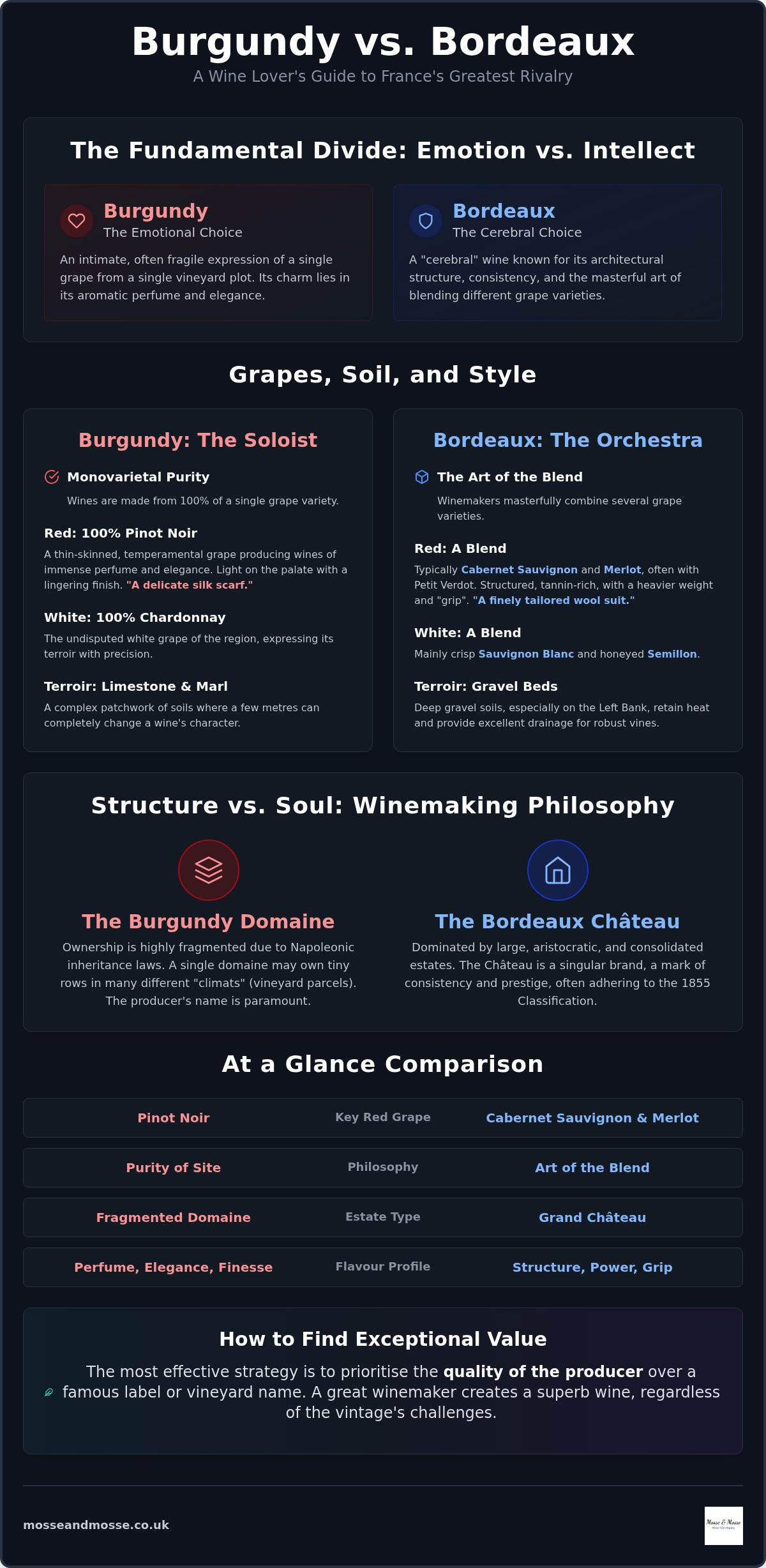
The geographic split between these two titans defines the very character of French wine regions. Bordeaux sits in the humid, maritime south-west, whilst Burgundy is nestled in the continental east. This distance creates two entirely different personalities. Many enthusiasts describe the experience of burgundy vs bordeaux as a choice between emotion and intellect. Bordeaux is often seen as "Cerebral" because of its architectural structure and consistent blending traditions. Burgundy, by contrast, is "Emotional," offering a singular, often fragile expression of a single vineyard plot.
Whilst Bordeaux winemakers are masters of the blend, typically combining Cabernet Sauvignon with Merlot and Petit Verdot, Burgundy is strictly monovarietal. If you're drinking a red from the Côte d'Or, it is 100% Pinot Noir. This philosophy extends to the white wine counterparts too. You'll find crisp Sauvignon Blanc and honeyed Semillon blends in the south-west, but in the east, Chardonnay reigns supreme and unchallenged. It's a fascinating study in how different grapes interpret the land.
The Varietal Split: Pinot Noir vs Cabernet Sauvignon
Pinot Noir is a notoriously temperamental, thin-skinned grape. In Burgundy, it produces wines of immense perfume, transparency, and elegance that feel light on the palate but linger for minutes. Bordeaux relies on the muscle of Cabernet Sauvignon. These wines are structured and tannin-rich, providing a heavier weight and a sense of "grip" that Pinot Noir simply doesn't possess. It's the difference between a delicate silk scarf and a finely tailored wool suit. One charms with aromatics; the other impresses with power.
Understanding Terroir: Gravel vs Limestone
The soil is the silent partner in this rivalry. In Bordeaux, particularly on the Left Bank, the land is dominated by deep gravel beds that retain heat and force vines to struggle. Burgundy’s Côte d’Or is a complex patchwork of limestone and marl, where a few metres can change the wine's character entirely. We define terroir as the unique intersection where soil, climate, and the human hand meet to create something that can't be replicated anywhere else on earth.
Structure vs Soul: The Winemaking Philosophies
The cultural gap between these two regions is vast. Bordeaux feels like an aristocratic endeavour with its grand châteaux, whilst Burgundy remains rooted in the soil, often managed by the same family for generations. This is often framed as France's ultimate wine duel, pitting the art of the blend against the purity of the site. In Bordeaux, the winemaker uses a palette of grapes to maintain a "house style" even in difficult years. Burgundy winemakers have no such safety net. If the frost hits their single variety, the vintage is defined by that struggle. This creates a "vintage lottery" in the east that makes the role of a trusted merchant essential for finding quality.
Why is Burgundy so fragmented? We have the Napoleonic Code to thank. These inheritance laws required estates to be split equally amongst heirs, resulting in the tiny strips of vines we see today. You might find ten different producers owning rows in the same small vineyard, each making a different wine from the same soil. In Bordeaux, the estates are larger and more consolidated. This makes the burgundy vs bordeaux choice a matter of scale. Do you want the reliable majesty of a grand estate or the intimate, varying story of a small family plot?
The Bordeaux Château: Consistency and Prestige
A Bordeaux Château is more than just a building; it's a singular brand and a mark of consistency. In the Médoc, this architectural approach to winemaking is most evident. Most estates still follow the 1855 Classification, a hierarchy that has dictated prestige for nearly two centuries. Whilst recent market shifts have seen land values in Pauillac and Margaux dip by over 20% since 2018, the prestige of the top names remains a global benchmark for quality and longevity.
The Burgundy Domaine: Intimacy and the Climat
In Burgundy, we talk about Domaines. These aren't singular estates but collections of "climats," which are specific vineyard parcels. A producer might have a few rows in the Côte de Nuits for powerful, earthy reds and others in the Côte de Beaune for elegant whites. Because ownership is so fragmented, the name of the producer is often more important than the vineyard itself. Finding the right bottle requires a bit of detective work. If you're feeling overwhelmed by the choices, get in touch for a personal recommendation from our cellar.
A Practical Guide to Choosing Your Favourite Style
Finding your preference in the burgundy vs bordeaux rivalry often comes down to a simple palate test. Ask yourself if you prefer the structured, blackcurrant and cedar notes of a Cabernet-heavy blend, or the ethereal, red-fruit and forest-floor aromatics of a pure Pinot Noir. Bordeaux offers a sense of "grip" and power that commands attention, whilst Burgundy provides a delicate, evolving perfume that rewards patience. In 2026, the market has shifted significantly. With Bordeaux vineyard values in regions like Saint-Émilion falling by 25.9% since 2018, there's a rare opportunity to find exceptional quality without the inflated trophy pricing of the past.
Occasions and Cellaring: When to Open Which?
Bordeaux remains the traditional choice for formal dinners and long-term cellaring. Its firm tannin structure acts as a natural preservative, allowing the wine to improve and soften over decades. Burgundy is better suited for intimate gatherings where the wine can be contemplated as it changes in the glass. For a standard Village-level bottle from either region, we recommend drinking it within five to eight years of the vintage to capture its peak fruit and secondary complexity.
Food Pairing: From Sunday Roast to Delicate Game
Pairing these wines requires matching the weight of the dish to the structure of the grape. A robust Bordeaux demands proteins that can stand up to its tannins, such as a traditional leg of lamb, rib of beef, or a mature, crumbly cheddar. Burgundy requires a more nuanced approach. Its high acidity and red-fruit profile make it a perfect partner for earthy flavours like pan-seared duck breast, wild mushrooms, or roasted guinea fowl. If you're planning a larger event, we offer tailored wedding and party wine advice to help you select the right style for your menu.
We take pride in hunting for value amongst smaller, independent producers who prioritise the bottle's contents over the label's fame. Even though Burgundy's share of French wine exports grew to 12.5% in 2025, we still focus on those hidden gems that offer the best price-to-quality ratio. If you'd like us to curate a selection based on your specific palate, contact our team for a personal consultation.
Navigating the Regions with Mosse and Mosse
Our family business has spent over 25 years refining our expertise in these legendary regions. We don't believe you should have to choose based on a label's prestige alone. Instead, we hunt for the quality inside the bottle. The burgundy vs bordeaux debate often feels daunting because of the sheer volume of choices, but our curated mixed cases are designed to take that guesswork away. We focus on direct relationships with producers who care as much about their soil as we do about your personal enjoyment.
With Bordeaux wine shipments falling below the three million hectolitre mark in early 2026, the market is shifting. We help you find the value that remains hidden from those only chasing famous names. If you're looking for that elusive intersection of quality and price, we often point our clients toward the Côte Chalonnaise. It's a region that offers the Burgundian soul and elegance at a far more accessible price point than its famous northern neighbours in the Côte d'Or.
Our Sourcing Process: Finding the Hidden Gems
Our selection process is a passionate hunt. We spend our time in the cellars of family Domaines rather than following fleeting marketing trends. Whilst larger retailers might focus on high-volume brands, we look for traditional European producers who prioritise terroir over commercial branding. These long-standing relationships allow us to offer wines that truly represent their origin. We've seen firsthand how a dedicated, small-scale producer can outperform a famous Château when the focus is on the vine rather than the marketing budget.
Building Your Collection: Magnums and Gifts
A great collection isn't just about standard bottles. We believe Magnums and larger formats are the ultimate way to celebrate, offering superior ageing potential and a sense of occasion. If you're looking to share your passion with others, our corporate and private gift boxes provide a bespoke way to give something meaningful. Whether you are stocking a cellar or choosing a single bottle for Sunday lunch, we're here to guide you.
We invite you to reach out to us directly for a personalised consultation to help you navigate the nuances of burgundy vs bordeaux. Explore our hand-picked selection of Burgundy and Bordeaux today and discover the difference that expert curation makes to your table.
Elevate Your Cellar with Confidence
Choosing between burgundy vs bordeaux doesn't have to be a source of stress. Whether you're drawn to the architectural power of a Cabernet blend or the evocative perfume of a single-vineyard Pinot Noir, the secret lies in looking beyond the branding. By focusing on the quality of the producer and the integrity of the vintage, you'll discover that both regions offer exceptional rewards for the curious drinker. We've seen how the market is changing, and there's never been a better time to find genuine value amongst independent estates.
As a family-run independent merchant with over 25 years of expertise in French fine wine, we take pride in doing the hard work for you. We hunt for hidden gems so you don't have to worry about overpaying for a famous name that doesn't suit your taste. With UK mainland delivery on all orders, getting a curated selection to your door is simple and reliable. If you're ready to explore these legendary regions further, browse our curated collection of Burgundy and Bordeaux or get in touch for a personal recommendation. We're here to help you find that perfect bottle for your next special occasion.
Common Questions About Burgundy and Bordeaux
Is Burgundy more expensive than Bordeaux?
Top-tier Burgundy often commands higher prices at the very peak of the market because the production volumes are so tiny compared to the large estates of the south-west. Whilst a famous Bordeaux Château might produce thousands of cases, a Burgundy Grand Cru might only yield a few hundred. However, the burgundy vs bordeaux price gap is narrowing in some sectors. Recent data from 2025 shows that Bordeaux is adjusting to a market crisis, with land values in prestigious areas like Saint-Émilion falling by 25.9% since 2018, making high-quality Bordeaux more accessible than it has been in years.
Which region is better for beginners starting a wine cellar?
Bordeaux is generally considered the more approachable starting point for a new collector because of its structured classification system. The 1855 Classification provides a clear hierarchy that helps you understand what you are buying without needing to memorise every individual producer's history. Burgundy is a lifelong study that requires more intimate knowledge of specific Domaines and tiny vineyard plots. We often suggest starting with a few cases of Bordeaux for reliable ageing whilst you explore the more nuanced, producer-led world of Burgundy.
Can I find good white wine in both Burgundy and Bordeaux?
You certainly can, though the styles are worlds apart. Burgundy is the global benchmark for Chardonnay, producing everything from the crisp, mineral-driven wines of Chablis to the rich, buttery textures of Meursault. Bordeaux specialises in blends of Sauvignon Blanc and Semillon. These wines, particularly from the Pessac-Léognan region, offer a beautiful balance of citrus zest and waxy complexity. Both regions produce world-class whites that deserve a place on any serious table.
Why does Bordeaux wine usually come in a different bottle shape to Burgundy?
The high, square shoulders of a Bordeaux bottle were traditionally designed to catch sediment as the wine is poured into a decanter. Because Bordeaux blends are rich in tannins, they throw more sediment as they age over decades. Burgundy bottles have a gentle, sloped shape because Pinot Noir is a thin-skinned grape that produces very little sediment. Historically, the sloped Burgundy shape was also easier for glassblowers to produce in the eastern regions of France.
What does "Right Bank" and "Left Bank" mean in Bordeaux?
This refers to where the vineyards sit in relation to the Gironde estuary and the rivers that bisect the region. The Left Bank is famous for its gravel-rich soils and Cabernet Sauvignon dominance, producing structured wines with great longevity. The Right Bank is dominated by clay and limestone soils where Merlot thrives, resulting in wines that are generally softer, more plum-driven, and approachable at a younger age. Knowing the difference is the first step in mastering the burgundy vs bordeaux divide.
How long should I age a bottle of Red Burgundy before opening?
Most Village-level Burgundy is at its most charming between 5 and 10 years after the vintage. Whilst the most prestigious Grand Crus can evolve beautifully for 20 years or more, Pinot Noir's delicate structure means it often reaches its peak sooner than a tannic Bordeaux. We always recommend checking the specific vintage conditions. For example, the 2025 Burgundy harvest showed excellent maturity and balance, suggesting these wines may have a very rewarding mid-term ageing potential.


