

Burgundy’s name on the label is only the beginning of the price story. For burgundy en primeur 2026, bottle prices depend on the appellation, producer and cru level, while case options shape the size of the purchase. Early market discussion describes the vintage as small but promising, but that alone doesn’t determine what an individual wine will cost.
It’s understandable to want clear prices before deciding which wines to buy. En primeur offers can differ widely across Burgundy, from regional wines to village, Premier Cru and Grand Cru bottles, so knowing how the classifications relate to the wines is just as useful as comparing figures.
This guide explains how to read bottle prices and case formats, compare Burgundy’s appellation and cru levels, and understand the en primeur buying process, including offers and allocations. You’ll have a clearer framework for weighing a wine’s place in Burgundy against its price and choosing what suits your cellar.
Key Takeaways
- Compare bottle prices in context: appellation, producer and cru level all shape what a Burgundy wine offers.
- Understand how regional, village, Premier Cru and Grand Cru classifications help you navigate the range.
- Look at case formats alongside individual bottle prices to judge which buying option suits your plans.
- Learn how en primeur offers and allocations work, and why limited yields can affect fulfilment.
- Follow the factors that influence release timing for the 2026 campaign, including producers’ decisions on when to make offers.
Bottle prices and case options
A price verdict for Burgundy en primeur 2026 cannot be drawn from vintage labels alone. The 2025 campaign is expected in January 2027, although some advance offers appear earlier. Until wines and offers are compared directly, the vintage year alone gives no like-for-like price measure.
The 2026 vintage has been described as small but promising. Growing conditions and the resulting crop can influence how much wine producers have to sell. That context may help explain an offer, but it doesn’t set a bottle price. Producer, appellation, cru classification and demand also shape the figure.
For a recent reference point, most Burgundy 2024 release prices were kept stable, with some wines reduced. That broad pattern doesn’t mean every 2024 bottle cost the same as its previous release, or that 2026 will follow suit. Compare individual wines and producers, rather than treating a region-wide summary as a price list.
Quality also varied within 2024. The vintage was described as having mixed-quality reds and excellent whites. That distinction matters when comparing a red and a white at similar appellation levels: the label’s colour and producer can affect how the release is positioned. Price alone won’t show whether the wine suits your cellar or drinking plans.
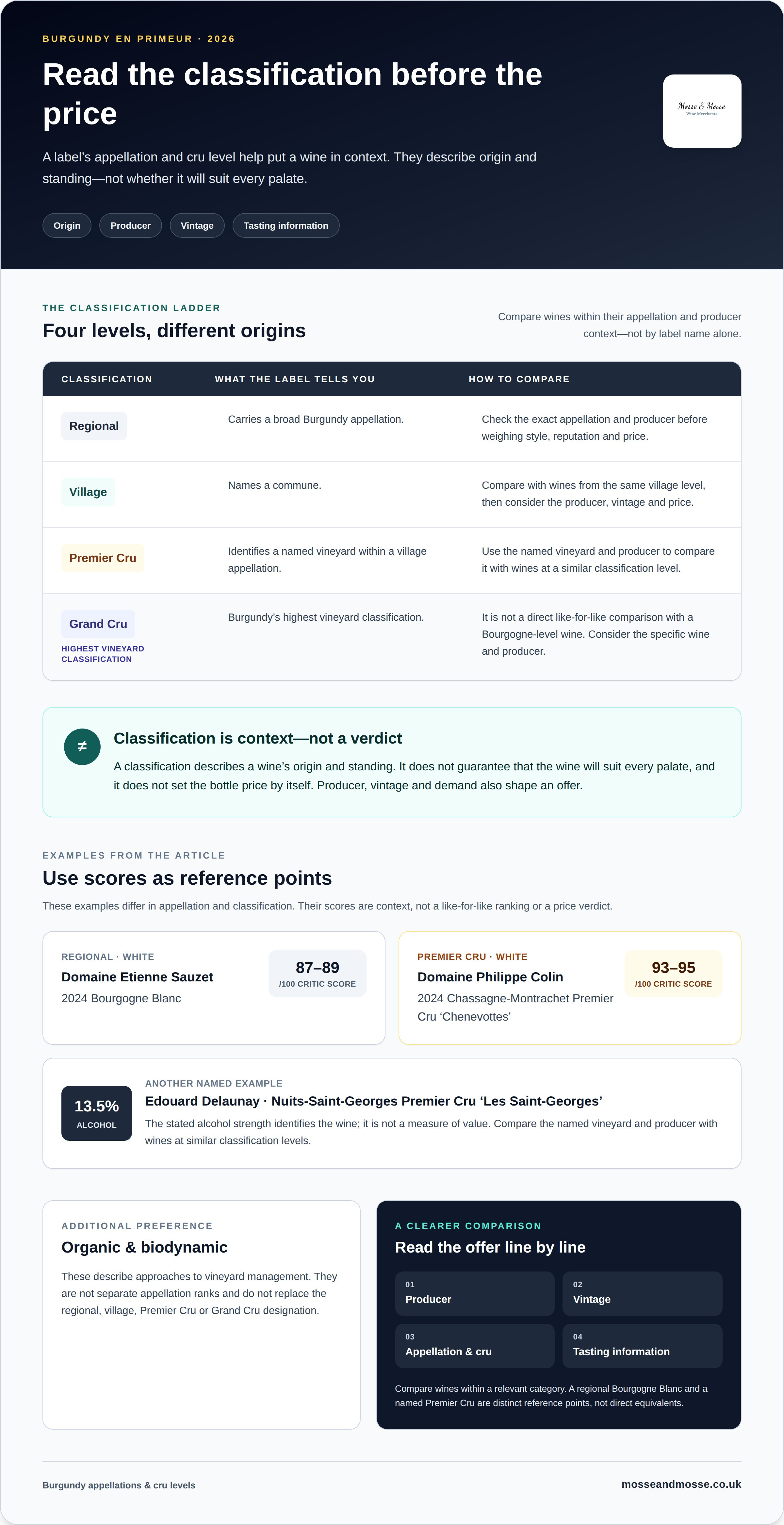
Read the offer line by line. Note the producer, vintage, appellation, cru and bottle format before comparing prices. A Bourgogne-level wine and a Grand Cru aren’t direct equivalents, even if both appear in Burgundy offers. The next section explains how those classifications help make comparisons more meaningful.
Check case details carefully: how many bottles it contains, whether it holds one wine or a selection, and whether the price is per bottle or per case. Multiply the per-bottle price by the case quantity to understand the total cost. Don’t assume every producer or offer uses the same case format.
A mixed case can bring together different appellations or producers, while a single-wine case focuses your purchase on one choice. The right format depends on whether you want to explore variety or build depth around a particular wine. In either case, compare the total cost with the price per bottle.
For 2024 comparisons, also separate the release price from the later buying decision. A stated price belongs to a specific wine, format and offer. Keep those details together when reviewing options, so a case total isn’t mistaken for a bottle price. This makes comparisons across Burgundy clearer without implying that 2026 pricing will match 2024.
There is not yet a like-for-like price comparison between the 2026 and 2025 vintages. Compare individual wines and offers directly, since the vintage year alone does not determine price.
Regional, Village, Premier Cru and Grand Cru wines
Burgundy’s classification helps explain a wine’s origin and standing. For a useful comparison, read the appellation alongside the producer, vintage and tasting information.
Appellation and classification choices
Regional wines carry broad Burgundy appellations, while village wines name a commune. Premier Cru identifies a named vineyard within a village appellation; Grand Cru is Burgundy’s highest vineyard classification. These levels describe origin, not a guarantee that a wine will suit every palate. Compare the exact appellation and producer before weighing style, reputation and price.
Value across appellations and producers
There’s no single best-value appellation or producer for every buyer. Value depends on the wine’s release price, classification, producer and the quality you want in the glass. Among named examples, Domaine Etienne Sauzet’s 2024 Bourgogne Blanc has a critic score of 87-89/100. Domaine Philippe Colin’s 2024 Chassagne-Montrachet Premier Cru ‘Chenevottes’ scores 93-95/100. These offer distinct reference points, not a like-for-like comparison.
Use scores as context, not as a verdict on price. Bourgogne Blanc and Chassagne-Montrachet Premier Cru differ in appellation and classification, so compare their prices against their respective levels. A named Premier Cru from Domaine Philippe Colin can illustrate how a vineyard-specific wine compares with regional Bourgogne Blanc. Producer reputation and vintage also shape the assessment.
A further example is Edouard Delaunay’s Nuits-Saint-Georges Premier Cru ‘Les Saint-Georges’, listed at 13.5% alcohol. That detail identifies the wine’s stated strength, not its value. Compare the named vineyard and producer with other wines at similar classification levels. The Côte de Nuits and Côte de Beaune also provide useful regional context for understanding where many Burgundy appellations sit.
Organic and biodynamic choices
Organic and biodynamic describe approaches to vineyard management, not separate appellation ranks. They don’t replace the regional, village, Premier Cru or Grand Cru designation on a label. For example, compare an organic village wine with another village wine, then assess producer, vintage and price. Treat farming approach as an additional preference alongside the details that identify the wine.
To create a grounded shortlist, first choose the classification and style that fit your plans. Then compare producers within that category, using vintage information and critic scores where available. The Domaine Etienne Sauzet and Domaine Philippe Colin examples show why regional wines and Premier Cru wines should be assessed in context, not ranked by score alone.
If you’d like a personal conversation about Burgundy styles and classifications, get in touch.
Burgundy en primeur buying
En primeur offers let buyers secure wines before delivery. UK buyers should compare payment, storage and allocation terms before committing.
Purchase charges and storage
Buying wine in bond defers duty and VAT, so the quoted offer and eventual cost may differ. Check how the merchant lists each charge and when it becomes payable. No duty or VAT rate is given here, so don’t apply a guessed figure to a Burgundy order.
Review storage separately. Ask for any storage charge to be listed separately from the wine price, with the relevant terms clearly explained. Check whether delivery is included or charged separately. These details reveal the full commitment, rather than leaving you to judge an offer by its bottle price alone.
Release timing
A firm release date for 2026 wines isn’t available here. Producers decide when to make offers, and some may release ahead of a wider campaign. One market view is that producers might bring forward offers to raise funds amid geopolitical and economic uncertainty. Treat that as a possibility, not a published timetable.
Keep the vintage year distinct from the campaign year. Burgundy’s 2025 campaign is expected in January 2027, with some advance offers appearing earlier. That timing applies to the 2025 vintage, not automatically to 2026 wines. For a 2026 offer, note the release date attached to that specific wine.
Participating producers and négociants
Pierrick Bouley and Clement Colin-Morey had advance offers for the 2025 Burgundy campaign. Those are named 2025 examples; they don’t establish participation in the 2026 campaign. Treat each producer or négociant name as relevant only to the vintage and offer stated alongside it.
For a 2026 selection, use the release itself to identify each participant. Match the producer or négociant to the vintage, appellation and specific wine. A producer’s previous campaign can provide useful context, but it doesn’t confirm a later offer or guarantee that the same wines will appear.
Merchant reputation and allocation terms
When choosing a UK merchant, review how clearly the offer presents the wine, price and terms. Look for the named producer, vintage, appellation, case format and payment conditions. Check how storage and delivery are handled, and whether costs are itemised. Clear details make offers easier to compare on equal terms.
Allocation terms matter when a small crop limits supply. Robert Rolls warned that low yields may prevent a supplier from fulfilling every order, and that many wines may be allocated. Read the stated quantity and fulfilment terms carefully. Before relying on a specific case, understand what happens if the full order cannot be supplied.
For a considered discussion of Burgundy offers and buying terms, contact Mosse and Mosse.
When will Burgundy 2026 en primeur wines be released?
No single release date for Burgundy’s 2026 wines can be given. The vintage year doesn’t itself set the campaign date, and a producer may make an offer before a wider release period. For buyers, the useful distinction is between the year on the wine and the date its offer becomes available.
Use the 2025 campaign as context
The Burgundy 2025 campaign is expected in January 2027, although some advance offers are appearing earlier. That date belongs to the 2025 vintage, not the 2026 wines. It offers a reference for how campaigns can develop, rather than a timetable to apply to the following vintage.
Advance offers from Pierrick Bouley and Clement Colin-Morey illustrate how named producers may appear before a broader campaign. Those offers concern 2025, so they don’t establish when either producer will offer 2026 wines. Keep the vintage attached to every date and offer you review.
Why release timing can vary
Producers make release decisions individually, so offers can arrive at different points. The timing may reflect commercial priorities as well as the decision to present the wines. One market view suggests producers might release early to bring money into their banks amid geopolitical and economic uncertainty. That is a possible influence, not a confirmed schedule for Burgundy’s 2026 wines.
Supply can shape the buying window too. Burgundy’s 2024 en primeur offers had generally been available for no more than a week when a newsletter went to press. That example shows why an offer’s appearance and its ordering deadline are separate details. It doesn’t predict the length of a 2026 offer.
How to follow a 2026 offer
When a 2026 offer appears, note the producer, wine, vintage and release date together. Then read the ordering deadline and allocation terms. These details show whether the offer is open for a limited period or linked to a restricted quantity. A campaign announcement alone won’t tell you those terms for each wine.
Keep separate records for advance offers and any later campaign release. For example, an early producer offer may precede other wines, while a merchant’s wider list may follow later. Comparing dates this way helps prevent a 2025 campaign reference from being mistaken for a 2026 release announcement.
For a considered conversation about Burgundy offers and release timing, discuss your Burgundy buying plans.
Mosse and Mosse
Mosse and Mosse offers a considered selection for anyone weighing Burgundy wines, including releases related to burgundy en primeur 2026. Based in Suffolk, the merchant serves wine enthusiasts across the UK mainland with personalised service to help you explore producers and regions in light of your preferences.
If you're considering other styles for your cellar, the range also includes white wine, Champagne and sparkling wines. These offer alternatives to compare with Burgundy while keeping their distinct styles and origins in mind.
For a personal conversation about your wine choices, contact Mosse and Mosse.
Choose wines with your cellar in mind
Let the role each bottle will play in your cellar guide your next step. Consider a Burgundy purchase alongside the occasions and styles you enjoy, whether you’re building a collection, choosing wines to share or exploring another region. That broader perspective can make a release decision more personal than simply following a vintage’s reputation.
For buyers weighing Burgundy en primeur in 2026, Mosse and Mosse’s range includes red wine, white wine, and Champagne and sparkling wines. The right choice depends on your tastes and what you want to drink or keep. A conversation can help you think through those preferences and the wines that may suit them, without treating every release as a must-buy.
Take the next step at your own pace. Contact Mosse and Mosse to discuss your wine choices and find bottles that feel right for you.
Frequently Asked Questions
What are UK prices for Burgundy 2026 en primeur wines?
There isn’t one UK price for Burgundy en primeur in 2026: each offer is priced by wine. The producer, appellation, cru classification, format and case size all affect the amount payable. Compare like with like, such as the same format and classification, and distinguish a per-bottle figure from a case total. A vintage-wide description alone can’t tell you what a particular wine will cost.
How does buying Burgundy en primeur work in the UK, including payment and delivery?
You reserve a wine before bottling, then follow the payment and delivery terms attached to the offer. The merchant’s paperwork should explain when payment is due, how the wine is stored and how delivery is arranged after bottling. Buying in bond defers duty and VAT until the wine leaves bond. Read the charges carefully, since storage, delivery and payment arrangements depend on the offer’s terms.
What are the risks of buying Burgundy en primeur before bottling?
The main risks are committing before you can taste the finished bottle and not receiving every wine ordered. Low yields can lead to allocations or prevent a supplier from fulfilling an order in full. The wine’s final character may also differ from expectations based on its early development. Consider how comfortable you are with these uncertainties, and read the offer’s fulfilment and storage terms before ordering.
What VAT, duty and storage charges apply to UK Burgundy en primeur purchases?
Buying wine in bond defers duty and VAT, so the quoted offer may differ from the eventual cost. Check when charges are payable, and review any storage and delivery costs separately.


