
Is it possible for a wine to be too honest, or have we simply become too reliant on the safety net of added sugar? For many enthusiasts, a first encounter with brut nature champagne can be a shock to the system. You might have found these zero-dosage bottles a touch too austere or bracingly acidic in the past. It's a common sentiment. Without the traditional liqueur d’expédition to soften the edges, there's nowhere for a winemaker to hide. However, when handled with meticulous craftsmanship, these wines offer a level of purity and transparency that is truly unparalleled.
In this guide, we'll demystify the technical terms that often cause confusion and explain why Tim Mosse carefully selects only the most balanced examples for our cellar. You'll discover the technical mastery required by houses like Ayala and Bollinger to achieve harmony without the crutch of sugar. We will also share our favourite ways to pair these bone-dry fizzes with food. Whether you're a seasoned connoisseur or a curious newcomer, you'll learn how to choose bottles that celebrate the authentic character of the vineyard whilst providing a sophisticated drinking experience.
Key Takeaways
- Learn why brut nature champagne is considered the ultimate expression of terroir, containing less than three grams of residual sugar per litre with no added dosage.
- Understand the technical role of the liqueur d’expédition and why its omission creates a "naked" wine that prioritises vibrant acidity and mineral purity.
- Discover how climate change and riper harvests in France are making zero-dosage styles more balanced and accessible for the modern cellar.
- Master the art of serving these bone-dry wines at 10-12°C, a slightly warmer temperature that allows complex fruit flavours to emerge.
- Identify sophisticated food pairings that thrive on high acidity, including fresh oysters, sashimi, and artisanal salty Suffolk ham.
What is Brut Nature Champagne? Understanding Zero Dosage
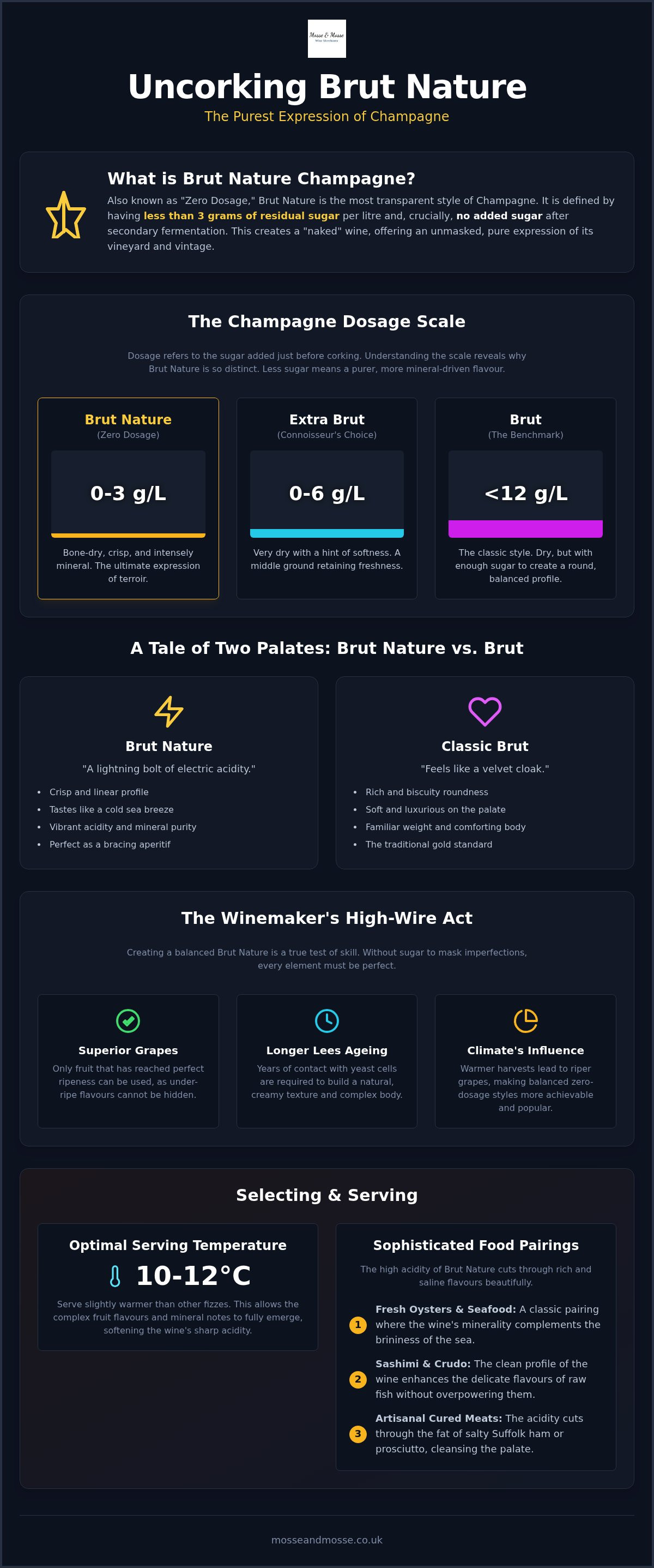
Brut Nature represents the ultimate test of a winemaker's craft. It's the most transparent expression of a vineyard possible, defined by having less than three grams of residual sugar per litre. Crucially, this style requires that no sugar is added during the final stage of production. For many of us accustomed to the standard Champagne & Sparkling Wines found on most tables, this "bone-dry" profile can be a revelation. It's a departure from the traditional Brut, which can contain up to 12 grams of sugar to soften the palate.
The secret lies in the omission of the "liqueur d’expédition". This mixture of wine and sugar is typically added just before the final corking to balance the wine's natural acidity. When a house chooses to skip this step, they're effectively removing the safety net. The result is what connoisseurs often call a "naked" wine. Without that touch of sweetness to round off the edges, every nuance of the fruit and every characteristic of the soil is laid bare. You can explore how this fits into the broader spectrum of Champagne sweetness levels to see just how distinct this category truly is.
The Technical Brilliance of Zero Dosage
Achieving balance in a zero-dosage wine is a high-wire act. Champagne is a cool-climate region where grapes naturally retain high levels of acidity. In a standard Brut, sugar acts as a counterweight to this sharp citrus profile. However, the modern "non-dosé" movement, led by adventurous grower-producers and prestigious houses alike, seeks to prove that sugar isn't always necessary. By allowing the specific terroir of the Marne Valley or the chalky slopes of the Côte des Blancs to speak for itself, these winemakers create a drink with "electric" energy and profound mineral depth.
Why "Naked" Wine Requires Better Grapes
You can't hide poor viticulture in a bottle of brut nature champagne. Sugar is a remarkable mask; it can easily disguise under-ripe fruit, green tannins, or structural imbalances. To produce a successful zero-dosage wine, winemakers must use only their highest quality grapes, often from exceptional vintages where the fruit has reached perfect maturity. This style also demands significantly longer lees ageing. Without sugar to provide "weight" on the tongue, the wine relies on years of contact with yeast cells to build a natural, creamy texture and a complex, yeasty body. Whilst some drinkers choose these bottles because they're lower in calories, we find the real draw is the uncompromising purity of flavour.
Brut Nature vs. Brut: Identifying Your Preferred Style
Choosing between a classic Brut and a brut nature champagne often comes down to the specific sensation you want on your palate. If you love a crisp and linear profile that tastes like a cold sea breeze, zero dosage is your target. Conversely, if you prefer the rich and biscuity roundness that many associate with traditional luxury, a standard Brut remains the gold standard. The sensory difference is profound; whilst Brut feels like a velvet cloak, Brut Nature is more like a lightning bolt of electric acidity.
For those wary of total dryness, the Extra Brut category offers a perfect middle ground. It retains the freshness of a low-sugar wine whilst allowing a tiny bit of dosage to soften the finish. This choice allows you to transition your cellar towards more modern, transparent styles without losing all the familiar "weight" of a classic fizz.
The Champagne Dosage Scale
Understanding the numbers helps strip away the mystery. The official scale measures residual sugar in grams per litre, and it's helpful to know where your favourites sit:
- Brut Nature: 0-3g (no added sugar).
- Extra Brut: 0-6g (the connoisseur's middle ground).
- Brut: Under 12g (the traditional benchmark).
It's interesting to see how even the big houses are evolving. Many modern wines, such as Ayala Brut Majeur, are already leaning towards a lower dosage to preserve freshness. Don't be fooled by the term "Extra Dry" either. Counter-intuitively, it sits further up the sweetness scale than Brut. For a deeper look at specific producers leading the charge, you can explore some of the Best Brut Nature Champagnes currently making waves in the industry.
Which Style Suits Your Occasion?
Context is everything when selecting a bottle. We often suggest a zero-dosage bottle as the perfect aperitif. Its bracing nature wakes up the senses and pairs beautifully with seafood-heavy menus. However, for a grand toast or a meal featuring richer poultry, the legendary Bollinger Special Cuvee provides the necessary body and structure. During a long, multi-course wedding breakfast, the high acidity of a drier style is invaluable for refreshing the palate between dishes. If you're planning an event in East Anglia and need help balancing your selection, please feel free to speak with us about your requirements.
The Connoisseur’s Choice: Why Zero Dosage is Trending
Once a niche sommelier secret, brut nature champagne has firmly established itself as a staple in the modern British cellar. It's no longer just a curiosity for those seeking the driest possible drink. Instead, it has become a symbol of winemaking integrity and a favourite amongst those who appreciate a more clinical, precise style. This trend reflects a broader desire for authenticity and transparency in what we consume, moving away from the heavily "corrected" wines of previous decades.
Terroir Transparency and Climate Change
Climate change is playing an undeniable role in this shift. Warmer harvests in France now allow grapes to reach better phenolic ripeness more consistently than in the 20th century. In the past, dosage was often used as a corrective tool to balance under-ripe, high-acid fruit. Now, with riper harvests, that safety net is less necessary. Collectors increasingly value "unmanipulated" wines that offer a direct line to the soil. This shift is often explored by those asking What is Brut Nature Champagne? and discovering its sensory purity. The rise of the "Grower Champagne" movement has further pushed larger houses to showcase specific plots without the veil of added sugar.
Zero Dosage in the Professional Cellar
Many of our private clients are surprised to learn that zero-dosage wines often possess exceptional ageing potential. The high natural acidity acts as a robust preservative, allowing the wine to evolve gracefully over years. This pursuit of ultimate freshness is a philosophy shared by the "R.D." (Recently Disgorged) concept pioneered by Bollinger. In these instances, long lees ageing meets a very low dosage to create a wine of immense complexity and structural power. Tim Mosse often remarks on the "jolly good" character of well-aged, low-dosage fizz. He notes how the autolytic notes of toasted nuts and brioche become even more pronounced when they aren't competing with residual sugar. We take great pride in sourcing these precise styles for our Champagne & Sparkling Wines collection.
If you are looking to curate a bespoke selection for your private cellar or an upcoming celebration, please contact us for personalised advice from our expert team.
Selecting and Serving Brut Nature in Suffolk
To truly appreciate the bracing purity of brut nature champagne, one must pay close attention to the details of service. Unlike standard fizzes that can be served ice-cold, zero-dosage wines benefit from being slightly warmer. We recommend a temperature of 10-12°C. This allows the delicate fruit profile, which is often hidden behind sharp acidity when too cold, to emerge and fill the palate. Similarly, leave the narrow flute in the cupboard. A tulip-shaped glass or even a standard small wine glass provides a wider bowl, allowing the complex aromatics to breathe and develop.
The Perfect Pairings for Bone-Dry Fizz
In East Anglia, we're blessed with produce that acts as a natural partner to these linear wines. The high acidity of a zero-dosage bottle is a masterclass in balance when paired with the richness of a Cromer crab or the briny depth of Lowestoft oysters. It follows the classic "salt and acid" rule; the wine cuts through the saltiness of local appetisers, such as a finely sliced salty Suffolk ham, creating a clean and refreshing finish. However, be cautious with your timing. Whilst it's a triumph with savoury courses, Brut Nature struggles against the sugar in a wedding cake or sweet desserts. For those moments, a wine with a higher dosage is a much better companion.
Personalised Curation from Fentons Farm
Finding a bottle that is balanced rather than just dry requires a curated approach. At Fentons Farm, we pride ourselves on being more than just a retailer; we're your local partners in discovery. You can organise a private tasting or a consultation with Tim Mosse to explore our range and find the specific style that suits your palate. This personalised service is particularly valuable when selecting Wedding & Party Wine for celebrations across East Anglia. Whether you're looking for bespoke Corporate & Private Wine Gift Boxes or a seasonal delivery to Bury St Edmunds, Ipswich, or Southwold, we ensure every bottle meets our exacting standards for quality and character.
Elevate Your Cellar with the Purity of Zero Dosage
Embracing the uncompromising world of zero-dosage wine is a journey toward tasting Champagne in its most authentic form. By removing the safety net of added sugar, winemakers allow the true character of the vineyard and the precision of the harvest to take centre stage. Whether you're drawn to the electric acidity of a young bottle or the complex, toasty notes of a well-aged vintage, brut nature champagne offers a level of clarity that's hard to find elsewhere.
At Mosse and Mosse, we've spent 25 years as an independent merchant at Fentons Farm, specialising in the finest French regions. We don't just sell bottles; we curate experiences for weddings, corporate gifts, and private collections across East Anglia. Finding a zero-dosage wine that achieves perfect balance requires a knowledgeable eye, and we're here to guide your selection with the warmth and expertise of a dedicated family business.
If you're ready to discover the bracing purity of these exceptional fizzes, explore our curated Champagne collection at Mosse and Mosse. We look forward to helping you find a bottle that truly resonates with your personal palate.
Frequently Asked Questions
Is Brut Nature the same as Zero Dosage?
Yes, these terms are interchangeable and describe Champagne produced without any added sugar in the final stage. Legally, a brut nature champagne must contain less than three grams of residual sugar per litre. By omitting the traditional liqueur d'expédition, winemakers leave the wine "naked," allowing the authentic character of the fruit to shine through. It's a style we often recommend to our Suffolk clients who value absolute transparency and mineral precision in their glass.
Is Brut Nature Champagne lower in calories than standard Brut?
Yes, it's typically lower in calories because it lacks the sugar found in standard dosages. Whilst a traditional Brut may contain up to 12 grams of sugar per litre, zero-dosage fizzes have almost none. For our health-conscious customers in Ipswich and Norwich, this makes it an appealing choice for celebrations. However, we always remind our guests that the primary reason to choose this style is for its bracing purity and intense flavour profile rather than just the calorie count.
Does Brut Nature Champagne taste sour?
A well-made bottle should never taste sour; instead, it should feel vibrant and "electric" on the palate. While the acidity is more pronounced than in a standard Brut, the best winemakers ensure the grapes are perfectly ripe before harvest. This ripeness, combined with extended lees ageing, provides a natural creaminess that balances the sharp citrus notes. We carefully curate our selection at Fentons Farm to ensure every bottle we sell offers harmony rather than just aggressive tartness.
Can I serve Brut Nature at a wedding or will it be too dry for guests?
It's a sophisticated choice that works beautifully as an aperitif, though it may be too bracing for some palates if served alone. We often suggest serving it alongside salty canapés or local seafood at weddings in Bury St Edmunds or Southwold. The high acidity is fantastic for refreshing the mouth between bites. If you're concerned about broad appeal, we can provide a consultation to help you find a balanced style that suits all your guests' preferences.
How long can you cellar a bottle of Brut Nature Champagne?
Many high-quality examples have excellent ageing potential, often evolving gracefully for five to ten years. The high natural acidity acts as a robust preservative, allowing the wine to develop complex notes of toasted nuts and brioche over time. We've seen top-tier bottles from houses like Bollinger develop remarkable depth in the cellar. If you're looking to lay bottles down in your own collection, we're always happy to share our expertise on which vintages are best suited for long-term storage.
Which Champagne houses are famous for their zero-dosage wines?
Several prestigious houses are renowned for mastering this difficult, safety-net-free style of winemaking. We particularly admire the craftsmanship of the following producers:
- Ayala: A house famous for its precise and elegant Brut Nature bottlings.
- Bollinger: Their "R.D." philosophy is a benchmark for freshness and complexity.
- Laurent-Perrier: Widely credited with pioneering the modern Ultra Brut category in the 1980s.
We specialise in sourcing these well-regarded houses for our private clients across East Anglia, ensuring you always have access to the finest examples of the craft.


