
The most powerful, highly scored bottle in your collection might well prove your greatest disappointment a decade from now. True longevity demands quiet structural harmony and impeccable provenance, not merely opulent fruit or towering alcohol. Selecting the best wines for cellaring requires looking past glossy marketing to evaluate how acidity, tannins, and core fruit concentration interact over time, ensuring every bottle evolves with genuine grace.
We've all felt the quiet anxiety of pulling a treasured cork only to discover a tired wine that peaked prematurely, and it's easy to see why shifting drinking windows and vintage variations create hesitation. In this guide, you will discover the four vital structural pillars that govern slow maturation, alongside a dependable checklist for selecting benchmark Bordeaux, crystalline Burgundy, and traditional European classics. Here is the practical blueprint you need to build an enduring, balanced cellar with total confidence.
Key Takeaways
- Master the four foundational structural pillars that allow fine wine to develop complex tertiary aromas rather than simply fading in bottle.
- Identify the best wines for cellaring across benchmark European terroirs, comparing enduring claret and crystalline Burgundy with evolving regional classics.
- Apply a balanced cellar allocation framework to harmonise immediate drinking pleasure with medium-term maturation and heirloom reserves.
- Learn why larger formats such as magnums slow the thermodynamic ageing process, and how merchant provenance safeguards your investment over decades.
The Anatomy of Age-Worthy Wine: What Makes a Bottle Worth Cellaring?
Age-worthiness isn't merely about a wine surviving in bottle; it's the capacity for positive transformation. While everyday bottles are crafted for immediate drinking with soft tannins and overt fruit, serious wines possess deliberate architectural tension. Structural balance is the silent architect of longevity, ensuring a wine gains depth rather than simply surrendering its youth. Cellaring rewards patience with aromatic subtleties that youthful pours can't replicate, slowly turning raw power into effortless complexity.
The Four Structural Pillars: Tannin, Acidity, Alcohol, and Fruit
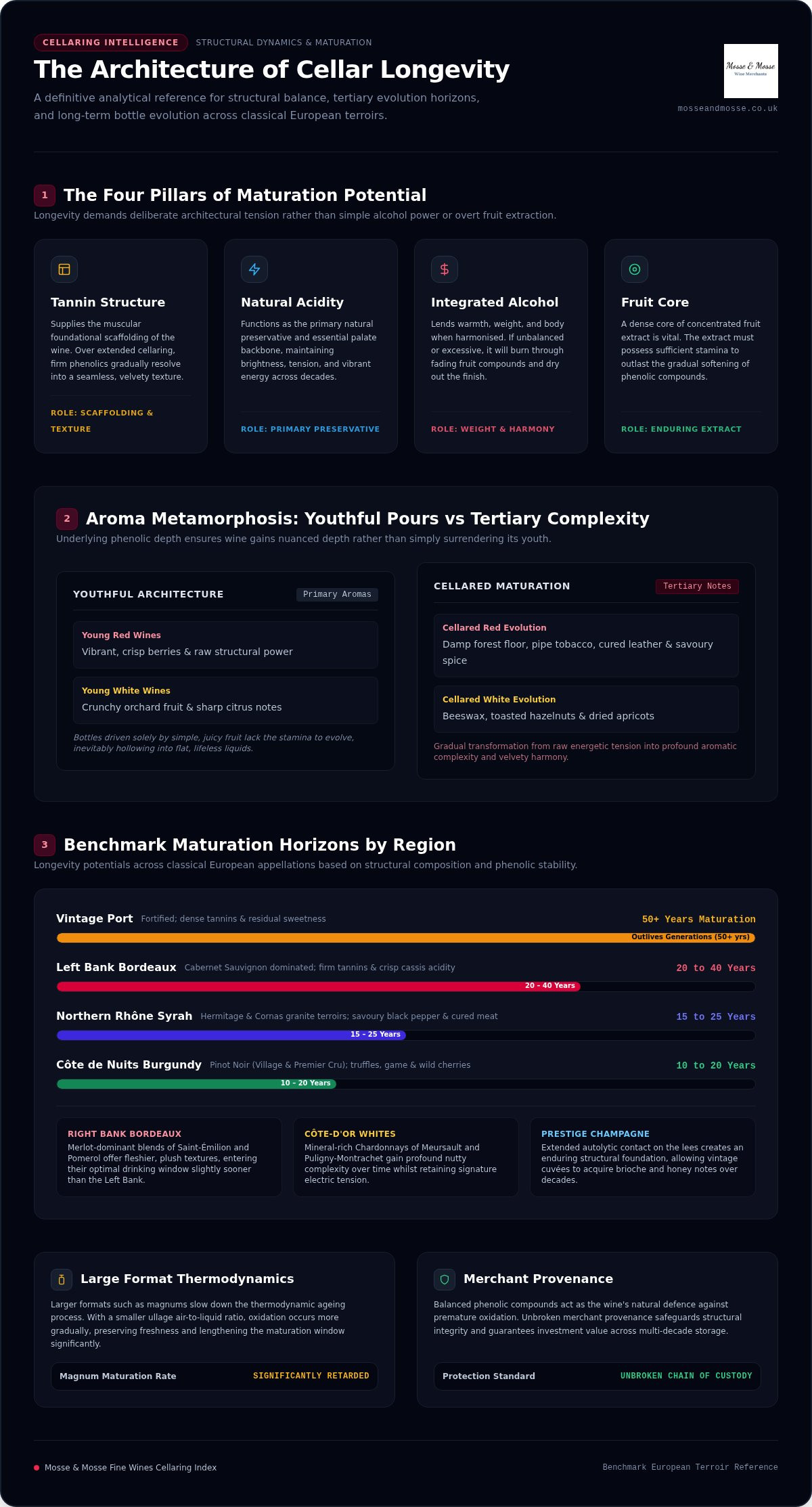
A bottle's maturation potential rests upon four pillars working in absolute harmony. Delving into the science of aging wine reveals how these elements preserve and elevate the liquid over time:
- Tannins: Ripe, muscular tannins supply the foundational scaffolding, gradually resolving into a seamless, velvety texture.
- Acidity: Bright natural acidity serves as the wine's backbone and primary preservative, keeping the palate energetic across decades.
- Alcohol: Integrated alcohol lends warmth and body, but excessive levels will inevitably burn through fading fruit and dry out the finish.
- Fruit Concentration: A dense core of concentrated fruit extract is vital, as it must outlast the gradual softening of phenolic compounds.
Tertiary Evolution: How Aromas Transform with Time
With patient cellaring, vibrant primary aromas of crisp berries and crunchy orchard fruit give way to nuanced tertiary notes. Fine reds develop evocative scents of damp forest floor, pipe tobacco, cured leather, and savoury spice. Age-worthy whites trade sharp citrus for beeswax, toasted hazelnuts, and dried apricots. The best wines for cellaring always possess underlying phenolic depth. Bottles driven solely by simple, juicy fruit lack the stamina to evolve, inevitably hollowing out into flat, lifeless liquids within a few short years.
Classic Benchmark Regions: Comparing the Best Wines for Cellaring in 2026
Selecting the best wines for cellaring requires looking beyond broad country labels to specific terroirs with proven endurance. While emerging cool-climate regions in the New World show genuine promise, classical European appellations remain the international benchmark. Traditional winemaking methods, focused on restrained extraction and modest new oak, consistently protect a wine's long-term evolution. Scientific insight into polyphenols and wine structure demonstrates that balanced phenolic compounds form a natural defence against oxidation, ensuring decades of steady improvement rather than early decline.
Left Bank and Right Bank Bordeaux: The Ultimate Cellar Foundation
Bordeaux remains the bedrock of serious cellaring. Left Bank appellations, dominated by Cabernet Sauvignon, rely on firm tannins and crisp cassis acidity to mature gracefully for twenty to forty years. In contrast, the Merlot-dominant blends of Saint-Émilion and Pomerol offer a fleshier, plush texture that enters its drinking window slightly sooner. Both styles deliver exceptional structural stamina. You can explore cellar-worthy estates from our Bordeaux portfolio to secure classic claret crafted for extended rest.
Red and White Burgundy: Finesse, Terroir, and Graceful Maturation
Burgundy trades Bordeaux's muscular power for ethereal aromatic complexity. In the Côte de Nuits, village and premier cru Pinot Noir develops intoxicating layers of truffles, game, and wild cherries over ten to twenty years. Meanwhile, the mineral-rich white Chardonnays of Meursault and Puligny-Montrachet gain profound nutty complexity while retaining electric tension. Discover premier cru options in our Côte-d'Or collection to witness how precise site classification directly dictates cellar longevity.
Traditional Rhône, Vintage Port, and Sparkling Longevity
Several other European classics demand space in any balanced cellar:
- Northern Rhône Syrah: Granite-grown wines from Hermitage and Cornas evolve savoury black pepper and cured meat characters over fifteen to twenty-five years.
- Vintage Port: Fortified and naturally preserved by dense tannins and residual sweetness, fine Port comfortably outlives its owners, often improving past the fifty-year mark.
- Prestige Champagne: Extended autolytic contact on lees creates a robust structural foundation, allowing vintage cuvées to acquire brioche and honey notes over decades.
If you would like tailored guidance on selecting benchmark vintages across these storied regions, you are always welcome to speak with our merchant team to arrange a personal consultation.
How to Build and Curate a Balanced Cellar: Practical Selection Criteria
Building an enduring collection is an exercise in deliberate choreography rather than impulse buying. Many enthusiasts assemble dozens of bottles only to face an uncomfortable dilemma: everything matures simultaneously, or worse, half the cellar requires another decade whilst daily racks sit entirely bare. Successful curation demands a disciplined 4-step framework. You must establish balanced drinking horizons, prioritise depth over fleeting variety, maintain disciplined logbook records, and enforce stable domestic storage conditions from day one.
The Three-Tier Cellar Strategy: Staggering Drinking Windows
To avoid cellar bottlenecks, divide your portfolio using a clear percentage framework:
- 30% Medium-Term Gratification (3 to 5 years): Approachable village-level Burgundies, youthful Right Bank clarets, and regional whites to enjoy without guilt while waiting on grander vintages.
- 50% Core Benchmark Maturation (7 to 12 years): The heart of your collection, featuring cru classé Bordeaux, premier cru whites, and structured Northern Rhône reds at their peak harmony.
- 20% Heirloom Reserves (15+ years): Exceptional vintage declarations, Left Bank titans, and prestige cuvées put away for landmark celebrations and future generations.
Budgeting and Case Purchases: Why Depth Beats Variety
Acquiring single, isolated bottles often produces remorse rather than pleasure. When you buy six-bottle unpeeled cases, you secure the ability to track developmental curves across years. Opening one bottle every twenty-four months lets you map the evolution from tight primary power to tertiary grace, helping you pinpoint your personal palate preferences. Anchoring your cellar with solid European foundations before sprinkling in select cool-climate New World allocations yields far greater long-term dividends than chasing scattered curiosities.
Storage Conditions: Protecting Your Investment at Home
Even the best wines for cellaring will spoil if neglected at home. Temperature must remain stable between twelve and fourteen degrees Celsius throughout the calendar year, avoiding sudden summer spikes. Humidity ought to hover reliably near seventy percent, ensuring natural corks retain their elasticity without encouraging mould. Keep bottles horizontal, away from continuous vibrations, direct ultraviolet light, and pungent household smells that can slowly permeate the cork closure.
Curating a harmonious drinking schedule takes time and careful planning. You can enquire about bespoke cellar planning with our Suffolk team to arrange a tailored mixed case suited to your private maturation goals.
Cellaring Formats and Provenance: Securing Your Collection with Expert Guidance
Even the most celebrated pedigree cannot survive careless handling. The physical conditions under which a bottle travels and rests dictate its ultimate destiny just as much as soil or climate. Deciding which bottles deserve space in your cellar involves two often-overlooked practicalities: choosing the optimal vessel size for your timeline and securing an unbroken chain of verified storage from the moment the cork is driven home.
The Power of Magnums: Superior Longevity and Slower Maturation
Format selection directly alters the thermodynamic ageing rate of fine wine. A standard 75cl bottle and a 1.5-litre magnum share almost identical ullage, the pocket of ambient air trapped between wine and cork. In a magnum, that microscopic volume of oxygen interacts with twice the liquid mass. The resulting chemical evolution occurs at roughly half the pace of a standard bottle.
This sluggish oxidation preserves crystalline fruit clarity, aromatic purity, and vibrant natural freshness over decades. Explore pristine options in our Magnums and larger formats selection to secure bottles built for multi-decade celebrations.
Provenance and Storage Integrity: The Independent Merchant Advantage
Acquiring the best wines for cellaring through speculative auction lots carries substantial risk. Unregulated secondary-market trades often disguise heat damage, compromised cork elasticity, or periods spent in dry domestic cupboards. Once delicate vintage chemistry suffers heat shock, no amount of subsequent chilling can repair the flattened aromatics.
Partnering with a specialist independent merchant offers absolute peace of mind. Operating from Dennington, Tim Mosse personally sources, inspects, and safeguards every parcel in temperature-managed conditions. Supported by dedicated regional courier delivery across Suffolk, East Anglia, and mainland Britain, our family team ensures your bottles arrive in flawless condition. You can consult directly with Tim to secure bespoke cellar selections, blending verified claret, premier cru Burgundy, and celebratory formats crafted to mature gracefully for years to come.
Curating Your Enduring Wine Cellar with Confidence
Cellaring fine wine is an investment in anticipation and future pleasure. As you select the best wines for cellaring, remember that enduring bottles rely on balanced acidity, phenolic depth, and unblemished storage rather than fleeting prestige. Staggering your drinking windows across approachable medium-term gems, structured regional benchmarks, and heirloom reserves ensures your collection always offers something sublime to pour.
Every cellar should reflect your personal tastes and milestones. Operating from Dennington, Tim Mosse provides direct personal curation, drawing on decades of sourcing expertise to offer carefully selected stocks of classic Bordeaux, premier cru Burgundy, and age-worthy celebratory magnums. From designing a balanced starter cellar to assembling bespoke mixed cases tailored to your exact maturation horizons, dedicated guidance protects every cork you lay down.
Contact Tim Mosse for personal cellar consultations to begin shaping a rewarding, perfectly preserved collection today.
Frequently Asked Questions
How long should I keep wine in my cellar before opening it?
Cellaring duration depends entirely on the appellation, vintage structure, and bottle format. Lighter regional wines often reach peak harmony within three to five years, whilst cru classé claret or structured Northern Rhône Syrah often requires ten to twenty years. The best wines for cellaring reward patience by revealing complex tertiary nuances. Tracking maturation with six-bottle cases lets you experience each developmental stage firsthand rather than guessing a single date.
Can screw-cap wines be aged in a cellar as successfully as cork-sealed bottles?
Yes, screw caps provide reliable closures for long-term cellaring, particularly for aromatic whites and crisp reds. Modern screw capsules allow tiny, consistent levels of oxygen ingress without the risk of cork taint or random bottle variation. While classical European appellations stick firmly to natural cork, top producers in Australia and New Zealand prove screw closures age cleanly. The primary difference is pacing, as screw caps encourage slightly slower development.
What happens if my home cellar experiences small seasonal temperature variations?
Gradual seasonal shifts of two to three degrees Celsius won't harm fine wine, provided the changes occur smoothly across months. Wine is surprisingly resilient against slow, gentle thermal cycles between winter and summer. The real danger lies in abrupt, daily fluctuations that cause liquid expansion, compromising the seal and drawing in air. Maintaining a steady annual average near twelve to fourteen degrees ensures chemical stability and prevents premature oxidation.
Are white wines truly capable of ageing gracefully over ten or more years?
Many classical white wines age just as magnificently as celebrated reds over ten to twenty years. Age-worthy whites rely on vibrant natural acidity, concentrated extract, and mineral structure rather than heavy tannins. Benchmark premier cru Chardonnays from Burgundy, dry German Rieslings, and vintage Champagnes gain breathtaking complexity, developing rich flavours of toasted brioche, beeswax, hazelnut, and dried orchard fruit as youthful citrus notes gently subside.
Why is a magnum considered significantly better for long-term cellaring than standard bottles?
Magnums mature at roughly half the pace of standard bottles due to a superior volume-to-ullage ratio. Because a magnum contains double the liquid volume under almost identical ambient air space, dissolved oxygen interacts much more slowly with the wine. This gentle thermodynamic pacing preserves radiant fruit purity, crisp freshness, and structural vitality across decades, making larger formats ideal for marking significant personal anniversaries.
How can an independent wine merchant help me establish my first collection?
An independent wine merchant provides tailored cellar planning, unbroken provenance, and objective curation suited to your exact palate. Rather than navigating vast warehouse catalogues alone, private collectors receive dedicated guidance on balancing drinking windows and selecting the best wines for cellaring. At Mosse and Mosse in Dennington, Tim Mosse offers direct consultation and temperature-managed stock, delivering balanced mixed cases across Bury St Edmunds, Ipswich, Woodbridge, and mainland Britain.


