

Could the bottle of wine that changes your perspective on reds be sitting on a shelf for less than twenty pounds? While many collectors flock to the prestige of Bordeaux, we've spent years discovering that the real treasures for those new to the vine are often found in the sun-drenched vineyards of Spain. If you've ever stood in a wine aisle feeling baffled by terms like Crianza or Reserva, you aren't alone. It's perfectly natural to worry about buying something too heavy or overly "oaky" when you just want a smooth, enjoyable glass to share with friends.
In this expert guide, we'll help you find the best spanish red wine for beginners by decoding the labels and highlighting the most approachable styles. You'll learn to distinguish between the bright fruit of a Garnacha and the structured elegance of a Rioja, ensuring you can shop with confidence. We'll also reveal how to find exceptional value that frequently puts more expensive French equivalents to shame. From understanding ageing laws to identifying hidden regional gems, this is your personal roadmap to finding a new favourite bottle without the guesswork.
Key Takeaways
- Understand why Spain’s vast viticultural landscape offers a superior quality-to-price ratio compared to other European regions, making it the ideal starting point for your wine journey.
- Decode confusing label terms like Crianza and Reserva to confidently select the best spanish red wine for beginners based on your preference for fresh fruit or complex oak notes.
- Discover the "undisputed king" Tempranillo and other approachable regional gems like Garnacha that provide a smooth, welcoming introduction to red wine.
- Learn practical serving secrets, including why the correct temperature and a short decant can significantly enhance the flavour and character of your chosen bottle.
Why Spanish Red Wine is the Perfect Starting Point for Beginners
Spain holds a unique position in the world of viticulture. It actually has more land under vine than any other nation, which translates into a staggering amount of variety for you to explore. For us, the real magic lies in the value. Whilst a high-end Bordeaux might require a decade of cellaring and a significant investment to reach its peak, many Spanish reds are released only when they are truly ready to be enjoyed. This makes them arguably the best spanish red wine for beginners because you don't need a private cellar to experience a wine at its best. You can simply pull the cork and enjoy the craftsmanship immediately.
We often find that these wines act as a perfect bridge for those who already have a preferred style from other regions. If you love the silkiness of a Pinot Noir, there’s a coastal Mencía waiting for you. If you prefer the punch of a Shiraz, the bold reds of Toro will hit the mark. The diversity is simply immense.
The Flavour Profile of Spain
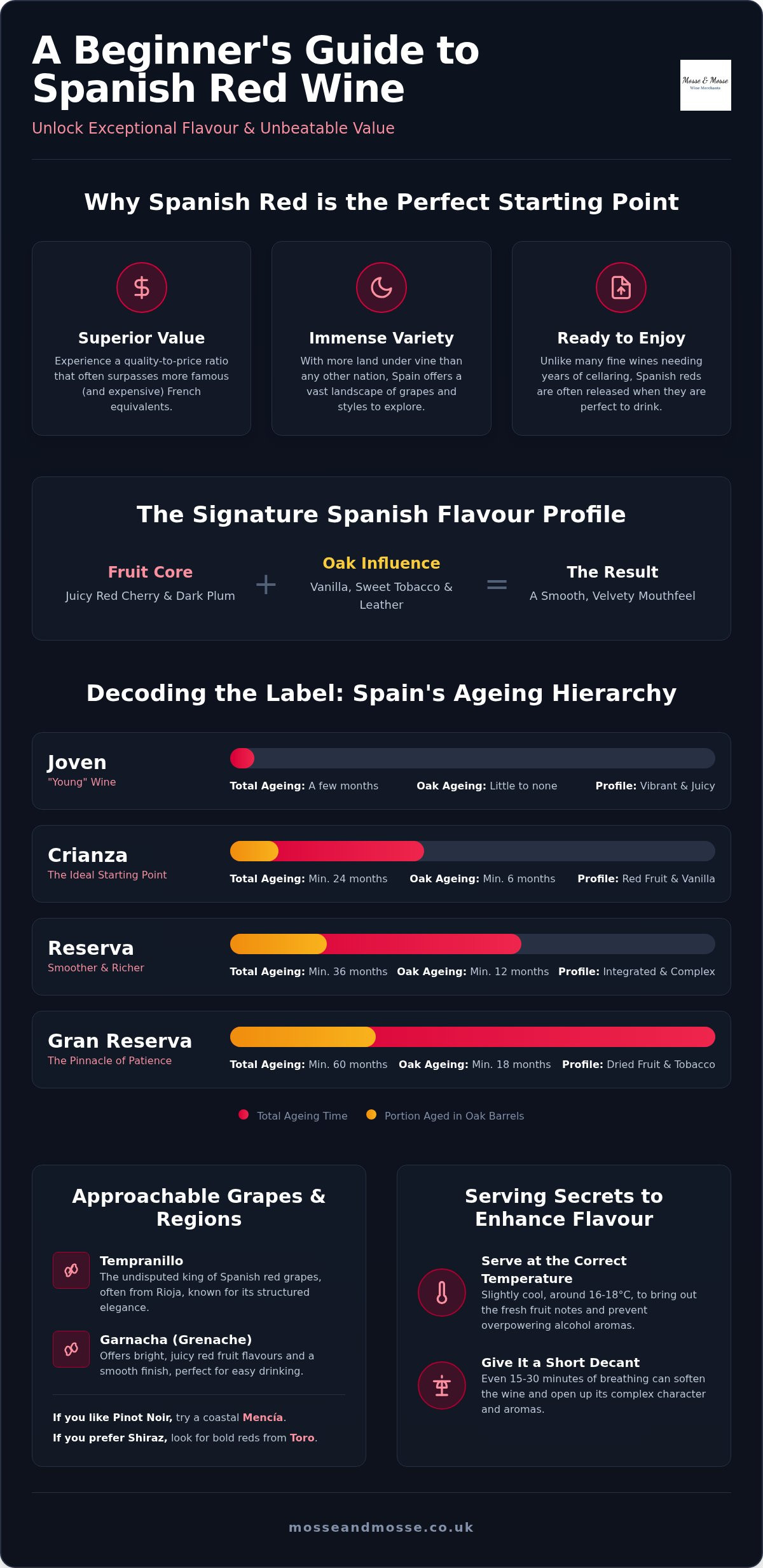
What makes these wines so enticing is their distinct sensory balance. You'll often find a core of juicy red cherries and dark plum, but it's the signature finish that really captivates. Because of the traditional use of oak barrels, you'll frequently detect notes of vanilla, sweet tobacco, and even a hint of leather. These savoury elements soften the fruit, creating a smooth, velvety mouthfeel that beginners often find much easier to enjoy than the harsh tannins found in younger French alternatives. It's this harmony between fruit and earthiness that makes Spanish wine so approachable from the very first sip.
A Heritage of Quality
Understanding the quality behind the bottle is essential for any newcomer. Spain uses a strict classification system to protect its reputation, with the DOCa (Denominación de Origen Calificada) representing the highest tier of production. This Comprehensive Guide to Spanish Wine details how these regions maintain such rigorous standards. At Mosse and Mosse, we take this a step further. As an independent family merchant, we personally curate our selection to ensure every bottle offers better value than mass-market retailers. We look for producers who respect tradition whilst ensuring the wine is vibrant and balanced for the modern UK palate. By focusing on well-regarded producers rather than just famous labels, we help you find the best spanish red wine for beginners without the premium price tag.
Decoding the Label: Understanding Crianza, Reserva, and Gran Reserva
Standing in front of a shelf of Spanish wine can feel overwhelming, but the label holds a secret code that identifies the best spanish red wine for beginners. Unlike many other regions, Spain has strict national laws governing how long a wine must sit in oak barrels and glass bottles before it reaches your table. This hierarchy acts as a reliable safety net when you're buying online. You aren't just buying a brand. You're buying a certified level of patience and craft.
The Ageing Hierarchy
Understanding these specific terms helps you predict exactly how a wine will taste. If you prefer vibrant, juicy flavours, look for a Joven. These are "young" wines with little to no oak contact, making them perfect for a casual evening. However, we often suggest a Crianza as the best spanish red wine for beginners. It requires a minimum of 24 months ageing, with at least six months spent in oak barrels. This provides a delightful middle ground between fresh red fruit and subtle hints of vanilla. If you want to step into luxury, a Reserva requires 36 months of ageing, resulting in smoother tannins and richer, more integrated flavours.
Gran Reserva: The Pinnacle of Patience
A Gran Reserva is a rare treat, often only produced in the most successful harvest years. These wines must age for at least 60 months, including a minimum of 18 months in oak. The Institute of Culinary Education's Guide to Spanish Wines highlights how this extended time transforms the liquid into something truly complex. You'll find sophisticated notes of dried fruits, tobacco, and a texture that feels like silk. Whilst these are magnificent, a newcomer might initially prefer the fruit-forward nature of a younger Crianza. For those truly special occasions, these complex reds are best enjoyed from our Magnums & Larger Formats where the ageing process is even more graceful.
Finding the right balance between fresh fruit and savoury oak is a personal journey. If you'd like a hand selecting a bottle that matches your specific tastes, do reach out to our family team for a chat and a personalised recommendation.
Beyond Rioja: Exploring Spain’s Most Approachable Regions and Grapes
Whilst Rioja is often the first port of call, searching beyond its borders reveals some of the best spanish red wine for beginners who want to explore different textures and weights. Spain’s viticultural map is a patchwork of distinct personalities. At the heart of it all is Tempranillo, the undisputed king. Depending on where you are, you might hear it called Cencibel or Tinto Fino, but its character remains unmistakable: strawberry, plum, and that signature tobacco finish.
If you prefer something more luscious, look for Garnacha. It's the grape behind some of Spain’s most fruit-forward reds, offering a burst of raspberry and spice without heavy tannins. For fans of bold, dark-fruited wines like Malbec, Monastrell is your perfect match. It’s thick-skinned, spicy, and deeply satisfying. These grapes provide a welcoming entry point because they don't rely on aggressive tannins to make an impression.
Rioja vs Ribera del Duero
Choosing between these two powerhouses depends entirely on your palate. Rioja is celebrated for its elegance and bright acidity. It’s the traditionalist’s choice, where the oak influence creates a refined, dusty finish. In contrast, Ribera del Duero is the darker, more powerful sibling. Often described as the Spanish answer to Bordeaux, it delivers a more modern, concentrated experience. It's a fantastic bridge for those who usually drink Cabernet Sauvignon.
- Choose Rioja if you enjoy Chianti or more structured, acidic reds.
- Choose Ribera del Duero if you typically reach for Malbec or Australian Shiraz.
The Rising Stars: Priorat and Jumilla
For those seeking something truly special, Priorat offers intense, mineral-driven wines grown on unique slate soils. They are powerful, complex, and memorable. On the other end of the spectrum, Jumilla provides incredible value. This is where Monastrell truly shines, producing deep, velvety reds that punch well above their weight. These regions are particularly popular choices for Wedding & Party Wine because they offer a sophisticated profile that appeals to everyone from casual drinkers to connoisseurs.
If you're unsure which region matches your current favourite style, get in touch with our team and we will help you find your perfect Spanish match.
Mastering the Art of Spanish Wine: Serving Tips and Food Pairings
Once you've selected your bottle, the way you serve it can be the difference between a good glass and an extraordinary one. We often find that "room temperature" in a centrally heated British home is far too warm for a delicate Rioja. Aim for 15 to 18 degrees Celsius. If your kitchen is warm, pop the bottle in the fridge for twenty minutes before pouring. This slight chill preserves the vibrant red fruit flavours we've explored and prevents the alcohol from feeling too "hot" on the palate.
Decanting is another simple trick that elevates the experience. Whilst many think it's only for vintage ports, even a youthful Crianza benefits from 30 minutes of air. It allows those signature oaky notes to soften and the fruit to breathe. When it comes to glassware, a glass with a large, rounded bowl is best for Tempranillo. It gives the complex aromas space to develop before they reach your nose. Learning these small details helps you Buy Wine Online with the confidence that you'll enjoy every drop exactly as the winemaker intended.
Pairing Spanish Reds with British Cuisine
Spanish wine is built for the dinner table. A Rioja Reserva is the natural partner for a classic Sunday roast, particularly lamb with rosemary. The acidity in the wine cuts through the richness of the meat perfectly. If you're serving something with a bit of heat, like a spicy chorizo stew or even a mild curry, reach for a Garnacha. Its fruit-forward nature handles spice much better than more tannic reds. For a cheese board, try a smooth Ribera del Duero with a sharp Cheddar or a creamy Stilton. It’s an effortless way to elevate a simple evening at home.
The Mosse and Mosse Approach to Curation
As an independent family business, our philosophy is simple: we prioritise the quality of the liquid over the fame of the label. We believe the best spanish red wine for beginners shouldn't be a gamble. This is why we often suggest curated mixed cases. They allow you to explore different regions like Jumilla or Priorat in a single delivery. It’s a wonderful way to find your personal favourite without committing to a full case of one style.
Whether you are looking for a special bottle for Corporate Gifting or simply want to start your own private collection, we provide a personalised service that larger retailers can't match. We love helping our clients discover wines that offer the same prestige as a fine Burgundy but with the incredible value that only Spain can provide.
Begin Your Spanish Wine Discovery
Finding the best spanish red wine for beginners doesn't have to be a daunting task. By understanding the ageing classifications and looking beyond the famous labels of Rioja, you can uncover bottles that offer incredible depth and character. Whether you prefer the bright fruit of a Garnacha or the structured elegance of a Ribera del Duero, Spain provides a world of diversity that consistently outperforms more expensive European rivals in terms of value.
At Mosse and Mosse, we bring over 25 years of expertise to every bottle we select. As an independent merchant, we take pride in offering a personalised service that larger retailers simply cannot match. We've curated seasonal mixed cases designed specifically to help you explore these regions from the comfort of your home, all delivered directly to your door with our national UK mainland shipping. If you're ready to find your new favourite bottle, explore our curated collection of Spanish red wines and let our family guide you to something truly special. There's a perfect Spanish red waiting for you; it's time to pull the cork and enjoy it.
Frequently Asked Questions
Is Rioja a grape or a region?
Rioja is a famous wine-growing region in Northern Spain, not a grape variety. It was the first region to be awarded DOCa status, the highest category in Spanish wine law. Whilst synonymous with red wine, the bottles are usually a blend, with Tempranillo taking the lead. Understanding this helps when searching for the best spanish red wine for beginners because it allows you to compare how the same grape tastes in different soils.
What is the difference between Tempranillo and Rioja?
The difference is simple: Tempranillo is the primary grape variety, whilst Rioja is the geographical region where it is grown. Think of it like this:
- Tempranillo: The grape providing the flavour.
- Rioja: The place providing the name.
You can find Tempranillo grapes grown all over Spain, often under local names like Tinto Fino. However, a wine labelled as Rioja must be produced within that specific region's borders.
Why does some Spanish wine have a gold wire mesh around the bottle?
That distinctive gold wire mesh was originally designed to prevent counterfeiters from tampering with the wine. In the nineteenth century, unscrupulous merchants would sometimes steam off labels or refill expensive bottles with cheaper liquid. The wire was impossible to replace once broken, acting as a seal of authenticity. Today, it is largely a traditional decorative touch used by historic bodegas to signal their heritage and commitment to classic Spanish winemaking styles.
How long can I keep a Spanish red wine once it is opened?
Most Spanish reds stay fresh for three to five days once opened, provided you store them correctly. Younger, fruitier wines tend to last longer than older bottles. To preserve the flavour, we recommend:
- Replacing the cork immediately after pouring.
- Storing the bottle in a cool, dark place.
- Using a vacuum stopper to remove excess air.
These simple steps help preserve those delicate cherry and vanilla notes for longer.
What is the best Spanish red wine under £20 for a beginner?
For a newcomer, a high-quality Rioja Crianza is often the best spanish red wine for beginners under the twenty pound mark. It offers a fantastic balance of vibrant fruit and subtle oak without being too heavy. Alternatively, look for a Monastrell from Jumilla. These wines provide incredible value and a plush, velvety texture that is easy to enjoy. We carefully curate our collection to ensure even our entry-level bottles offer a true taste of Spanish quality.
Should I chill Spanish red wine?
You should consider a light chill, especially during the warmer months. We don't mean serving it ice-cold like a Rosé, but bringing the temperature down to around sixteen degrees Celsius makes a world of difference. It prevents the alcohol from overpowering the fruit and keeps the wine tasting fresh and balanced. Just twenty minutes in the fridge before serving is usually enough to reach that cellar cool temperature that traditional Spanish bodegas prefer.


