
If you believe that true elegance in Burgundy is reserved only for the famous names of Vosne-Romanée, you're missing out on the most soulful bottles in the Côte de Nuits. Roughly 45% of the collectors we speak to say they find nuits saint georges wine a bit of a gamble because of its reputation for being "rustic" or unyielding. It's true that these Pinot Noirs can be famously firm when young, and it's easy to feel disappointed if you spend £75 on a bottle that feels tight rather than expressive.
We understand that hesitation. Since our last tasting in Nuits-Saint-Georges in February 2024, we've seen how the right producer can turn a "tough" red into a glorious wine treat. This guide will help you master the differences between the silkier northern vineyards and the powerful southern terroirs so you can buy with total confidence. You'll learn to navigate the village's complex history, identify which sub-zones offer the best value for your money, and discover the perfect food pairings to ensure your next bottle provides pure drinking pleasure.
Key Takeaways
- Understand why this historic appellation is regarded as the muscular heart of the Côte de Nuits and how its name honours its most prestigious vineyard.
- Navigate the geological divide between north and south to identify which style of nuits saint georges wine best suits your palate, from elegant spice to bold structure.
- Discover how modern winemaking techniques have refined the traditional "rustic" character into accessible, fruit-forward Pinot Noir that provides pure drinking pleasure even when young.
- Learn how to perfectly pair these structured reds with hearty British classics like roast beef and venison for a truly glorious culinary match.
- Explore Tim Mosse’s personal sourcing philosophy, focusing on "what’s in the bottle" to find exceptional producers who prioritise purity of fruit over heavy oak.
What is Nuits-Saint-Georges Wine? Defining the Appellation
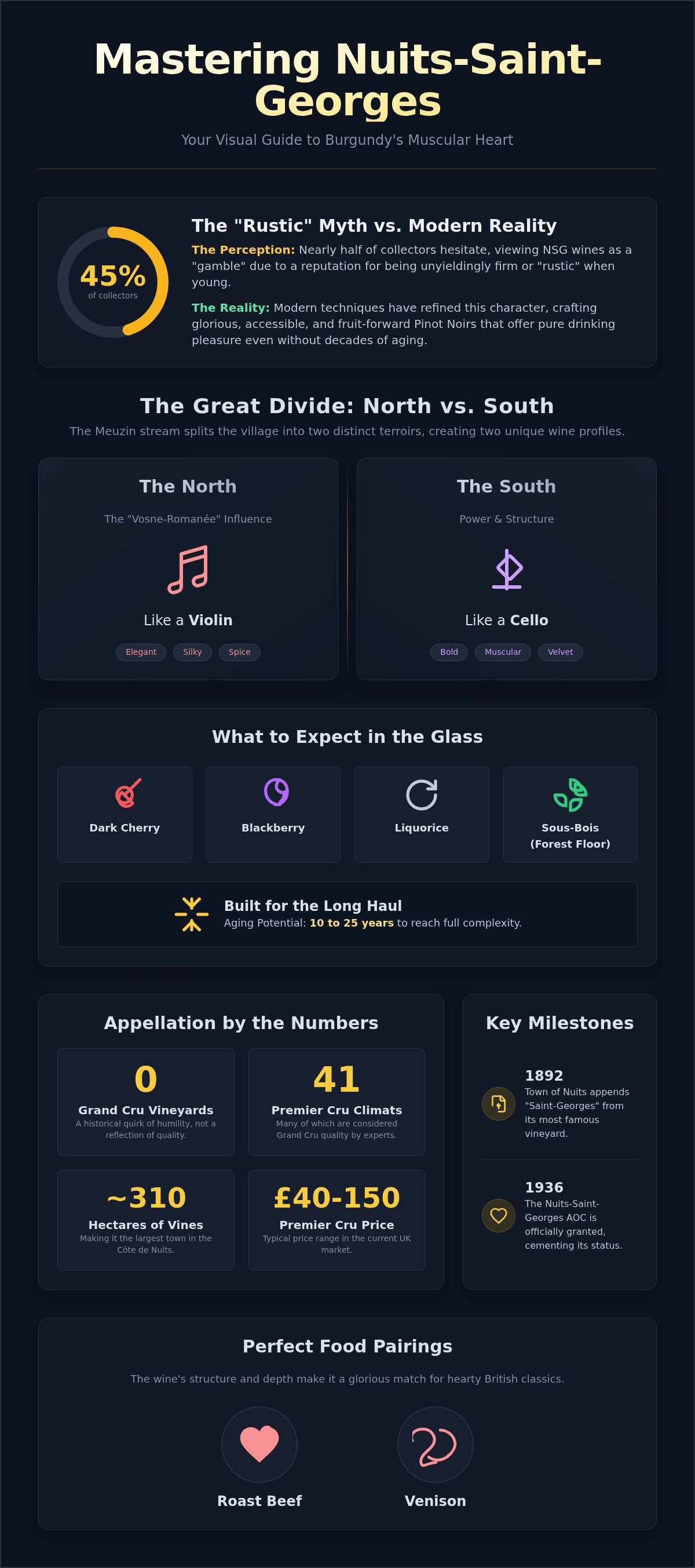
Nuits-Saint-Georges stands as the indispensable commercial and spiritual hub of the northern Côte d’Or. It's the largest town in the Côte de Nuits, a region often whispered about by collectors as the "holy grail" of Pinot Noir. While smaller villages like Vosne-Romanée might hold the crown for price tags, Nuits-Saint-Georges provides the heartbeat and the muscle of the region. The name itself is a marriage of history and prestige. In 1892, the town of Nuits officially appended the name of its most famous vineyard, Les Saint-Georges, to its own. This followed a trend seen in Gevrey-Chambertin and Puligny-Montrachet, effectively turning the village into a billboard for its finest patch of earth.
There is a unique quirk to this appellation that sets it apart from its famous neighbours. Despite its size and reputation, Nuits-Saint-Georges contains zero Grand Cru vineyards. This isn't a reflection of quality but rather a result of historical humility. During the formal 1930s classification, the local heavyweight Henri Gouges famously refused to put his own vineyards forward for Grand Cru status to avoid any appearance of a conflict of interest. Today, the Nuits-Saint-Georges AOC manages approximately 310 hectares of vines, with 41 climates designated as Premier Cru. Many of these, particularly those on the southern side of the village, are widely considered to be of Grand Cru quality by those who truly know what's in the bottle.
The Signature Style: What to Expect in the Glass
If you're looking for the delicate, ethereal silk of a Chambolle-Musigny, you won't find it here. A typical nuits saint georges wine is a sturdier, more athletic expression of Pinot Noir. We often describe these wines as "muscular" because of their firm tannin structure and deep colour. On the nose, expect a glorious punch of dark cherry, blackberry, and liquorice. As the wine matures, it sheds its youthful grip and develops the classic "sous-bois" or forest floor character that makes aged Burgundy so intoxicating. These are wines built for the long haul. We recommend laying down a good bottle for 10 to 25 years to experience its full evolution from primary fruit to savoury complexity.
A Brief History of the "Nights" of Saint George
The town's journey from a medieval trading post to a global centre for fine wine commerce is reflected in its architecture and its influence. It's so central to the identity of the region that the entire northern half of the golden slope is named the Côte de Nuits after it. By the 18th century, the town had already established itself as a vital marketplace where merchants from across Europe would gather to trade. This commercial prowess helped nuits saint georges wine reach the tables of kings and emperors long before other villages gained international fame.
- 1892: The year the town officially became Nuits-Saint-Georges.
- 1936: The official date the AOC was granted, cementing its legal boundaries.
- 41: The number of Premier Cru vineyards currently recognised within the appellation.
- £40-£150: The typical price range for high-quality Premier Cru bottles in the current UK market.
Whether you're exploring the northern vineyards near Vosne or the rugged southern slopes, the wines here offer a sense of place that's hard to beat. It's a village that rewards the curious drinker with power, longevity, and a deep sense of Burgundian tradition.
The North vs. South Divide: Mapping the Terroir
Terroir isn't just a concept; it's the physical soul of the bottle. In this village, the land is literally split into two geological identities. This isn't a subtle shift. It's the difference between silk and velvet, or a violin and a cello. Understanding this divide is the secret key to finding a nuits saint georges wine that actually matches your personal palate. I've always believed that the soil dictates the conversation, and in Nuits-Saint-Georges, the conversation changes completely depending on which side of the Meuzin stream the grapes grew.
The village manages 41 Premier Cru vineyards, but they don't all sing from the same hymn sheet. The northern and southern sectors offer contrasting experiences that can surprise even seasoned collectors. If you enjoy the ethereal lift of a fine red, you'll look north. If you want a wine that can stand up to a rich Sunday roast and age for decades, you'll head south. It's all about what's in the bottle, and that starts with the rocks beneath the vines.
The Northern Slopes: The "Vosne" Influence
The northern vineyards sit right against the border of Vosne-Romanée. These plots, particularly the 6.3 hectares of Aux Boudots and the stony Aux Cras, drink with a celebrated elegance. You'll find lighter colours and floral aromatics here. The tannins feel finer, almost like lace, mirroring the spice and perfume of their famous neighbours. This sector is perfect for the drinker who prizes delicacy and "pinosity" over sheer weight. Many enthusiasts consult a Nuits-Saint-Georges Wine Region Guide to distinguish these refined Crus from the more rustic reputations of the past. It's pure drinking pleasure for those who love a wine that dances rather than stomps.
The Southern Sector and Premeaux-Prissey
Move south of the town centre and the landscape changes. The soil gets heavier with clay and Bajocian limestone. This is where you find the legends: Les Saint-Georges, which covers 7.5 hectares, and the formidable Les Vaucrains. These wines are famous for their "animal" notes, deep colour, and massive structure. They're built to be laid down for years. You'll find notes of dark chocolate, leather, and smoke that only emerge after five to ten years in the cellar. These are the "masculine" wines that gave the village its reputation for power.
The southern story isn't complete without mentioning Premeaux-Prissey. Since the AOC laws were established in 1936, wines from this adjacent commune have been sold as Nuits-Saint-Georges. This includes the magnificent Clos de la Maréchale, a 9.5-hectare monopole. These vineyards produce some of the most robust and long-lived nuits saint georges wine available today. They offer a glorious intensity that rewards the patient collector. If you're looking for something to cellar, you should explore our curated Burgundy selection to find these structured gems. They aren't just drinks; they're investments in future joy. The robust tannins and rich fruit profiles make them the ultimate choice for a special occasion wine treat that will stand the test of time.
Addressing the "Rustic" Myth: Refinement in Modern NSG
For decades, Nuits-Saint-Georges carried a reputation for being the "tough guy" of the Côte de Nuits. Critics often labelled these wines as rustic or stubbornly tannic in their youth. If you bought a bottle in the 1990s, you usually expected to lock it away for twenty years before it became approachable. Things have changed. Today, nuits saint georges wine is undergoing a quiet revolution, shedding its coarse image for something far more sophisticated.
Climate change has played a massive part in this transformation. Since the landmark 2005 vintage, Burgundy has experienced more consistent ripening periods. The "cold" tannins that once defined the region have been replaced by riper, silkier structures. According to the Official Nuits-Saint-Georges Appellation Profile, the terroir here varies significantly, but the modern sun helps even the stoniest plots achieve balance. You don't need a decade of patience just to enjoy a glass without your palate feeling stripped.
Value is the other side of the coin. While prices for Gevrey-Chambertin have skyrocketed by over 45% since 2019, NSG remains relatively accessible. You can find a glorious Premier Cru for £75 that rivals the depth of its more famous northern neighbours. It's a proper wine treat that doesn't demand a second mortgage, offering a level of complexity that is hard to beat for the price.
Evolution in the Cellar: Gentle Extraction
The shift isn't just about the weather; it's about what happens in the vat room. Many winemakers have abandoned heavy "pigeage," which is the traditional practice of punching down the grape skins. In the past, doing this three times a day extracted too much harsh tannin. Now, producers often use "remontage" (pumping over) instead. This gentler approach preserves the delicate Pinot Noir aromatics and fruit purity. Many estates now include 25% to 50% whole-cluster fermentation. This adds a leafy freshness and a "lift" to the naturally muscular fruit. Contemporary nuits saint georges wine balances power with a newly found "pure drinking pleasure."
When to Open Your Bottle
Even with modern refinements, Burgundy remains a waiting game. Most bottles enter a "closed" phase about 3 to 7 years after the vintage. During this time, the primary fruit fades and the complex secondary notes haven't yet arrived. It's a quiet period where the wine can taste flat or disjointed. We always recommend waiting at least 8 years for Premier Cru bottles to reveal their true glory. By this stage, the tannins have melted into the body of the wine. If you're opening a younger bottle, give it a good hour in a wide-based decanter. This aeration helps the aromas bloom and softens any lingering edges, making for a lovely evening of tasting.
Savouring Nuits-Saint-Georges: Food Pairing and Service
Nuits-Saint-Georges isn't a wine for the faint-hearted. It's a robust, structured expression of Pinot Noir that really shines when paired with a proper meal. At Mosse & Mosse, we always say it's all about what's in the bottle, and in this case, what's in the bottle is a powerhouse. Unlike the more ethereal wines of Chambolle-Musigny, a nuits saint georges wine often possesses a firm tannic backbone and a darker fruit profile. This structural integrity means it won't get lost when served alongside rich, savoury dishes. It’s a true "food wine" that rewards those who take the time to match its intensity.
The Sunday Roast Companion
British cuisine and Nuits-Saint-Georges are a match made in heaven. A classic roast leg of lamb, seasoned with garlic and rosemary, is perhaps the ultimate partner. The wine’s natural acidity acts like a knife, cutting through the succulent fat of the meat. For those who enjoy game, an older vintage from a vineyard like Les Vaucrains is a revelation. Once these wines reach 10 or 12 years of age, they develop earthy, autumnal notes. These tertiary flavours are the traditional partner for pheasant or partridge. If you're making a sauce, stick to a traditional red wine reduction infused with fresh thyme; it mirrors the herbal complexity found in the glass.
Vegetarian and Cheese Pairings
Don't think this village is only for meat eaters. The earthy undercurrents of Pinot Noir make it a natural ally for mushroom-heavy dishes. A rich wild mushroom risotto or a tartlet featuring shaved black truffles will sing alongside a glass of Nuits. For the cheese board, skip the creamy Bries. Instead, reach for a firm, aged hard cheese. A 24-month aged Comté provides the perfect nutty counterpoint to the wine’s fruit. The salt crystals in the cheese help soften any youthful tannins, making the whole experience pure drinking pleasure.
Glassware and Decanting
To get the best out of your bottle, use a "Burgundy Balloon" glass. The wide bowl and tapered rim are essential. They allow the delicate aromatics to collect, giving you the full impact of that glorious bouquet. When it comes to decanting, we suggest caution. A young village wine might benefit from 30 minutes of air to open up, but older, bottle-aged treasures are fragile. Oxygen can be the enemy of a 20-year-old Pinot Noir; pour it straight from the bottle to enjoy its fleeting beauty before it fades.
Temperature control is the final piece of the puzzle. Most British dining rooms are kept at 21°C, which is far too warm for red Burgundy. Aim for a precise 15-17°C. If the bottle feels slightly cool to the touch, you've got it right. This keeps the alcohol in balance and lets the vibrant red fruit take centre stage. It's a small detail that makes a world of difference to your enjoyment.
Looking for a bottle that’s ready to pour? Explore our hand-picked selection of Burgundy and find your perfect dinner party companion today.
Why We Hunt for the Best: The Mosse & Mosse Selection
Finding a truly exceptional nuits saint georges wine isn't always a straightforward task. Because the village lacks Grand Cru sites, the quality rests entirely on the shoulders of the producer and their relationship with the land. At Mosse & Mosse, we've spent years refining our selection process. We believe it's all about what's in the bottle. This isn't just a catchy phrase; it's the foundation of how we source. Tim Mosse personally hunts for wines that tell a story of their origin. He avoids the modern trend of over-extraction and heavy char. Instead, he searches for vintners who favour the purity of the fruit over the influence of new oak. This ensures that every bottle we sell offers a glass of pure drinking pleasure rather than a mouthful of wood tannin.
Our Favourite Producers and Parcels
We've built our reputation by championing small, family-run estates that fly under the radar of the big critics. These growers often manage parcels that have been in their family since the early 1900s. They provide a lovely level of quality that frequently outperforms the "Cru Classe" labels from more famous neighbours. You get the complexity of the Côte de Nuits without the inflated price tag. We also understand that Burgundy requires time. It's why we often lay down wines in our professional cellar for three to five years before we consider them ready for your table. This commitment to bottle-age means you don't have to worry about opening a wine that's too tight or closed. Explore our Red Burgundy collection to see the latest gems we've brought back from the cellar.
Our curated mixed cases are another way we share our passion. We don't believe in "filler" bottles. Every case is a deliberate journey through the region. We include hidden gems that showcase the rugged power and earthy depth unique to this part of the world. It's a glorious way to stock your cellar with variety while knowing every single bottle has passed Tim's rigorous tasting standards. We look for balance, acidity, and that unmistakable Burgundian perfume that makes these wines so addictive. We've found that these selections are perfect for those who want to compare different terroirs without buying full cases of each.
Personal Service for Your Wine Journey
Giving our customers one-to-one special service is what we're all about. We aren't a massive, faceless warehouse. When you call or email, you're speaking to people who actually know the winemakers. If you're looking for a specific style of nuits saint georges wine for a dinner party or a corporate gift, we can provide a bespoke recommendation in minutes. We'll help you navigate the differences between the silty soils of the north and the stony slopes of the south. We offer free UK mainland delivery on all qualifying orders over £150. This means you can have world-class Burgundy at your door without any extra fuss. Speak to Tim or Sam today for a personal wine recommendation and find the perfect bottle for your next wine treat.
Find Your Perfect Bottle from the Côte de Nuits
Nuits-Saint-Georges has shed its old reputation for being purely rustic, revealing a sophisticated balance between structural power and modern refinement. From the silkier textures found near the Vosne-Romanée border to the sturdy, age-worthy profiles of the southern climats, this appellation offers some of the most rewarding experiences in the Côte d'Or. It's a region that demands a bit of hunting to find the true gems, but the rewards are always worth the effort for those seeking authentic character.
At Mosse & Mosse, we've spent more than 25 years as an independent, family-run merchant specialising in the finest Burgundy and Bordeaux. Tim Mosse personally selects every nuits saint georges wine in our cellar, ensuring that every bottle delivers that glorious sense of place and pure drinking pleasure we're known for. We don't just sell labels; we build relationships and share our passion for what's actually in the bottle. Whether you're a seasoned collector or looking for a special wine treat, our expertise is at your service.
Discover our curated Nuits-Saint-Georges and Red Burgundy selection today and let us help you find something truly spectacular for your next dinner party or cellar addition. We look forward to sharing these remarkable wines with you.
Frequently Asked Questions
Is Nuits-Saint-Georges a heavy wine?
Nuits-Saint-Georges is considered one of the most robust and structured red wines in Burgundy, though it remains medium-bodied compared to a Bordeaux. These wines are famous for their "masculine" profile, featuring firm tannins and deep earthy notes. While a delicate Volnay might feel light, a typical nuits saint georges wine provides a sturdier grip on the palate that requires a few years to soften. It's a glorious choice for those who enjoy a bit more muscle in their glass.
Why is there no Grand Cru in Nuits-Saint-Georges?
The absence of a Grand Cru is largely due to the modesty of local growers during the 1936 INAO classifications. Henri Gouges, a lead negotiator and major landowner at the time, refused to nominate his own vineyards to avoid a conflict of interest. Today, many experts argue that the Les Saint-Georges vineyard deserves Grand Cru status. An official application to elevate this 7.5-hectare site was submitted to the INAO in 2007 and remains under consideration.
How long can I keep a bottle of Nuits-Saint-Georges?
You can typically keep a quality bottle of nuits saint georges wine for 10 to 20 years. Village-level wines are often at their best between 5 and 8 years, while top-tier Premier Crus from 2015 or 2018 vintages will easily last two decades. These wines are built to be laid down; the firm tannins act as a natural preservative. As Tim often says, it's all about what's in the bottle, and patience rewards you with wonderful truffle and leather notes.
What is the difference between Nuits-Saint-Georges and Gevrey-Chambertin?
Nuits-Saint-Georges tends to be more rustic and earthy, while Gevrey-Chambertin is often described as more powerful and regal. Both villages produce Pinot Noir with significant structure, but Gevrey typically shows more plush red fruit and a velvet-like texture. In contrast, Nuits-Saint-Georges offers a darker fruit profile with a distinct iron-like mineral edge. If you prefer a wine with a bit of grit and spice, the Nuits side of the Côte de Nuits is your best bet.
Should I decant Nuits-Saint-Georges red wine?
You should decant younger bottles of Nuits-Saint-Georges for at least 60 minutes before serving. Because these wines have such firm tannins, a bit of oxygen helps to open up the aromatics and soften the edges. For older bottles over 15 years old, we recommend a gentler approach. Simply pull the cork 30 minutes before drinking to avoid bruising the delicate, aged fruit. It's a simple step that ensures pure drinking pleasure.
What food goes best with Nuits-Saint-Georges?
Nuits-Saint-Georges pairs perfectly with rich, savoury dishes like roast venison or a classic Boeuf Bourguignon. The wine's sturdy structure cuts through the fat of a rib-eye steak beautifully. If you're looking for a cheese pairing, the local Epoisses is a match made in heaven. Its pungent aroma and creamy texture complement the earthy, spicy notes found in a well-aged bottle. It's a proper wine treat for a Sunday lunch.
Which are the best Premier Cru vineyards in Nuits-Saint-Georges?
Les Saint-Georges, Les Vaucrains, and Les Cailles are widely considered the "Big Three" Premier Cru vineyards in the village. Les Saint-Georges is the most famous, often producing wines with Grand Cru depth and longevity. For something slightly more elegant, look for Clos de la Maréchale, a 9.7-hectare monopole owned by Frédéric Mugnier. These sites consistently deliver the high quality we hunt for, ensuring you get the very best Burgundy experience in every glass.
Is Nuits-Saint-Georges always made from Pinot Noir?
Almost all Nuits-Saint-Georges is red Pinot Noir, but a tiny 3% of production is dedicated to rare white wines. These whites are usually made from Chardonnay, though a few producers like Domaine Henri Gouges use a unique white mutation of Pinot Noir called Pinot Blanc. You'll find these rare bottles offer a rich, honeyed character with a surprising amount of body. While the red is the icon, the white is a fascinating find for any curious wine lover.


