Last Saturday, you might have poured what felt like a standard glass of a robust 14.5% ABV Pauillac, only to realise the bottle was finished much faster than a lighter white would be. It's a common frustration for wine lovers; labels are often tiny and a punchy bottle of red can contain nearly 11 units, which is far more than many drinkers expect. We want you to feel confident about the units in a bottle of wine you choose to serve, ensuring that every glass is a pleasure rather than a puzzle. At Mosse and Mosse, we believe that true expertise is about sharing that knowledge so you can enjoy your wine to the fullest.
We agree that tracking your intake shouldn't feel like a chore, especially when you're opening a glorious bottle-aged treat. This guide will show you exactly how many units you're consuming and provide the simple formula to calculate it for any vintage. You'll get a clear comparison between different styles, from a light Moscato to a structured Bordeaux, giving you the confidence to plan quantities for your next dinner party. It's all about enjoying the best quality while staying in total control of the occasion.
Key Takeaways
- Learn the official UK definition of an alcohol unit and why a standard 750ml bottle is never just a single serving.
- Discover how varying ABV levels change the total units in bottle of wine, from light, elegant whites to the "big" reds of Bordeaux.
- Avoid the common "home pour" trap by mastering the measurements for standard UK glass sizes and professional pub measures.
- Simplify your event planning with a reliable method for calculating exactly how much wine to provide for weddings and celebrations.
- Understand why focusing on the artisan quality and flavour complexity of the "juice" is more rewarding than simply counting alcohol volume.
Understanding Alcohol Units in a Bottle of Wine
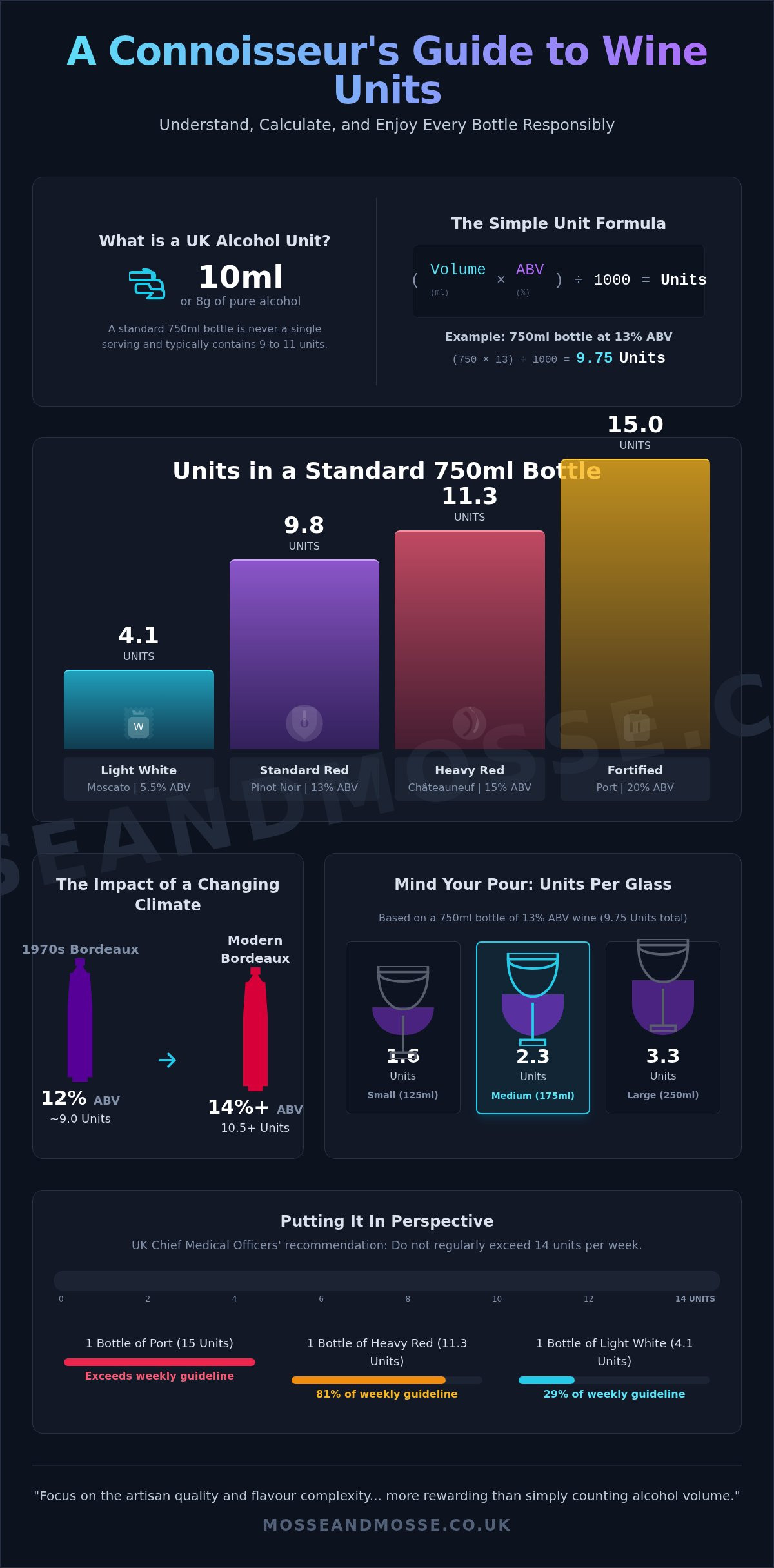
Understanding the units in bottle of wine choices you make is the first step toward true connoisseurship. In the United Kingdom, a single unit is strictly defined as 10ml (or 8g) of pure alcohol. While it might be tempting to think of a bottle as a single serving for a long dinner, a standard 750ml bottle is never just one unit. Most bottles we source at Mosse and Mosse contain between 9 and 11 units, depending on the specific harvest and region. We focus on the quality of the liquid because we believe in savouring the craft. It's all about what's in the bottle, and knowing the strength helps you appreciate the nuance of a fine vintage without rushing the experience.
The Simple Unit Formula for Any Wine
You don't need to be a mathematician to track your intake. The calculation is straightforward and works for any volume or strength. Take the total volume in millilitres, multiply it by the Alcohol by Volume (ABV) percentage, and then divide the result by 1,000. This gives you the exact unit count for that specific bottle.
Let's look at a worked example for a standard 750ml bottle of Bordeaux at 13% ABV:
- Step 1: Multiply 750 (ml) by 13 (ABV). This equals 9,750.
- Step 2: Divide 9,750 by 1,000.
- Step 3: The result is 9.75 units.
We always suggest rounding up to 10 units when you're hosting. It's a safer bet for responsible entertaining and ensures your guests enjoy their wine treat with total peace of mind. Whether you're pouring a light white or a robust red, this formula keeps you informed.
Why Units Matter for Moderate Enjoyment
The UK Chief Medical Officers recommend that adults don't regularly exceed 14 units per week. Tracking the units in bottle of wine selections helps you pivot from drinking for effect to tasting for pure pleasure. High-quality, bottle-aged wines offer complex layers that deserve your full attention. By monitoring units, you can spread a glorious bottle of Cru Classé over a couple of evenings. This allows the flavours to breathe and evolve, turning a simple glass into a genuine event. We hunt the best so you can enjoy what's in your glass, and moderation is the key to catching every subtle note the winemaker intended.
This mindful approach to consumption is part of a wider trend of people taking more control over their personal health. For those who are proactive about monitoring their well-being, resources are available for a range of concerns. For example, if you have concerns about potential bacterial infections, you can check out mrsatest.co.uk.
How ABV Impacts the Number of Units in Your Favourite Bottle
Alcohol by Volume (ABV) is the definitive variable that dictates the total units in bottle of wine. It represents the percentage of pure alcohol relative to the total liquid volume. When Tim hunts for new additions to our cellar, he isn't looking for the highest alcohol content. He's looking for harmony. A wine at 14.5% can be pure drinking pleasure if it has the fruit and structure to back it up, but a poorly made high-alcohol wine often feels "hot" on the palate. Understanding the units in bottle of wine helps you plan your evening, especially when moving from a light aperitif to a heavy main course red.
Climate change has fundamentally altered the landscape of traditional European regions. In the 1970s, a typical Bordeaux might have reached 12% ABV. Today, increased sunshine and heat mean grapes develop more sugar, frequently resulting in alcohols of 14% or higher. This shift means a single bottle today often contains 15% to 20% more alcohol than the same label did forty years ago. We believe in transparency; checking the label is vital for managing your intake while enjoying your wine treat.
Units by Wine Style: A Quick Comparison
The style of wine you choose significantly shifts the unit count. Here is how some common favourites compare in a standard 750ml bottle:
- Light Whites: A Moscato d’Asti at 5.5% contains approximately 4.1 units.
- Standard Reds: A classic Burgundy Pinot Noir at 13% contains approximately 9.8 units.
- Heavy Reds: A powerful Châteauneuf-du-Pape at 15% contains approximately 11.3 units.
The Fortified Factor: Port and Sherry
Fortified wines like Port and Sherry sit in a category of their own. Because grape spirit is added during the fermentation process, the alcohol content climbs much higher than still wine. A 750ml bottle of 20% Port contains 15 units, which is a significant jump from a standard red. These are intense, glorious liquids that demand respect. We always recommend serving these in smaller 75ml measures to appreciate the complexity. If you're looking for a special gift, you can explore Burgundy and Bordeaux alongside our curated fortified selections to find the perfect balance for your table.
Measuring Units: From the Standard Bottle to the Glass
Pouring a glass at home often leads to what we call the "heavy hand" trap. While a standard 750ml bottle typically contains 9 to 11 units depending on the ABV, how that translates to your glass depends entirely on your choice of stemware. It's remarkably easy to lose track of the units in bottle of wine when you're distracted by good company or a particularly lovely bottle-aged Claret. At Mosse & Mosse, we believe that understanding these measures helps you savour the quality inside the bottle without overdoing it.
Units in Standard Glass Sizes
UK hospitality standards generally stick to three specific sizes, but the shift in recent years has been toward larger pours. Here is how those measures break down for a wine with 13% ABV:
- Small (125ml): This is the traditional "tasting" measure. It contains 1.6 units. It's the perfect size for exploring a complex Burgundy, as it allows the wine to breathe without the last few sips getting too warm in the glass.
- Medium (175ml): Now the most common serve in UK pubs, this contains 2.3 units. If you have two of these, you've already consumed 4.6 units, which is a third of the weekly recommended limit of 14 units.
- Large (250ml): This is exactly one-third of a bottle. At 3.3 units per glass, just two of these will see you finish most of the units in bottle of wine. In a large, wide-bowled glass, 250ml can look deceptively small.
The shape of your glass often tricks the eye. A wide Burgundy balloon glass has a much larger surface area than a tapered Bordeaux glass. Pouring 125ml into a large glass can make the wine look "lost," often tempting you to add a "top-up" that inadvertently doubles your unit intake. To visualise a unit without a measuring cylinder, remember that 125ml should roughly fill the widest part of a standard wine glass.
The Magnum and Beyond
For those special family gatherings, a 1.5L Magnum is often the go-to choice. It's exactly two standard bottles, meaning it contains 19.5 units if the wine is 13% ABV. Magnums are glorious for parties because the wine ages more slowly and develops more complexity, offering pure drinking pleasure for a larger group.
Managing units with larger formats requires a bit more discipline. When we host tastings, we find that using a 125ml measure ensures everyone enjoys the wine treat responsibly. If you're serving a Magnum at a dinner for six people, each person will receive 3.25 units if the bottle is shared equally. It's a simple way to keep track while ensuring the focus remains on what's in the bottle.
Planning Your Event: Calculating Units for Weddings and Parties
Planning a large gathering requires more than just picking a glorious Bordeaux. You've got to calculate the total units in bottle of wine to ensure your guests enjoy the day without overdoing it. Most hosts find that for a standard four-hour reception, guests consume roughly three glasses of wine. If you're serving a classic 13% ABV red, that's about 4.8 units per person. Understanding the units in bottle of wine across your entire order helps you stock the bar responsibly and avoid nasty surprises the next morning.
Beware the "top-up" trap. When waitstaff are attentive, glasses rarely hit the bottom. This makes it incredibly difficult for guests to track their units. We suggest budgeting for 1.5 units per hour as a safe planning benchmark for a lively party. Balancing your selection with lower-ABV whites or sparkling wines helps manage the overall unit count across the afternoon. It's all about providing a lovely experience while keeping everyone safe.
Wedding Wine Calculations
Organising your wedding wine involves a delicate balance of celebration and safety. The traditional rule of thumb is a half-bottle per person. For a standard 13.5% ABV bottle, this equates to roughly 5 units per guest during the wedding breakfast alone. That's a significant amount before the evening party even begins. To get the balance exactly right for your big day, we recommend seeking an expert consultation through our Mosse and Mosse Wedding Wine Services.
Corporate Gifting and Responsible Giving
When choosing gifts for staff or clients, quality always beats quantity. Selecting premium, bottle-aged wines encourages slower, more mindful sipping rather than rushed consumption. We find that mixed cases with varying unit strengths offer the best variety for a diverse team. A high-quality Pauillac provides a rich, complex experience that commands respect and a slower pace. By knowing the exact units in bottle of wine you've selected, you can plan your corporate hospitality with confidence. Explore our Corporate Gifting options to find the perfect gift box for your team.
Ready to plan your next event with confidence? Contact us today for a bespoke wine consultation.
Why "What’s in the Bottle" Matters More Than the Unit Count
Tim Mosse lives by a simple rule: it's all about what's in the bottle. While tracking the units in bottle of wine is a practical way to manage your consumption, those numbers don't define the experience. Artisan winemaking isn't about hitting a specific alcohol target. It's about capturing the essence of the vineyard. Mass-produced bottles often rely on high alcohol levels to mask a lack of character, but a well-crafted wine relies on balance, acidity, and terroir.
Pure drinking pleasure comes from complexity rather than raw strength. When you choose a bottle from a dedicated producer, you're tasting years of tradition and careful land management. These wines don't need to be rushed. In fact, glorious, bottle-aged wines actively reward a slower pace. Opening a Bordeaux that has been laid down for eight or ten years is an event. You'll find yourself sipping less because there's so much more to discover in every glass.
- Artisan wines prioritise flavour profile over high ABV.
- Slow sipping naturally reduces the total units consumed in an evening.
- Quality "juice" provides a more satisfying experience than cheap, high-alcohol alternatives.
- Focusing on the "wine treat" aspect makes every drop count.
The Mosse and Mosse Selection
Our cellar focuses heavily on the iconic regions of Burgundy and Bordeaux. These areas produce wines with incredible structural variety. We've designed our curated mixed cases to let you explore these different profiles at your own pace. By trying a range of styles, you'll learn that a lower-alcohol Burgundy can often provide a more intense flavour journey than a heavy, industrial red. It's about treating yourself to something special rather than just filling a glass.
Personal Service for Your Next Case
We don't believe in a one-size-fits-all approach to wine. Tim and Sam are always on hand to offer personal recommendations tailored to your palate. If you're looking for a specific vintage or want to explore a new appellation, just get in touch. We want to help you find bottles that offer genuine excitement. We also provide free UK mainland delivery on our curated cases to ensure your next favourite wine arrives safely at your door. Explore our current favourite wines and mixed cases to see what we're drinking this season.
Enjoy Better Wine with Confidence
Navigating the units in bottle of wine doesn't have to be a chore; it's simply a tool to help you plan your next gathering with precision. Remember that a standard 75cl bottle at 13.5% ABV contains roughly 10 units, while a richer 15% bottle pushes that count higher. This knowledge is vital when you're calculating quantities for a wedding or a large dinner party. However, at Mosse & Mosse, we believe the real focus should always be on the quality of the liquid in your glass. As an independent Suffolk wine merchant with over 25 years of experience, we've dedicated ourselves to finding "Old World" gems that deliver pure drinking pleasure.
Owners Tim and Sam Mosse provide a personal service that faceless retailers simply can't match. We hunt for the best bottle-aged Bordeaux and glorious Burgundy so you don't have to. Whether you're looking for a special gift or stocking your own cellar, our expertise ensures every sip is a treat. We also offer free UK mainland delivery on all our curated mixed cases to help you explore new regions without the extra cost. Browse our curated collection of Burgundy and Bordeaux today. It's time to stop counting and start enjoying what's truly in the bottle.
Frequently Asked Questions
How many units are in a 750ml bottle of 13% red wine?
A standard 750ml bottle of 13% ABV red wine contains exactly 9.75 units. Whether you're enjoying a structured Bordeaux or a delicate Burgundy, this figure helps you track your consumption accurately. Knowing the units in bottle of wine ensures you can savour your favourite vintage while staying mindful of your intake.
Is a whole bottle of wine too many units for one day?
Yes, finishing a whole bottle of wine in one day exceeds the UK Chief Medical Officers' low-risk drinking guidelines. These guidelines recommend that adults don't regularly drink more than 14 units per week, ideally spread over three or more days. Since a single bottle often contains between 9 and 11 units, drinking it in one sitting uses up at least 64% of your entire weekly allowance.
How many units are in a large 250ml glass of wine?
A large 250ml glass of wine with 13% ABV contains 3.25 units. This measure is equivalent to one third of a standard 750ml bottle. Many pubs and restaurants serve this size as their largest option, but it's important to remember that just two of these glasses will put you over 6 units, which is often classified as a binge drinking session.
Does white wine have fewer units than red wine?
White wine doesn't automatically have fewer units than red wine, as the unit count depends entirely on the alcohol by volume (ABV) percentage. While some light Italian whites might sit at 11% ABV, many full-bodied Chardonnays reach 14%, matching the strength of a heavy Cabernet Sauvignon. You should always check the label because the units in bottle of wine are determined by the specific fermentation process and grape sugar levels rather than the colour.
How many units are in a bottle of Prosecco or Champagne?
A standard 750ml bottle of Prosecco or Champagne at 12% ABV contains 9 units. These sparkling wines are often served in 125ml flutes, which provide 1.5 units per glass. If you're celebrating with a bottle of fine bubbles, it's easy to forget that the alcohol content is very similar to many still wines in our collection.
How many units are in a bottle of Port?
A 750ml bottle of Port typically contains 15 units due to its higher average ABV of 20%. Port is a fortified wine, meaning grape spirit is added during production, which increases the alcohol content significantly compared to table wine. A traditional 50ml serving of Port contains 1 unit, making it a potent but lovely way to conclude a meal.
Can I drive after one glass of wine?
You should avoid driving after any amount of wine because alcohol affects everyone differently based on weight, age, and metabolism. In England, Wales, and Northern Ireland, the legal limit is 80mg of alcohol per 100ml of blood, a limit that a single 175ml glass of 13% wine can easily approach. To stay safe and protect others, it's best to stick to zero alcohol if you're behind the wheel.
How do I calculate units if the ABV is not a whole number?
You can calculate the units by multiplying the total volume in millilitres by the ABV percentage and then dividing the result by 1,000. For a bottle with 13.5% ABV, the calculation is 750 times 13.5, divided by 1,000, which equals 10.1 units. This simple formula allows you to be precise regardless of the bottle size or the specific strength of the wine you've chosen.


