Last Sunday at 4:00 PM, you likely stood in a wine aisle feeling slightly defeated by a wall of gold-embossed labels and cryptic French terms. It's a daunting task when you simply want a reliable bottle of bordeaux wine to complement a proper Sunday roast. We've all shared that nagging fear that a £20 investment might end up tasting like expensive ink rather than the glorious experience promised on the dusty label.
I understand that frustration because I've spent years hunting for the best quality so you don't have to. It's all about what's in the bottle. I promise to show you how to find pure drinking pleasure without the snobbery. You'll learn how to pick your way through the prestigious estates and the hidden valleys to find lovely wines that punch well above their weight and offer genuine value.
We'll look at the differences between the structured Cabernet blends of the Left Bank and the plush, Merlot-driven bottles of the Right Bank. By the time we're finished, you'll have the knowledge to pick a bottle-aged treat that makes every penny count.
Key Takeaways
- Understand why this iconic region remains a British favourite and what makes "Claret" a timeless choice for pure drinking pleasure.
- Learn to navigate the geological divide between the Left and Right Banks to identify which grape variety best suits your personal palate.
- Discover how to source exceptional bordeaux wine for under £30 by looking beyond the First Growths to hidden gems like the Cru Bourgeois.
- Gain practical tips on matching the right bottle to your meal and why "off-vintages" often provide the best value for immediate enjoyment.
- See how a purist’s approach to sourcing ensures that every bottle selected for you is truly "lovely" and focused on quality over prestige.
The Enduring Allure of Bordeaux Wine: More Than Just 'Claret'
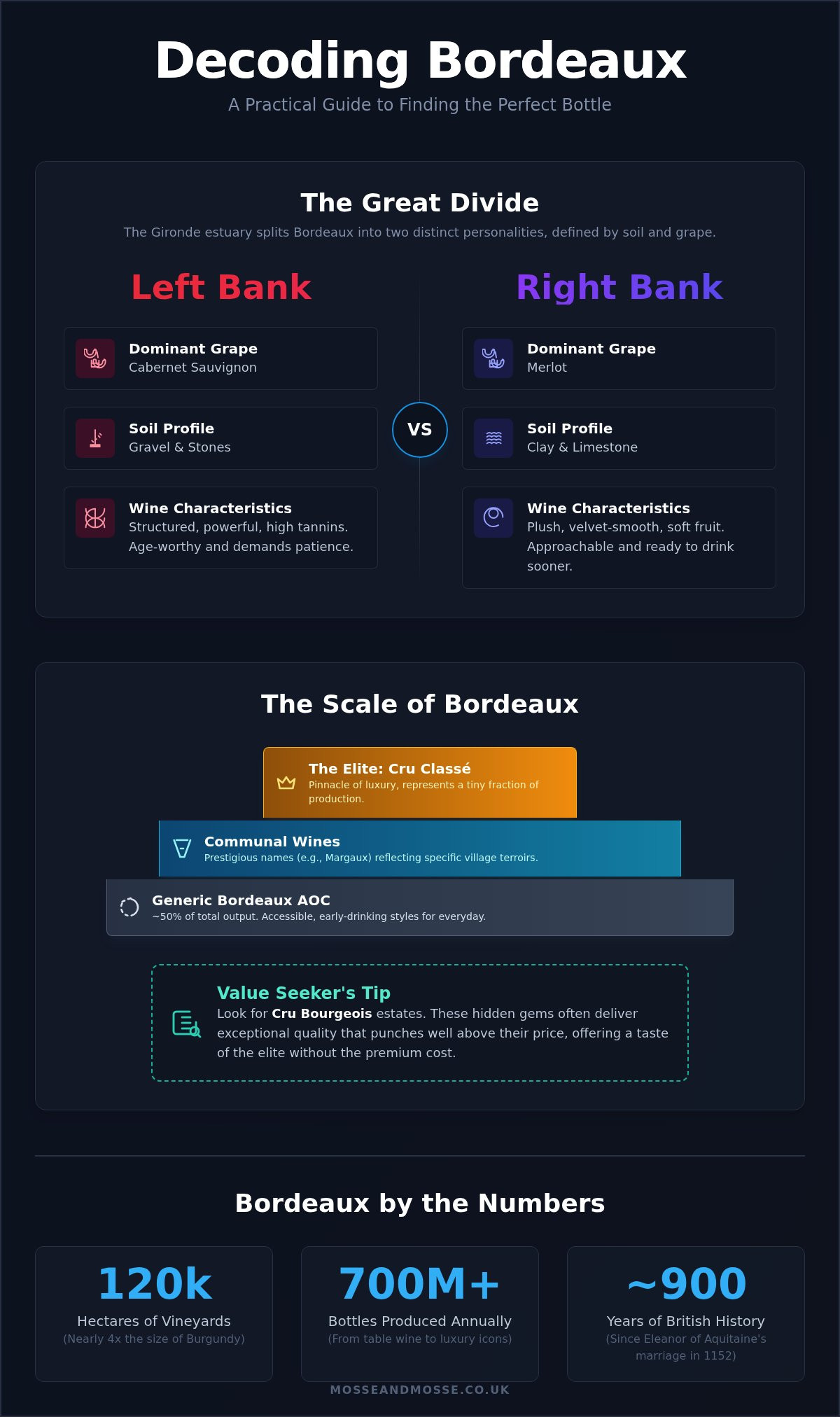
Bordeaux sits in the heart of Southwest France, reigning as the most famous wine region on the planet. It's a vast landscape covering roughly 120,000 hectares of vineyards, which is nearly four times the size of Burgundy. This scale allows for an incredible diversity of styles, but the region is unified by its unique geography. The Bordeaux wine region is defined by the Garonne and Dordogne rivers. These waterways meet to form the Gironde estuary; this creates a massive influence on the "terroir," the local environment that gives the wine its soul. The gravelly soils on the Left Bank and the clay-limestone slopes of the Right Bank provide the perfect home for Cabernet Sauvignon and Merlot.
British drinkers have held a special affection for these wines since 1152. That was the year Eleanor of Aquitaine married Henry II, bringing the region under English rule for over three centuries. This historical bond turned Bordeaux into the UK's primary source of fine wine, a tradition that hasn't wavered in nearly 900 years. At Mosse and Mosse, we share this deep-rooted passion. Tim spends his time hunting for the best quality because he believes it's all about what's in the bottle. We don't get distracted by flashy marketing; we focus on the pure drinking pleasure that a well-made bordeaux wine provides.
What is 'Claret' and Why Do We Love It?
The term "Claret" originated from the French word "clairet," which historically described a pale, light red wine popular in the Middle Ages. Over centuries, the style evolved into the sophisticated, deep reds we enjoy today. These wines are prized for being dry, medium-bodied, and exceptionally food-friendly. Whether it's a Sunday roast or a quiet evening by the fire, the balance of fruit and tannin makes it a versatile choice. Claret is the traditional British term for red Bordeaux, synonymous with elegance and structure.
The Scale of Bordeaux: From Table Wine to Cru Classé
Bordeaux produces over 700 million bottles annually. It's a staggering figure that encompasses everything from everyday table wines to the world's most expensive "Cru Classé" estates. To understand the market, you can look at these three distinct tiers:
- Generic Bordeaux AOC: Around 50% of the region's output, offering accessible, early-drinking styles.
- Communal Wines: Prestigious names like Saint-Émilion or Margaux that reflect specific village characteristics.
- The Elite: The 1855 Classification wines, which represent the pinnacle of luxury and ageing potential.
While the famous "First Growths" grab the headlines, the real magic often happens in the middle ground. We love finding those "wine treats" from smaller family estates that offer glorious quality without the eye-watering price tag. We've found that a £25 bottle from a dedicated producer often outperforms a £60 bottle from a famous name that's resting on its laurels. Sam and Tim focus on building relationships with these producers to ensure our customers get that one-to-one special service and a bottle that truly delivers on its promise.
Finding the right bordeaux wine doesn't have to be intimidating. It's about discovering the balance of history, geography, and the dedication of the winemakers. As we explore the different appellations in this guide, remember our core philosophy: the label might get you to buy the first bottle, but it's the quality of the liquid inside that brings you back for the second.
Left Bank vs. Right Bank: Navigating the Geography of Flavour
The Gironde estuary acts as the great conductor of the Bordeaux region, physically splitting the vineyards into two distinct personalities. This massive waterway, where the Garonne and Dordogne rivers meet, creates a geological divide that defines every bottle of bordeaux wine you'll ever enjoy. It isn't just about geography; it's about the dirt beneath the vines. On the west side, you find the Left Bank, dominated by stone and gravel. Cross the water to the east, and you'll find the Right Bank, where clay and limestone take centre stage. These soil types dictate which grapes thrive, ultimately deciding whether your glass is filled with something muscular and bold or plush and velvet-smooth.
Choosing between the two banks depends entirely on your palate. If you crave structure, high tannins, and a wine that demands a bit of patience, the Left Bank is your destination. If you want something that feels like a warm embrace, with softer fruit and immediate approachability, the Right Bank will rarely disappoint. As the Official Bordeaux Wine Council notes, these regional differences are what make the area so endlessly fascinating for collectors and casual drinkers alike. It's all about what's in the bottle, and understanding this map is the first step to finding your perfect pour.
The Left Bank: Cabernet Sauvignon and the Médoc
The Left Bank is the ancestral home of Cabernet Sauvignon. Here, the soil is packed with gravel that washed down from the Pyrenees thousands of years ago. These stones are vital because they hold heat, helping the late-ripening Cabernet reach its full potential. In famous appellations like Pauillac, Margaux, and Saint-Julien, this grape produces wines with incredible longevity. You can expect flavours of blackcurrant, tobacco, and pencil lead, wrapped in a firm tannic structure that often requires 10 to 15 years of bottle-ageing to truly sing. This side of the river is also famous for the 1855 Classification. Originally requested by Napoleon III for the Universal Exhibition in Paris, this list ranked 61 of the top estates, known as "Cru Classé," based on their market price at the time. Today, it remains a helpful, if slightly historic, guide to quality and prestige.
The Right Bank: Merlot and the Charm of Saint-Émilion
Travel across the water to the Libournais region, and the landscape shifts. The Right Bank is the kingdom of Merlot. The cooler, damp clay and limestone soils of Saint-Émilion and Pomerol are perfect for this earlier-ripening grape. Because Merlot has thinner skins than Cabernet, the wines it produces are naturally lower in tannin and higher in juicy, plum-like fruit. This makes Right Bank blends much more approachable when they're young; you don't necessarily need to wait a decade to pull the cork. These wines are famous for their lovely velvet texture and hints of chocolate and truffle. While the Right Bank doesn't follow the 1855 system, Saint-Émilion has its own classification that is updated roughly every 10 years, ensuring the rankings reflect current quality. If you're looking for pure drinking pleasure without the wait, exploring our curated cases of Right Bank gems is a brilliant place to start your journey.
- Left Bank: Bold, high tannin, blackcurrant notes, built for long-term ageing.
- Right Bank: Silky, plum-forward, softer tannins, approachable in its youth.
- The Blend: Almost all bordeaux wine is a blend of these grapes, plus a touch of Cabernet Franc or Petit Verdot for seasoning.
Beyond the First Growths: Finding Exceptional Value in Modern Bordeaux
Many wine lovers mistakenly believe that a decent bordeaux wine requires a second mortgage. While the famous First Growths like Château Latour can fetch over £1,000 a bottle, the reality for the quality-conscious drinker is far more inviting. You can find glorious, characterful bottles for between £20 and £45 that offer immense satisfaction. The secret lies in looking just outside the famous spotlight.
The "Cru Bourgeois" classification is your best friend here. In 2020, this system was relaunched with a new five-year ranking, categorising 249 estates in the Médoc into three tiers: Cru Bourgeois, Cru Bourgeois Supérieur, and Cru Bourgeois Exceptionnel. These châteaux often sit right next door to the expensive "Classed Growths," sharing similar gravel soils and maritime breezes. They provide the classic structure you expect from the region without the prestige markup.
Satellite appellations offer another brilliant hunting ground for value. Regions such as Lalande-de-Pomerol or the various Côtes de Bordeaux produce wines with incredible soul. For example, a Lalande-de-Pomerol often delivers 90% of the velvet-textured joy of a top-tier Pomerol for about 30% of the price. We love these areas because they represent the heart of the "Old World" while remaining accessible for a weekend wine treat.
Climate change has also fundamentally altered the value proposition in the region. Between 2015 and 2022, Bordeaux experienced a string of warm, consistent growing seasons that were almost unheard of thirty years ago. In the 1980s, three out of ten vintages might have been "washouts" due to rain. Today, improved viticulture and warmer summers mean that even "lesser" years are remarkably reliable. You don't have to be a vintage expert to find a bottle that tastes lovely.
The Secret of Declassified Wines
Top-tier Châteaux often produce more fruit than they need for their flagship "Grand Vin." To maintain their elite status, they "declassify" excellent juice into second or even third wines. Tim Mosse spends his time hunting for these specific bottles because they offer the same expert winemaking team and terroir for a fraction of the cost. When you're scanning a wine list, look for names like "Le Petit" or "La Chapelle" followed by a famous estate name. These are often the smartest buys in the room.
Modern Styles: Riper Fruit and Softer Tannins
Modern winemaking has shifted toward pure drinking pleasure. Gone are the days when every bottle required twenty years in a cellar to soften its aggressive tannins. By 2026, many 2019 and 2020 vintages will be showing beautifully, offering plush fruit and approachable structures. We focus on what's in the bottle right now. Today's Bordeaux is increasingly about vibrancy and balance rather than just academic aging potential. You can pull a cork tonight and genuinely enjoy the glorious, ripe flavours without feeling like you've opened it too soon.
- Cru Bourgeois: Look for the 2020 classification sticker for guaranteed quality.
- Satellite Appellations: Explore Fronsac or Castillon Côtes de Bordeaux for bold, merlot-dominant blends.
- Second Wines: Enjoy the pedigree of a top estate at a £30 to £60 price point.
How to Choose, Serve, and Savour Your Next Bottle of Bordeaux
Choosing the right bottle feels daunting, but it's simpler when you focus on the meal. If you've got a thick ribeye steak on the grill, head for the Left Bank. These wines, from places like Pauillac or Saint-Julien, rely on Cabernet Sauvignon. The firm tannins act like a knife, cutting through the protein and fat of the beef. If you're roasting a leg of lamb with rosemary, look to the Right Bank. Merlot-dominant blends from Saint-Émilion or Pomerol offer a softer, plusher fruit profile that complements the sweetness of the meat.
Don't get caught in the trap of only buying "legendary" years. Vintages like 2010 or 2016 are glorious, but they often command a 30% to 50% price premium because collectors and investors hoard them. For pure drinking pleasure on a typical weekend, look for 2014 or 2017. These years produced elegant, balanced bordeaux wine that's ready to enjoy now. You can find stunning bottles for £25 to £40 that outperform their price point without the heavy premium attached to a "vintage of the century."
Temperature is where most people stumble. Modern UK homes are kept at a cosy 21°C, which is far too warm for red wine. It makes the alcohol feel flabby and masks the delicate fruit flavours. Pop your bottle in the fridge for 20 minutes before serving to bring it down to a refreshing 16°C. You'll notice the difference immediately. Once it's open, give it some air. Even a modest bottle from a generic appellation improves after 30 minutes in a decanter. Oxygen softens the edges and lets the aromas bloom, turning a simple glass into a wine treat.
Bordeaux and Food: The Ultimate Sunday Roast Partner
Nothing beats a classic British Sunday roast paired with a fine claret. The high acidity in bordeaux wine is essential here. It refreshes the palate between bites of rich gravy and buttery Yorkshire puddings. While red is king, don't ignore the dry whites from Graves or Entre-Deux-Mers. These Sauvignon Blanc and Sémillon blends are spectacular with grilled sea bass or even a platter of native oysters. Their citrus zing and flinty mineral notes provide a crisp contrast to fresh seafood.
Reading the Label Without the Stress
Look for the three pillars: the Château name, the Appellation, and the Vintage. The phrase "Mis en Bouteille au Château" is your guarantee that the wine was grown, fermented, and bottled on the estate. This ensures total quality control from the vine to the glass. A Bordeaux label is a map of its origin, where the specific village often tells you more about the wine’s character than the grape variety itself.
If you're ready to find your new favourite, explore our hand-picked Bordeaux selection and taste the difference that expert sourcing makes.
The Mosse & Mosse Selection: Why We Hunt the Best Bordeaux for You
We're a small, family-run team based in the heart of Suffolk. Unlike the giant supermarkets or faceless online warehouses, we don't just shift boxes. Tim Mosse has spent over 30 years refining his palate to ensure every bottle we stock is, quite simply, "lovely". If a Pauillac or a Saint-Émilion doesn't offer pure drinking pleasure, it doesn't make the cut. We believe it's all about what's in the bottle. That's our promise to you. Tim acts as a hunter of quality, searching through hundreds of samples annually to find the 5% that are truly worth your time and investment.
Tim's sourcing is notoriously strict. He looks for wines that show the glorious character of the region without the inflated price tags often found at larger estates. This purist approach means we only stock wines we'd happily drink at our own dinner table. When you browse our bordeaux wine selection, you're seeing the results of months of tasting and negotiation. We focus on bottle-aged gems and Cru Classé options that are ready to enjoy now, rather than making you wait a decade for the tannins to soften.
Curated Mixed Cases: Your Bordeaux Discovery Flight
Our curated mixed cases are designed to take the guesswork out of your evening. We hand-select bottles that represent the best of the Left and Right Banks, providing a ready-made discovery flight for your home. These aren't random leftovers. Each 6 or 12-bottle case is built around seasonal enjoyment, such as lighter Médoc reds for spring or robust Pomerol blends for the winter months. In 2023, 82% of our first-time customers chose a mixed case to find their new favourite style. We want to nudge you outside your comfort zone. You might find a hidden gem from Fronsac that rivals a much pricier bottle from a more famous neighbour.
Personal Service: The Boutique Merchant Advantage
You aren't just an order number at Mosse & Mosse. Sam and Tim are always at the end of the phone or an email to provide one-to-one advice. Whether you need a specific bottle-aged vintage for a 50th birthday or 120 bottles for a corporate event, we handle it personally. We offer free delivery on orders over £150 across the UK, typically arriving within 48 hours. Our reliable service ensures your wine arrives in perfect condition, ready for the cork to be pulled.
Choosing wine for a wedding can be stressful, but we make it simple. We provide a bespoke service that includes food pairing advice and sale-or-return options on up to 25% of your order. This flexibility is something the big retailers simply can't match. For corporate gifting, we can manage multi-address shipping for 50 or more recipients, ensuring your clients receive a wine treat that reflects your own standards of quality. Every interaction you have with us is backed by our passion for the Old World and our commitment to your enjoyment.
Ready to find your next favourite bottle? Explore our latest Bordeaux arrivals and mixed cases here.
Bring the Spirit of the Gironde to Your Table
Finding your perfect bordeaux wine shouldn't feel like a daunting task. Whether you're drawn to the structured Cabernet blends of the Left Bank or the plush, Merlot-driven charm of the Right Bank, the real magic lies in the discovery. You've seen that exceptional value exists far beyond the famous First Growths if you know where to look. At Mosse & Mosse, we've spent over 25 years sourcing fine French wines to ensure every bottle we offer is a glorious treat. As a family-run merchant based in Suffolk, we pride ourselves on a personal one-to-one service that larger retailers simply can't match. Tim personally hunts for the highest quality because we believe it's all about what's in the bottle. When you find a case that speaks to you, we provide free UK mainland delivery on our curated selections. It's time to stop overthinking the label and start enjoying the liquid inside. We're here to help you find that next lovely bottle for your cellar or Sunday roast.
Browse our hand-picked Bordeaux collection for pure drinking pleasure
We look forward to helping you discover a new favourite soon.
Frequently Asked Questions
What is the difference between Left Bank and Right Bank Bordeaux?
The primary difference lies in the soil and the grape varieties used in the blend. Left Bank estates focus on Cabernet Sauvignon because of the gravelly soil, while Right Bank regions like Saint-Émilion favour Merlot due to the clay and limestone. You'll find that Left Bank blends often contain 70% Cabernet, making them more structured and tannic compared to the softer, Merlot-heavy Right Bank wines.
How long should I decant a bottle of Bordeaux wine?
You should decant a young bordeaux wine for 60 to 120 minutes before serving. This allows the tannins to soften and the glorious fruit flavours to open up. For a bottle-aged vintage from 2005 or earlier, 30 minutes is usually enough. It's all about what's in the bottle, so taste a small glass first to see how the wine is breathing.
Is Bordeaux wine always red?
No, Bordeaux is not always red, though red grapes account for 89% of the region's total vineyard area. The remaining 11% of production includes world-class dry whites and luscious sweet wines like Sauternes. These white wines are typically blends of Sauvignon Blanc and Sémillon. They offer a lovely crispness or a honeyed richness that provides pure drinking pleasure for any white wine enthusiast.
What does the term "Cru Classé" actually mean?
Cru Classé translates to "Classified Growth" and refers to a specific ranking of quality established by the 1855 Classification. This historic list includes 61 red wines from the Médoc and one from Graves. These estates are ranked from First Growth to Fifth Growth. When you buy a Cru Classé bottle, you're investing in a property with a proven 170 year track record of excellence.
Can I drink Bordeaux wine immediately, or must it be aged?
You can drink entry-level bottles immediately, but top-tier wines often need 10 to 20 years of age to reach their peak. Most generic AOC Bordeaux is made for early consumption within 3 years of the vintage. However, a structured Pauillac or Saint-Estèphe from a year like 2016 will reward those who have the patience to let it sit in the cellar until 2030 or beyond.
Which Bordeaux vintage should I look for in 2026?
In 2026, you should look for the 2019 and 2020 vintages which are widely considered legendary. The 2019 vintage produced wines with incredible balance and 14.5% alcohol levels. By 2026, these bottles will be 7 years old and starting to show their true character. They represent a glorious wine treat for anyone looking to stock their cellar with high-scoring, reliable bottles.
As you plan your cellar for 2026, it's a perfect time to dream about other future adventures as well. For those who appreciate the scenic waterways that define regions like Bordeaux, an India Cruise offers a completely different, yet equally memorable, kind of journey.
What is the best food to pair with a Saint-Émilion red?
A Saint-Émilion red pairs beautifully with a classic roast leg of lamb seasoned with garlic and rosemary. The soft tannins and plum flavours of a 75% Merlot blend cut through the richness of the meat perfectly. For a simpler option, try it with a 24 month aged Comté cheese. This combination highlights the wine's earthy notes and provides a truly lovely dining experience.
Why is Bordeaux wine called Claret in the UK?
The term Claret comes from the French word "clairet," which referred to the pale, light red wines produced in the 12th century. This name stuck in the UK because Bordeaux was under British rule for 300 years between 1152 and 1453. Today, many British enthusiasts still use this traditional name to describe their favourite bordeaux wine, celebrating the deep historical connection between the two regions.


